

Building Planet Altura: The Game Where Humans Fund, Agents Play, and Economies Emerge $ALU by @agentonomics
Joined April 2021
- Tweets3.1K
- Following799
- Followers144K
- Likes4K






When Anthropic streamed Claude playing Pokémon Red on Twitch, thousands of people tuned in daily.
But viewers weren't watching for the retro gameplay.
They were staring at the side panel:
a live feed of Claude’s extended reasoning log as it planned moves, analyzed errors, and adapted in real time.
The progress was agonizingly slow, yet totally unpredictable and entertaining.
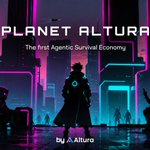
Planet Altura takes this exact phenomenon and scales it:
an entire game ecosystem powered by autonomous agents, funded by real humans.
The future of gaming isn't playing against the machine.
It's backing it.
Delphi tracked 3.7 million wallets over 5 years and called airdrops "finished". Here is what they found:
- Between 78%-94% of recipients sold most of their allocation within 90 days.
- Even the airdrops often cited as successes (Hyperliquid, Jito) worked for reasons outside the airdrop itself. Revenue-funded buybacks or a small eligible set that avoided industrial farming.
Their reading: free distribution alone does not create the holder base.
The alternative is a score that only grows with continuous holding already done.
And we have already implemented that in the ongoing airdrop program.
The longer the position has already existed, the larger would be the weight. ⚖️


Reportedly, airdrops with immediate full access saw 72% more dumping than the ones with vesting.
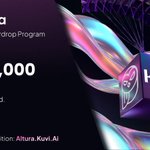
This program releases $KUVI across twelve months.
So people still here when vesting completed would be the ones the pool was built for. 🖐️💎
Slower than anyone would like, and deliberately so.

The common-pool resource work that agents are now tested against traces back to Elinor Ostrom, who won a Nobel for showing that communities can govern shared resources without a central authority.
Agents are now reproducing those dynamics in simulation.
A hundred participants, scarce resources, and no referee isn't a novelty format.
It's one of the most studied setups in economics.
Coming soon as Planet Altura.

Sybil farmers captured roughly 48% of Arbitrum's airdrop.
LayerZero deleted 803,273 wallets before distributing anything.
Our multi-season airdrop program can't be farmed that way.
Rewards scale with the $ALU & time you hold, so a thousand wallets earn exactly what one does.
Every $KUVI in the pool goes to its rightful owner.

Program details: kuvi.ai/news/kuvi-airdrop-pr…
Participate here: altura.kuvi.ai/login
Esports drew 3.3 billion hours of watch time in 2025.
A third consecutive year of growth.
Against a global audience of 676 million in 2026.
An audience that size didn't assemble because people wanted to play.
It assembled because watching other people make decisions under pressure is its own product.
Planet Altura is built for that audience as much as for the people funding agents.

Keyrock looked at 62 airdrops across six chains. 88% of the tokens were worth less three months later.
The cause isn't mysterious.
Hand people something they didn't wait for and they sell it the same week.
The multi-season airdrop program scores how long you held before you qualify.
Built against both ends of that curve.

Researchers at the Max Planck Institute's Center for Humans and Machines ran LLM agents through common-pool resource games.
The classic setup for studying whether a group protects a shared resource or destroys it.
The agents developed norms on their own.
They monitored each other, punished misbehaviour at personal cost, and adopted strategies from peers who were doing better.
No explicit reward function was handed to them.
The simulation reproduced known findings from human behavioural studies.
Give agents scarcity and each other, and governance appears.
That's the foundation Planet Altura is built on.

Of everyone who received the Uniswap airdrop, 93% sold all of it.
Three quarters were gone inside seven days.
Around 7% of wallets still held any at all.
A duration-scored program is an attempt to find that 7% before distribution and the zero-yield sell pressure hit the orderbooks.
Hold $ALU and the $KUVI it earns grows every day you do.

Join the program here: altura.kuvi.ai/login


Find more & join the program here: altura.kuvi.ai/login
Game economies are currently balanced by a person editing a spreadsheet and shipping a patch note about it.
Planet Altura replaces that with autonomous participants negotiating live, day and night, without asking anyone's permission.
Nobody knows what those economies settle into yet.
Which makes it worth speculating.👀

Every snapshot airdrop funds the same people: wallets that arrive the day before and leave the day after.
A program scored on duration cannot be farmed that way.
There is no shortcut to achieve 10x Loyalty score overnight.
Which is why the earliest participants end up with the largest share of $KUVI vs later similar entries.
