

Unlocking the potential of today’s nuclear reactors using the next-gen ANEEL™ fuel technology
Chicago, IL
Joined September 2019
- Tweets513
- Following201
- Followers1.4K
- Likes428






Why is hafnium removed from zirconium used in nuclear fuel cladding?
Zirconium absorbs very few neutrons, while hafnium is a strong neutron absorber.
Though chemically similar, they play opposite roles in reactors. Removing hafnium helps preserve neutron economy.
#NuclearEnergy #NuclearFuel #NuclearEngineering #Zirconium

92
We’re pleased to welcome Dr. Nathan Capps as CCTE’s Fuel Lead!
Joining us from Oak Ridge National Laboratory, Nathan brings extensive expertise in nuclear fuel development, testing and licensing as we advance our thorium-based ANEEL fuel platform towards commercial qualification.

1
134
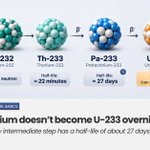
Thorium does not become uranium-233 instantly.
When Th-232 absorbs a neutron, it begins a transformation:
Th-232 → Th-233 → Pa-233 → U-233
Th-233 decays in minutes, but Pa-233 has a half-life of about 27 days before becoming fissile U-233.
This delay is a key feature of the thorium fuel cycle: breeding U-233 takes time, with isotopes continuously forming, transforming and being consumed inside the reactor.
#Thorium #NuclearEnergy #NuclearFuel

3
167
Why is zirconium used for nuclear fuel cladding?
Fuel cladding must contain nuclear fuel, transfer heat to the coolant and withstand years of high temperatures, pressure and neutron irradiation.
That is why many water-cooled reactors use zirconium alloys.
Four key reasons:
🔹 Low neutron absorption. Zirconium absorbs very few neutrons, helping maintain neutron economy.
🔹 Corrosion resistance. It performs well in hot water and steam under normal operating conditions.
🔹 Strength. Thin zirconium alloy tubes provide a reliable barrier without significantly restricting heat transfer.
🔹 Irradiation resistance. These alloys are engineered to maintain their integrity during years of reactor operation.
The cladding may be just a thin metal tube, but it plays a critical role in reactor performance and safety.
In nuclear fuel design, what surrounds the fuel matters almost as much as the fuel itself.

1
1
125
Does using thorium require building a new kind of reactor?
Not necessarily.
Thorium is a fuel material, not a reactor type.
Thorium-based fuels have been tested in existing reactor technologies, including light-water and heavy-water reactors.
For example, the US Shippingport reactor operated with a thorium-based breeder core from 1977 to 1982.
But changing the fuel is not as simple as replacing one material with another. Fuel design, neutron behaviour, safety analysis and licensing all need to be addressed.

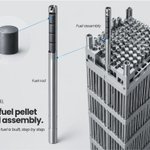
What is the difference between a fuel pellet, a fuel rod and a fuel assembly?
These are three different levels of nuclear fuel structure.
🔹 Fuel pellet: A small piece of ceramic fuel containing the nuclear material.
🔹 Fuel rod: A metal tube containing stacked fuel pellets. The cladding encloses the fuel and helps transfer heat to the coolant.
🔹 Fuel assembly: A group of fuel rods arranged in a precise geometry, allowing coolant to flow between them.
Fuel pellet → Fuel rod → Fuel assembly
Each component plays a distinct role in how nuclear fuel operates inside a reactor.

94
Clean Core Thorium Energy retweeted

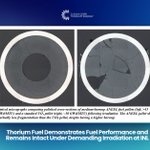
CCTE’s Thorium Fuel Demonstrates Unprecedented Fuel Performance and Remains Intact Beyond 45 GWd/MTU at Idaho National Laboratory. Congratulations @cleancoreenergy. This shows superior performance of thorium fuel and opens pathways for earlier deployment. globenewswire.com/news-relea… – at Maval, India

New post-irradiation results from @INL show @cleancoreenergy's ANEEL thorium fuel remained intact beyond 45 GWd/MTU, with markedly less cracking, restructuring and swelling than conventional UO₂ fuel examined under comparable conditions.
More physical evidence of ANEEL’s performance.

Read more here: globenewswire.com/news-relea…
60
What happens to gases created inside nuclear fuel?
Fission produces xenon and krypton, which can migrate from the fuel into the fuel–cladding gap.
These gases transfer heat less efficiently than helium, potentially raising fuel temperatures and affecting pressure, swelling and performance.

Why does irradiation testing matter in nuclear fuel development?
Modelling can predict how a fuel should behave. Irradiation testing shows how it actually behaves under reactor conditions.
As fuel is irradiated, its composition and physical properties change. Testing provides real-world data on material behaviour, dimensional changes, fission gases, fuel-material interactions and performance at higher burnup.
ANEEL has undergone irradiation testing at @INL's Advanced Test Reactor, generating physical data to support continued modelling and development of the fuel technology.

More nuclear means more pressure on the entire fuel cycle.
Global reactor uranium requirements could rise from ~69,000 tonnes in 2025 to 150,000+ tonnes by 2040 with conversion, enrichment and fabrication capacity also needing to expand.
That’s why fuel efficiency and alternative fuel strategies matter. More energy from nuclear fuel can help reduce pressure across a growing fuel system.

More nuclear means more demand for nuclear fuel. But meeting it isn’t simply about opening more uranium mines.
Mining, conversion, enrichment and fabrication all need to scale. Fuel design matters too: extracting more energy from nuclear material and broadening the resource base.
That’s part of the logic behind CCTE’s ANEEL fuel: combining thorium with enriched uranium to make better use of available nuclear resources.

What does 45 GWd/MTU actually mean?
It measures burnup: how much energy nuclear fuel produces relative to the amount of fuel loaded.
But reaching a certain burnup is only part of the story. The other question is how the fuel behaves when it gets there.
That’s what post-irradiation examination tells us.

2
148
Nuclear fuel pellets do not all look the same.
They can be solid, annular, dished or chamfered, and the differences are not cosmetic.
Pellet geometry affects temperature distribution, heat transfer and behaviour during irradiation. In nuclear fuel engineering, even a few millimetres matter.

Clean Core Thorium Energy retweeted
Thorium fuel surpasses 60 GWd/MTU in major test ahead of reactor demo
Apart from its significance in terms of performance qualification at high burn-up this capability also means potential net energy gain while producing uranium233.
share.google/5hKfusxrmc2O94z… – at Mumbai, India

CCTE has engaged @KINECTRICS to conduct an independent technical review of the ANEEL fuel qualification programme ahead of commercial reactor demonstration.
The review will assess key aspects of fuel design, manufacturing, safety and regulatory readiness, building on recent progress with @BWXT Canada and @CNL_LNC.
Following the completion of accelerated ANEEL irradiation testing at @INL earlier this year, this marks another important step in advancing ANEEL toward commercial reactor demonstration.

Not every nuclear reactor needs enriched uranium.
Natural uranium contains just 0.7% uranium-235 – too little for most commercial reactors.
PHWRs, including CANDUs, are different. Their heavy-water moderator enables them to sustain a chain reaction using natural uranium without enrichment.
That fuel flexibility also makes PHWRs well suited to advanced fuel concepts, including thorium-based fuels.
Reactor design determines which fuels become possible.

Without neutrons, a nuclear reactor stops.
When a fissile atom splits, it releases energy and new neutrons. Some cause further fission, some are absorbed, and some escape.
A reactor works by keeping that neutron population in balance.
Nuclear energy isn’t just about splitting atoms. It’s about controlling the neutrons that keep the chain reaction going.
