

Databricks is the Data + AI company, helping organizations build and scale data and AI apps, analytics and agents.
Joined July 2013
- Tweets15.8K
- Following1.1K
- Followers99.3K
- Likes9.6K






We're excited to expand our partnership with @SAP this week at #SAPTechEd!
AI needs business context, and much of it lives in SAP systems. The new SAP Application Data Foundation simplifies access to cloud and on-premises application data in SAP Databricks, helping reduce custom pipelines, TCO, and time to value.
With Genie, Lakebase, Unity Gateway, and Lakeflow coming to the platform, teams can put that data to work across analytics, apps, and AI agents.
databricks.com/blog/databric…

Agents shouldn't have to relearn the same facts every session.
Agent Memory on Agent Bricks combines session history with distilled long-term memories. A background pipeline extracts durable facts, removes duplicates, and replaces information contradicted by newer conversations. Lakebase provides low-latency access.
In our internal benchmarks of enterprise data tasks, this memory architecture tripled agent pass rates while using 31% fewer tokens compared to agents without memory.
databricks.com/blog/introduc…
Databricks retweeted

Databricks VP @nikitabase argues Claude Code is just the beginning, and the next wave of AI software factories will require an entirely new infrastructure stack:
"Claude Code was all the rage, still all the rage. But now we're talking about AI factories. We're moving from a tool that helps you generate code better to a platform where you can ship software as a factory."
"But the place you ship software to is still some sort of infrastructure. The AI factory of the future will work a lot better on this agentic infrastructure."
"State, such as database state, is paramount, and it’s probably one of the harder things to solve."
@databricks @neondatabase

.@nikitabase is going live to talk all things Lakebase and @neondatabase. Come listen in!

ASTRA GETS DISTILLED | ECONOMICS OF INTELLIGENCE | MISTRAL LARGE 4 nitter.gq/i/broadcasts/1RKZzBava…

“Just because the model looks better on the benchmarks doesn't mean it actually got better on your very specific use case.”
Model launches make headlines. Our Chief AI Scientist @jefrankle gets into the research, RL, evals, and tradeoffs behind them with @readtechnically.

"You never quite know what you're going to get when you push the frontier."
But what does pushing the frontier actually look like day-to-day? What do AI researchers...actually do?
On Ep 2 of Technically Speaking, @jefrankle (Chief AI Scientist @databricks) & @meganreyno get into it:
→ How he runs his team: "If I don't have numbers, I don't believe you."
→ Why you should ship before you feel ready: "you need to ship the best of what you have at any given time"
→ Who he hires: "people who are never quite satisfied"
🎬 Watch the full episode: youtu.be/Qz58c13N7ms
Presented by our friends at @Railway.
Stay tuned for some of our favorite moments...
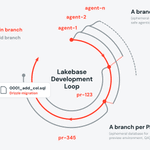
Coding agents can work in parallel. Their databases should too.
Lakebase branches an entire Postgres database in under a second, giving each agent an isolated environment for migrations and testing without copying the parent database.
How it works:
databricks.com/blog/lakebase…

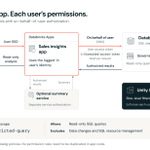
OBO authorization for Databricks Apps is now GA.
Apps can use the signed-in user's existing Unity Catalog permissions, while API scopes limit what they can do on their behalf.
Build personalized, governed apps without recreating access rules in code:
databricks.com/blog/now-ga-b…

Our PMs use Genie One to run weekly adoption reviews, investigate usage spikes, and forecast what happens next.
Genie Ontology gives it the context to know which metrics and sources to trust, so the analysis starts with our business logic instead of from scratch.
A look at how we use it:
databricks.com/blog/how-geni…


Load billions of rows into Lakebase Postgres without competing with live application workloads.
With LTAP, Spark handles bulk loads on separate compute, keeping the primary focused on serving queries. databricks.com/blog/load-ter…
Databricks retweeted

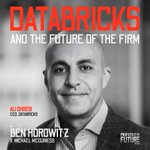
Ben Horowitz on Databricks CEO Ali Ghodsi: "You just don't get this good of a market opportunity with this good of an entrepreneur. That's the rarest of rare things."
Despite surpassing a $7 billion run rate and growing 80% year over year, Databricks might be the most under the radar story in Silicon Valley.
Three years ago, every interaction on Databricks involved a human. Today, the company is seeing more queries from agents than people.
Ali believes AGI is already here. Yet inside most companies today, AI still isn't trusted to reliably update records in Salesforce.
"AI does not have an intelligence problem," Ali explains. "It has a context problem."
Even the smartest human would be all but useless without access to the company's data, permission to act, feedback, or the knowledge in other employees' heads. Ali's answer is what he calls a "system of record for agents."
But the bigger question is how agents will change the firm itself.
85 years ago, James Burnham's The Managerial Revolution described how a small class of professional managers centralized the decision-making inside of companies. Today, thanks to a new wave of technology, the craft practitioners at the front lines are regaining responsibility again. The irony is that the decline of managerialism may look more like everyone becoming a manager.
In this issue of Profiles of the Future, @bhorowitz and @mikemcg0 explain how seven Berkeley academics built Databricks, and why it will power the future of the firm: a16z.news/p/databricks-and-t…

What people do at work all day is changing.
Agents can take on more of the work we already know how to do, while people closest to the problem gain more room to investigate and act without waiting on layers of hierarchy.
a16z's @bhorowitz and @mikemcg0 explore why the system of record powering agents matters so much to that shift, and why Databricks is well-positioned to power it.
Read the full article: a16z.news/p/databricks-and-t…

Now available on Databricks: GPT-6.1 Terra.
On our OfficeQA Pro v2 benchmark, it shows a large quality improvement and sits on the quality-cost pareto frontier.
Use it, or any of 70+ other models, on the data already in your Lakehouse to build governed AI apps and agents.
Unity Gateway governs, monitors, and secures every call from a single control plane.
Try GPT-6.1 Terra ↓
docs.databricks.com/aws/en/r…
Finance teams spend too much time figuring out why numbers changed.
Genie One helps them investigate variances, cash flow, close exceptions, and spend using their own business context and governed data.
databricks.com/blog/how-geni…
What if agent memory didn’t need another sync pipeline?
Join @rxin, Databricks Co-founder and Chief Architect, to unpack the LTAP architecture for agentic apps:
• Transactions + analytics read the same copy of data
• Agent memory, application state + historical data share the same permissions
• Runs on standard Postgres with existing drivers, extensions + ORMs
Register: databricks.com/resources/web…


AI is getting more autonomous, and governance has to keep up. Teams need control over what AI can access and do, a handle on rising AI costs and the freedom to choose the best models, agents and tools.
The Big Book of AI Governance shows how leading organizations manage all three at enterprise scale without slowing innovation.
Download the eBook →
databricks.com/resources/ebo…


[DEMO] With the Databricks Excel Add-in, bring the right Databricks data into Excel with more flexibility and less repetitive work:
→ Generate cascading filter values to narrow data before importing
→ Reuse existing Databricks SQL queries directly in Excel
→ Use custom functions like DATABRICKS.SQL and DATABRICKS.Table to import data into your workbook
Watch the full demo to see how they work: youtu.be/GKQt543lGDg
A 2,500 GB database with a 20 GB hot working set doesn’t need 2,500 GB of RAM.
That principle runs through Lakebase Postgres cost optimization: size around what your application actually needs.
✦ Sync only the working set your app queries
✦ Match Snapshot, Triggered or Continuous sync to freshness requirements
✦ Size compute so hot data fits in cache
✦ Set PITR and snapshots around actual recovery needs
The full guide breaks down how to keep costs predictable while maintaining the performance, availability and developer experience applications need: databricks.com/blog/practica…
What if the next big leap in AI agents comes from better memory, not bigger models?
@theDeepView explores MemCurrent. In our internal benchmark of 114 enterprise tasks, agent success rose from 22.3% without memory to 68.4% with episodic and derived memory.
thedeepview.com/articles/why…

Every new agent can become another integration, policy set and observability stack to maintain.
As agents take actions across data, models, tools and business systems, that fragmentation gets expensive fast. The better pattern is shared infrastructure for choice, context and control:
1️⃣ Agent Bricks for building, governing and optimizing agent fleets
2️⃣ Omnigent for composing agents across harnesses
3️⃣ Unity Gateway for centralized access, cost controls and observability
databricks.com/blog/how-scal…
