

Past CEO https://nitter.gq/t.co/aokWHcksN3 (NASDAQ: GTM), Past CEO https://nitter.gq/t.co/mPFq9wtEXo, and Co-Founder of ClearSlide.
San Francisco, CA
Joined April 2008
- Tweets316
- Following229
- Followers1.8K
- Likes168

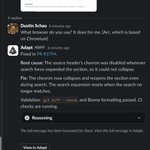

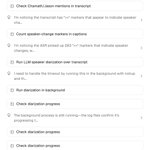



Connected autonomous agents. Think beehive.

Persistent sandboxes & durable shared storage feel like the right primitives for autonomous engineering.
The magical part, at least for me, is when an agent can test its changes against real infrastructure. The tedious parts of our stack isn't the actual coding, its the devops loop around it. How does this k8s change impact sandbox deployment rollouts? Does adding a new protocol message type for our shared filesystem break existing filesystems? Does the new image actually boot correctly with nested-virt?
These are scenarios the codex/claude code/whatever can test without my input now. I attach the required creds to the sandbox, and just spin up codex (with --dangerously-bypass-approvals-and-sandbox of course) and let it get to work. I can do that by making sure the sandboxes the agents start up with have an appropriate gcp service account, letting claude/gpt create the resources it needs to test.
So now the question is how to scale that. Can development become deploying a fleet of agents on durable, credential-scoped computers that can build, deploy, observe, debug, and iterate against real infrastructure in parallel? I think it can, we just need the right primitives.

Jim Benton retweeted

I'm curious if Anthropic (and other labs) watermarking text output could lead to less AI slop. If it's so easy to detect emails & webpages as AI-generated, then what happens when gmail and google starts auto-marking them as spam?
Jim Benton retweeted

Today I woke up to some really unexpected good news. My latest blog post for Adapt, where I shared a bit about my AI workflow, made it to the front page of Hacker News. news.ycombinator.com/item?id…

So many amazing people on X. I wanted to analyze the 1.5k responses to Elon’s Grok 4.6 build retweet to connect with the very best. This is my CEO use case of using Adapt + X + Apollo with our company @adapt agent connected to 47 integrations. @MarioNawfal you were top of the list.

Jim Benton retweeted

Adapt is so badass. I have a dozen agents executing recurring tasks that I no longer need to even worry about.

We’re moving from asking, “What AI do you use?”
to “What AI does your company run on?”
to “What AI is running your company?”
Today, we’re launching your @ company agent in Adapt. Your company’s own AI, branded with your name and deployable within minutes.
Tag @ yourcompany in Slack and ask it to do the work.
As we go through this change, it is important that a company owns its AI.
Own the agent, @ yourcompany.
Own the knowledge it builds.
Own the model routing.
Own the experience.
The company agent is the durable layer. It gives your company access to the best frontier and open-weight models, choosing the right model for each task to balance quality, speed, and cost.
When you tag @ yourcompany, you’re talking directly to your business through one front door. It learns how your company works, chooses the right model and skill, delegates work to specialized agents, and becomes more valuable as your company’s knowledge grows.
A few things make this possible.
It has to connect to every system your employees rely on, with the right access and permissions to understand the business and take action.
It needs its own secure computer to write code, build apps, analyze data, operate software, and do the work.
It has to be everywhere your people work. Web, Slack, iMessage, GitHub, and more.
Vercel CEO Guillermo Rauch articulated this perfectly when describing @ v, the internal company agent they built.
“If agents become the foundation of modern companies, you being in complete control, from source to runtime to data to token, seems like a pretty big deal.”
Every company will have its own @ company agent.
Adapt is how you deploy yours.
What AI is running your company?
Real example of Adapt as our company agent in Slack today, shared by one of our engineers
“Adapt found the real issue. I came to the same conclusion as DS, but Adapt went further.”

exactly. and it's unnecessary work as well.

chief of staff agents managing your marketing agent and your infra agent etc is play. it's fun but centralizing and having a universally intelligent agent that can just use skills or different integrations as needed is better. There are too many cases where information is missing or left out unnecessarily, and the overhead becomes more cost than it provides
Vercel built @ v. Ramp built Glass. Uber built Agentic Pods. Own your AI.

Excited to announce today our branded company agent @Adapt!
It's really encouraging and exciting to see some of the best teams in the world (Vercel, Ramp, Block, etc.) building these company agent products and then having the base-level product that any team can build their own in minutes.
When I think back on my time at Postman (a great team in its own right!) it was awesome to see us start to explore our AI journey, most of which was leveraging Slack bots that were built with a very specific purpose: like one for user research, one for competitive analysis, and so forth. We would brand these, give them their own unique handles, and then they received surprising adoption and oftentimes pretty meaningful insights to help us orient and make decisions.
I think trying something small and self-contained is the right way for teams to start their AI journey. But with the rising capabilities of frontier-level intelligence, we've come to believe that teams don't need multiple agents that fragment insights and leave information segmented and silo'd. They need one agent that does work, and does so in the open, in team-based collaboration surfaces like Slack. One universal agent, with the right context via integrations and the ability to do real work with an integrated sandbox and filesystem, replicates all of those sub-agents in a much more powerful and flexible way. And because everyone has access and can see what's possible, it raises the bar of AI-fluency across the whole company. The one agent becomes a rising tide that lifts all boats, not a select few.
It's still very early, so we have so much to do, so much to build, but I am very encouraged by the release today which gives a glimpse of what I genuinely believe will be the way in which the bulk of teams work in the future in an AI-native manner.
Check it out and perhaps just as importantly: let me know what you think and what you're building.
adapt.com/blog/branded-slack…
We’re moving from asking, “What AI do you use?”
to “What AI does your company run on?”
to “What AI is running your company?”
Today, we’re launching your @ company agent in Adapt. Your company’s own AI, branded with your name and deployable within minutes.
Tag @ yourcompany in Slack and ask it to do the work.
As we go through this change, it is important that a company owns its AI.
Own the agent, @ yourcompany.
Own the knowledge it builds.
Own the model routing.
Own the experience.
The company agent is the durable layer. It gives your company access to the best frontier and open-weight models, choosing the right model for each task to balance quality, speed, and cost.
When you tag @ yourcompany, you’re talking directly to your business through one front door. It learns how your company works, chooses the right model and skill, delegates work to specialized agents, and becomes more valuable as your company’s knowledge grows.
A few things make this possible.
It has to connect to every system your employees rely on, with the right access and permissions to understand the business and take action.
It needs its own secure computer to write code, build apps, analyze data, operate software, and do the work.
It has to be everywhere your people work. Web, Slack, iMessage, GitHub, and more.
Vercel CEO Guillermo Rauch articulated this perfectly when describing @ v, the internal company agent they built.
“If agents become the foundation of modern companies, you being in complete control, from source to runtime to data to token, seems like a pretty big deal.”
Every company will have its own @ company agent.
Adapt is how you deploy yours.
What AI is running your company?
More on why your Slack agent should look and feel like it belongs to your company.
adapt.com/blog/branded-slack…

Jim Benton retweeted
Reviewing AI-generated code is the hot topic, but my middle ground is different: build what I want, validate it, learn in the flow, then split it into small reviewable pieces where I can fix the code and architecture.
adapt.com/blog/build-wide-sh…

Zuckerberg’s essay focuses on people controlling their personal superintelligence. The same principle applies to companies. Every company needs an integrated AI system that reflects its goals, understands its context, works across its systems, and remains independent from any one model provider. That is how we design Adapt.
about.fb.com/news/2026/08/th…

Building and fixing in public! Awesome demo Het!

We had prospects visiting our demo page... and just not booking. I used the @Adapt agent to help me triage the issue and it turned out our Cal API was quietly failing for a chunk of users
You make this look so easy Patrick. Brilliant demo!
I'm an engineer, I don't make ads. I wanted to see how far @Adapt would get on its own, so I gave it one prompt and let it run. It came back with this. Then I asked it to log into the app and record itself using itself, and it did that too.
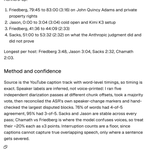
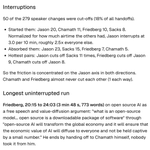
Huge fan of the all-in-pod. I decided to burn some tokens today and was curious about interruptions after listening to last week's pod, so I asked Adapt.com, "Access the latest all in pod. Go through it and analyze the talk time by key member. Analyze how often people interrupt others, and analyze the longest answer that goes uninterrupted?" These guys are on their absolute A game right now. I found the Adapt insights a fun morning share for our weekly kickoff. Sharing here as well:


