training models • trading @hyperliquidx • PM + data + analytics
California
Joined December 2020
- Tweets71.3K
- Following9K
- Followers24.6K
- Likes229K







Hyperliquid

Hyperliquid was the main venue for price discovery ahead of $ANT IPO, the biggest ever.
While the bankers marketed a $70 to $78 range and priced the IPO at $83, the @tradexyz market was already pricing a pop, before Nasdaq published a single indication. The stock opened 34% above its IPO price, with Hyperliquid trading within a dollar of the open.
Allocations went to a few institutions. Price discovery happened onchain, open to anyone, weeks before the first trade on Nasdaq.
Congrats @sershokunin. Hyperliquid.

The $ANT IPO played out almost exactly how I expected.
Anthropic priced at $83, opened at $111.50, rallied to nearly $115, then closed at $97.17.
Strong initial demand followed by significant selling pressure.
Billions were invested long before the public had access. Early investors eventually look to realize gains, while new buyers provide liquidity.
Today’s price action is a reminder that chasing IPO hype comes with risks.
Being early to an IPO doesn’t necessarily mean being early to the investment.


VC capital moving toward AI doesn’t necessarily mean crypto is dying.
Maybe the next phase of crypto looks different.
Fewer inflated valuations, less dependence on venture funding, and more focus on actual usage, trading activity, and sustainable revenue.
Hyperliquid is an interesting example of what can be built without traditional VC funding.
A $10B valuation means very little if the underlying product can’t sustain demand.
I’d rather see markets people actually use than another cycle of billion dollar launches.

so all of the VC money that went into crypto between 2020-2024 (and the reason for those regular multi billion dollar TGEs) are almost 100% gone from crypto and pivoted to AI now
are we ever going to have another 10B+ TGE? (under the assumption Kalshi and Polymarket are never TGEing)
absolutely dire scenes in crypto rn
Looking back at this post from February, it’s incredible how much AI agents have evolved in just 9 months.
This was back when OpenClaw was still in its early days, before Peter joined OpenAI. I remember spending countless hours configuring agents, troubleshooting errors, editing files, running tests, and learning new skills almost daily alongside the models I was training.
There was no simple plug and play experience. Getting an agent to reliably execute a workflow required patience, research, experimentation, and a lot of trial and error.
Fast forward to today, and the difference is remarkable.
The iterations we’ve seen throughout 2026 have completely changed what’s possible. Tools like Grokbot and Muse are making capabilities that once required extensive technical setup increasingly accessible to everyday users.
Workflows that previously took hours of configuration can now be approached in a fraction of the time.
I’ve invested so much time researching, building, breaking, and rebuilding my own systems this year. Looking back at where I started and what I’ve built today makes me appreciate just how quickly this technology is advancing.
And being involved in both AI and finance, I see these developments as much bigger than productivity improvements.
We’re watching the infrastructure for an entirely different way of interacting with technology and financial markets take shape.
The direction is becoming increasingly clear, and I’m glad I’ve spent this year learning and building firsthand.

Just got back from a workshop where they demonstrated how AI agents can seriously level up your workflow.
Great event today for the OpenClaw workshop in San Francisco at @frontiertower


HIP-4 Outcome Trading Milestone.
@Outcomexyz has surpassed $400M in cumulative trading volume.
• Trading volume: $400.3M
• Unique traders: 8.8K
• Fees generated: $193.5K

A lot of people associate a good market with prices going up.
When prices start declining, sentiment changes and suddenly everyone feels like there are no opportunities left.
But markets move in both directions.
Most people are familiar with buying an asset and profiting when its price appreciates, but fewer understand how to position themselves for downside moves.
Learning how short positions work can completely change the way you look at price action.
It doesn’t make trading easier, but it helps you understand that opportunities aren’t limited to bull markets.
Sometimes it’s not about the market conditions, but how you approach them.

Anthropic has priced its IPO at $83 per share, with an $81.3B offering ahead of tomorrow’s Nasdaq debut.
Worth remembering what happened with SpaceX.
Shares debuted at $135, rallied to $225, then fell to roughly $105 before recovering to $145.
Billions have been invested in these companies long before the public gets access. Early investors can be sitting on substantial unrealized gains by the time an IPO arrives.
And while lockups may prevent immediate selling, those investors eventually have an opportunity to realize profits.
That’s where public market liquidity becomes important. New buyers aren’t just investing in future growth, their demand can also absorb shares from earlier investors looking to exit.


We’ve priced our IPO at $83 per share, with trading expected to begin on Nasdaq tomorrow.
anthropic.com/news/anthropic…
Legal disclaimer: A registration statement relating to the Class A common stock was declared effective by the Securities and Exchange Commission on November 18, 2026. The offering is being made only by means of a prospectus. Copies of the final prospectus may be obtained, when available, from: Goldman Sachs & Co. LLC, Attention: Prospectus Department, 200 West Street, New York, NY 10282, by telephone at (866) 471-2526, or by email at [email protected]; or Morgan Stanley & Co. LLC, Attention: Prospectus Department, 180 Varick Street, 2nd Floor, New York, NY 10014, or by email at [email protected]


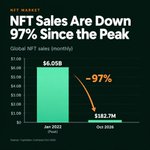
Blue chip NFTs are still here, but liquidity tells a different story.
Global NFT sales dropped from $6.05B in January 2022 to $183M in October 2026, a 97% decline.
Collections still have holders, but holding doesn’t necessarily mean there’s demand.
Floor prices show what sellers are asking. Liquidity shows whether buyers are actually there.
The question now is whether real demand returns.

I recently asked Grok to scan the accounts I follow on X and identify those that have become inactive.
The result was nearly 1,000 accounts.
Going through that list felt like revisiting the history of crypto through the people, projects, and builders I’ve connected with since 2020.
From the early days of DeFi and the NFT boom to Bitcoin ordinals, to the emergence of Hyperliquid, HyperEVM, and an entirely new generation of onchain applications.
I’ve now lived through two full market cycles, watching startups emerge from an idea, build communities, attract capital, and sometimes disappear just as quickly.
Some projects became successful businesses. Others never made it beyond their first cycle. Many builders moved on, investors were washed out, and entire communities faded away.
What makes this experience remarkable is having witnessed so much of that evolution firsthand, through the relationships and networks built along the way.
Crypto has experienced extraordinary periods of innovation, speculation, wealth creation, and destruction. Surviving multiple cycles gives you a different appreciation for the people who continue showing up and building.
I’m genuinely grateful to still be here, learning, participating, and watching this industry evolve.
And despite everything we’ve experienced, I believe some of the most important developments in finance and technology are still ahead of us.
To everyone still building, creating, researching, and participating: it’s a pleasure to be part of this space with you.
Looking forward to connecting with more of the people shaping its next chapter.