

“Influential health care wonk at the libertarian @CatoInstitute”-WP @CatoHealth Bsky: @ mfcannon 🧵: @ michaelfcannon https://nitter.gq/t.co/iSsIoCZyN7
Special Meat Container, C Space
Joined November 2009
- Tweets48.9K
- Following1.4K
- Followers11.9K
- Likes20.9K






Pinned Tweet
Think of your least favorite presidential candidate. Now imagine s/he wins. Doesn’t limiting government power seem like a good idea?
We cannot observe P = MB = MC.
We can observe entry and exit.
nationalaffairs.com/publicat…


Such a Gordian knot, this central price setting.
So help us design an objective metric for determining "proper" pricing -- since we cannot allow prices to coordinate the market, inelasticity, all the things.
How will we know what the proper price is?
1
3
431


Your approach looks like selective reform for your patrons.
I didn’t say or imply higher subsidies. I want market rates for my work and the freedom to negotiate and compete.
Site neutrality: reduce hospital premiums for equivalent services.
Reform Stark, repeal CON and lift physician ownership limits.
Remove corporate-practice barriers to capital.
Limit noncompetes imposed by entities that accept public funds.
Let independent physicians partner and negotiate with Medicare Advantage plans, other insurers, government purchasers and vendors.
Allow private contracting without fully opting out of Medicare.
Let us choose which insurance products we accept.
Remove anticompetitive barriers to direct patient and employer contracting.
Hard to believe, but small, efficient practices are part of a functioning market.
The prescription is not Do Nothing, but Do No Harm.
If the goal re site-of-service differentials is a 1:1 ratio, for example, the route with the fewest political barriers is to increase subsidies to doctors.
Ergo, that effort most likely produces harm.

The solution:
1. Don’t waste any resources assuaging this or that corner of the industry by arguing for a different set of distortions.
2. Use the absurdity and harms of existing distortions to argue for getting government out of health care entirely.
cato.org/outside-articles/wo…

Hospitals are indeed buying up physician practices because Medicare pays hospitals more than physicians for the same service.
But that does not imply that Medicare underpays physicians.
Medicare could be overpaying both, just overpaying hospitals more.


Michael F. Cannon 🇮🇪🇺🇸 retweeted

We agree that affordability is a problem, but we disagree on the solution. @mfcannon’s Universal Health Accounts proposal would extend the tax advantages of employer-sponsored insurance to self-employed, part-time and gig workers.
Self-described free-market advocates fall into two camps on Medicare overpaying hospitals relative to doctors.
One spends its time demanding central planners stop creating distortions.
The other says it’s foolish to think central planners could ever stop.
No, his response is poor because it selectively ignores government-created arbitrage.
Medicare can pay more for the same care under hospital ownership, encouraging hospitals to buy independent practices.
We agree on market principles but that usually means the government shouldn’t pick winners. You can’t cite “market trends” while ignoring payment rules that favor one competitor.
I respect his work… but he isn’t as ‘free market’ as he wants people to believe
2
2
428

If Medicare prices are systematically below marginal cost for hospital services, wouldn’t we see hospitals exiting Medicare but continuing to serve private payers?
The issue is that medicare sets a floor that is too low, below even the actual cost of providing care for many services (recuperates approximately 80% of marginal cost for hospital services, though this exact % varies by how efficient the hospital is).
3
5
428
One might think single-payer could be the answer. Unless:
- government were responsible for both excessive Medicare prices & higher private prices
– the industry had captured all those interventions
– the industry would likely capture M4A
If so, M4A would offer no savings.
Where past reform efforts stirred fears of disruption, Universal Health Accounts would minimize disruption. Where past efforts sparked opposition by increasing taxes and/or federal deficits, Universal Health Accounts could be revenue- and budget-neutral.
cato.org/policy-analysis/uni…

1
6
292
Physician-owned hospitals are clamoring to get into Medicare.
Providers on the lower side of site-of-service differentials are not exiting.
Yet the myth that Medicare sets prices too low lives on.
nationalaffairs.com/publicat…
AFAIK, no one proposes capping US health spending at other countries’ levels.
However, capping *compulsory* health spending—currently 14% of US GDP—at the Canadian level (8%) is a great idea.
And it likely would not reduce overall health: cato-unbound.org/2007/09/10/…

We have the healthcare system of a very rich country because we ARE a very rich country!
Afaik no one is saying we should cap NHE at the level of, say, Canada. If we did, we’d probably get worse outcomes!
1
4
442
Michael F. Cannon 🇮🇪🇺🇸 retweeted

Yes. And increasingly true in Medicaid, given states' ability to engage in financial gimmicks to channel federal $ to politically powerful hospitals. In many states, Medicaid now pays 2x-3x Medicare rates.
Really important to protect OBBB reforms that limited these gimmicks.

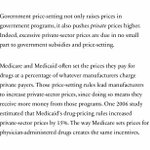
Sorry (not sorry) to disappoint, but Medicare and Medicaid routinely set and pay prices above marginal cost. nationalaffairs.com/publicat…


The Cato Institute (#CatoIsNotAnAcronym) has acknowledged no such thing.
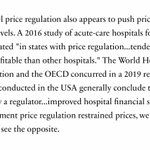
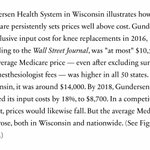
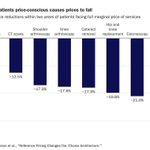
Private prices are often 2X Medicare’s because government pushes prices higher in both places, including via mechanisms that guarantee private prices will be higher than Medicare’s.
nationalaffairs.com/publicat…


Well, I would sure hope so lol? But do they not also routinely set pay below marginal cost?
Private reimbursement rates are 254% of medicare’s for hospital services. Even worse for medicaid. The CATO institute has acknowledged that this is due to poor reimbursement rates!
1
10
743