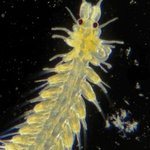
A single drop of sea water holds a whole hidden world. 🔬
Quinten Geldhof, also known as Microhobbyist, zooms in on plankton, a thriving mix of tiny crustaceans, algae, and mollusks. These microscopic organisms anchor the ocean’s food web and feed everything from small fish to giant whales. Phytoplankton even helped produce roughly half of Earth’s oxygen!
Ever feel like just a speck of stardust in the cosmos? ✨
@SirishaBandla felt the overview effect firsthand when she saw Earth against the vastness of space. She felt small, but never insignificant. Knowing no nearby world supports life as diverse as ours left her ready to make a difference back home.
⚡ Researchers at NC State used a laser to create a beam of plasma that transmits radio waves, the first demonstration of its kind. Nicknamed the “lightsaber” antenna, it could one day let spacecraft adjust antennas without bulky mechanical parts.
Starting November 21, step into a wintry wonderland of miniature trains, snowy peaks, and tiny townsfolk at All Aboard! Trains at Science Park, our beloved seasonal tradition.
Get tickets here: bit.ly/4zu9TtC
Straight A’s mean you’re smart, right? 🎓
@Trevornoah argues that memory recall is only one function of the human brain. He defines human intelligence as one-shot problem solving, the ability to process a completely new idea in an instant. Our brains can identify the problem and the solution simultaneously, a cognitive feat that makes humans truly unique.
🔥 El Niño sets off a cascade of tropical fires, starting with drought and peat fires in equatorial Asia and then moving to the central and eastern Amazon. NASA scientists say the 2026 El Niño has followed that same pattern.
This past weekend, we celebrated Native American Heritage Month with a full day of live music, dance, Meet-a-Scientist moments, and a one-day-only film screening. Thank you to Delta, and every partner who joined us, and to everyone who came out to celebrate indigenous heritage with us.
Imagine a telescope as big as our entire planet. 🔭🌎
Astrophysicist @ErikaHamden explains that the Event Horizon Telescope is really a global network of telescopes stretching from Greenland to Antarctica. They observe the same object at the same moment, then combine their images to act like one Earth-sized telescope. The result is the highest resolution images ever captured of black holes, including the one at the center of our Milky Way.
This project is part of IF/THEN®, an initiative of Lyda Hill Philanthropies.
Happy Voyager Day! 🛰️
Earlier today Voyager achieved a distance of one light day away from Earth. Learn more about the journey with us on Substack: substack.com/home/post/p-224…
1
3
515
🦇 A huge genomic and fossil study suggests bats first evolved in Europe around 65 to 60 million years ago before spreading across the globe.
4
668
Starting November 21 until January 15, climb aboard a freight train for a music-infused journey across America with “Train Time” in our Mugar Omni Theater, sponsored by @MathWorks.
Get tickets here: bit.ly/4kgwupA
5
329
One light-day from home.
Tomorrow at 5:16 a.m. EST, @NASA’s Voyager 1 will be one light-day from Earth, about 16 billion miles. No human-made object has ever gone this far. A signal from Voyager now takes a full day to reach us. It launched in 1977, took the “Pale Blue Dot” photo, became the first spacecraft in interstellar space, and is still sending data home.
Tonight after sunset, join NASA’s VGR moment and flash a message to Voyager with your phone, a flashlight, or any light you have. Then tell us in the comments where you joined in, or drop a photo or video of your light.
#Voyager1 #OneLightDay #NASA #Space
Did you know that birds can get jet lagged? 🪿
Ahead of the fall and winter travel season, learn more about migration can affect birds with us on Substack: earthshiftfrommuseumofscienc…
How did a Mars rover stand-in become NASA’s newest lunar rover? 🌕
@NASA’s PROMISE, the Polar Rover for Observation, Mapping, and In-situ Exploration, will survey parts of the Moon where we hope to build a base someday. For years, it served on Earth as an engineering model, a near-exact copy of Mars rovers Curiosity and Perseverance used to test fixes before sending them to the real spacecraft. Now it’s being upgraded for lunar exploration and is expected to head to the Moon in 2028.
🌠 The Leonid meteor shower peaks this week, and it’s the fastest annual meteor shower, with meteors hitting our atmosphere at about 70 km per second. They’re debris from Comet Tempel-Tuttle, which circles the Sun every 33 years.
Could tortoises hold the secret to aging? 🐢
Learn more about how turtle saliva might help us understand how to prevent some of the cellular damage associated with aging with us on Substack: thatslifefrommuseumofscience…
4
556
One trail of leafcutter ants made the Peruvian rainforest feel like a real-life Jurassic Park. 🐜
After two days of traveling by boat, @PaulRosolie reached a remote research station surrounded by towering rainforest trees with massive buttress roots. There, he spotted leafcutter ants crossing the trail, something he'd never seen in person. In that moment, it felt like color had entered the world, and Paul knew he'd found where he belonged.
What makes this chemical reaction grow? 🔥
@GWolf_Science creates a carbon snake, showing how heat and the release of gases can completely transform a material’s shape, size, and structure. The result is a fragile, carbon-rich foam that grows upward as gases expand through the mixture. It's a fascinating example of how familiar materials can undergo surprising changes through chemistry!