

Founder @coinbureau | Host @FinanceBureau_ | Ex @GoldmanSachs | Mensa | Posts not financial advice |
Joined May 2012
- Tweets13.7K
- Following293
- Followers50.7K
- Likes7.5K





Retail traders are gonna get wrecked.
Last week we saw the biggest inflow into leveraged tech ETFs on record.
The problem with these ETFs is that they exacerbate moves on rebalancing.
In order to keep the leverage ratios, they buy on rallies & sell on declines.
US investors should see what happened to retail traders in South Korea before piling into these instruments.

Trump didn't post about the US government's stake in Intel last week.
Perhaps the optics of a single day loss on the government's stake of $11 Billion wasn't the best.
Maybe he's getting ready to blast the CEO on Truth Social soon...

Intel's collapse is INSANE.
The stock is down over 27% overnight.
The reason: AI is eating the PC market.
Memory supply is going to AI data centres. PC prices spike, demand craters, & the slump runs into 2027.
The stock doubled this year on AI hopes. AI is what killed it.
Not looking good for the US market open today.


Just so you're keeping track with the Iran war, in the past 24 hours:
- Qatari mediators spent 12+ hours in Tehran on Friday to restart US-Iran talks, continuing in Doha yesterday
- Iran's FM called Vance's letter a "positive step". Direct talks still not confirmed
- Khamenei warned any new US-Israeli strike faces retaliation with "no geographical limitations". Target lists reportedly expanding
- Trump has been briefed on military options by his Centcom commander
- Trump held a call with Netanyahu yesterday to co-ordinate potential actions
Both sides are talking. Both sides are loading.
We will get a sense of which way the wind blows when the oil markets open tomorrow.
What if the AI jobs panic was never really about AI?
AI-related layoffs are now the lowest of the year, and the media coverage has faded with them.
That suggests either:
1. Companies found the savings were smaller than promised
2. They realised that cutting staff to fund AI capex damages the business that pays for it
3. It was all just a convienent excuse
Either way, the evidence for a sudden, AI-driven jobs apocalypse is slowly disappearing.

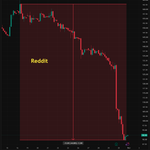
The collapse of Reddit will be studied.
After reporting earnings, its stock collapsed 30% in a single day.
It's down 44% in 2 weeks.
But the most important detail is what was revealed in that earnings call.
The CEO said AI is killing Google search.
People no longer get sent to Reddit from Google. They merely get their answers from the AI Mode itself.
Even Google confirmed this themselves with their disastrous results - AI mode is cannibalising their search business.
Pretty soon, no one will visit Reddit voluntarily. Its traffic will continue to crater.
The worst part?
Reddit isn't alone. There are millions of companies and publishers that rely on search traffic.
That's what happens when you rely on a single funnel for discovery.

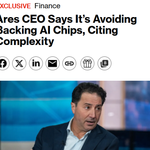
One of the largest private credit firms just refused to finance AI chips, and the rest of the market should be asking why.
Ares' CEO has admitted that they struggle to estimate the actual depreciation on GPUs.
It's worried it could be stuck holding these assets long after they're released.
That's a striking admission especially given so many of the recent chip-backed deals.
Pretty soon, the market is going to violently reprice the debt on a lot of this GPU fugazi financing.


The oil market is experiencing a domino effect that reveals the TRUE shortage.
1st domino: There were crude supply fears when the conflict began which led to production shutdowns & physical barrels removed.
2nd: Large stocks of floating storage temporarily eased concerns and then focus shifted to refined products. Refined fuels spiked while diesel margins hit records.
3rd: Shipping costs exploded as tankers got attacked & China started buying again. Freight rates went through the roof as ships braved the Hormuz routes.
4th: Refineries in Asia & Europe started considering cutting production despite enjoying record margins because the cost of transporting crude had become too expensive.
5th: Fewer refineries meant less diesel production which meant less storage. Hence the reason for diesel storage levels near record lows just before winter.
So, what happens now?
Well, shipping rates will self-correct.
Diesel crack spreads are already coming down so refineries are cutting back → tanker demand drops → shipping costs finally moderate again → refineries can go back & buy more crude.
But there's a problem.
Crude inventories are being drained in record numbers.
The longer this drags on, the smaller that cushion becomes.
When inventories are depleted, the real shortage begins.
Crude prices could then rise disproportionately, outpacing both refining margins AND shipping costs.
The dominoes all fall back to crude.
Big Tech is pouring billions into AI - but look at where the money is going!
Microsoft, Google, Amazon, Nvidia, OpenAI & Anthropic are connected through a massive web of investments, infrastructure spending and commercial deals.
And Nvidia sits at the centre of it all.
Look at the network:
- Nvidia is both an investor in AI companies and a supplier of the chips powering their expansion.
- Microsoft, Google & Amazon provide AI infrastructure and services while also investing across the ecosystem.
- OpenAI & Anthropic sit at the intersection of investments, cloud services and hardware spending.
- CoreWeave, Nebius, Nscale & Oracle are part of the infrastructure network supporting the AI build-out.
- AMD, Broadcom, Intel & other chipmakers are tied into the same expanding network of AI spending.
The result is an increasingly interconnected system where money only flows from investors to AI companies & back towards their infrastructure and hardware suppliers.
These circular relationships can make the industry's growth only look stronger than the underlying returns ultimately justify.
Revenue for one company becomes an expense for another. Investment capital helps fund purchases from companies operating within the same ecosystem.
The demand may be real. The technology may be revolutionary. And the investment can still be terrible.
All three can be true at the same time.
