

Teach: @CtrRelPol | Research: @myfaithcounts | Books: The Nones, Great Dechurching, Vanishing Church | Former Pastor: @AmericanBaptist | Graphs about Religion
Mount Vernon, IL
Joined May 2008
- Tweets10.5K
- Following183
- Followers42.9K
- Likes4.5K




Pinned Tweet
Coming up in October on the newsletter.
October 1: Most religious groups have become less religious over time. Is that true among evangelicals?
October 5: Examining the role of the Bible in American Catholicism
October 8: I do a deep dive on the 100 largest United Methodist Churches in the United States
October 12: Some data on religion in Canada. Did they experience the predicted revival?
October 15: A closer examination of factors that lead to retention in American Catholicism.
October 19: How many Americans cast their ballots in a house of worship? A lot more than I would have guessed.
October 22: A careful examination of the claim of a surge in Orthodox Christianity.
October 26: If I only compare the most devout Catholics with the most devout evangelicals, do they have similar politics?
October 29: A really in depth inspection of the decline in the Archdiocese of Detroit

Ryan Burge 📊 retweeted

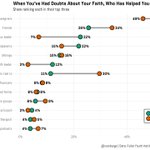
I'm thrilled that @RyanBurge is digging into our new @fullerFYI research with nearly 3,000 Gen Alpha teenagers. His latest analysis explores a question I care deeply about: When teenagers have doubts about faith, who do they turn to?
tinyurl.com/7h9sssy5


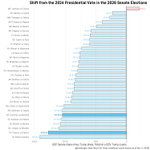
How much vote switching happened in 2026?
Not that much according to NORC data of 113K Americans.
Among white evangelicals who voted for Trump, only 2% voted for a Democrat in 2026.
For non-evangelical Protestants and Catholics, it was a bit higher: 6%.

What do Christian teens struggle with?
I'm guessing it's the same struggles as adults Christians.
31% of teens wonder why bad things happen.
23% feel disconnected from God.
Very few teens constantly struggle with feeling upset with God or doubt God's realness, though.


Thanks to @fullerFYI, I have good survey data on Gen Alpha - for the very first time.
One key finding:
Christian teens have stronger familial networks than non-Christian teens.
And non-Christian teens are 3x more likely to have no one to talk to about their doubts.

82% of evangelicals say the Bible is extremely or very important.
It's 46% of Catholics.
Among evangelicals, 51% of say that they read the Bible weekly (outside of church)
For Catholics, 14% read scripture weekly

Full post here.
Free and unlocked.
graphsaboutreligion.com/p/wh…

Religious switching is up.
That means that religious retention is down.
Retention among Protestants wa 90%. Now it's 73%.
For Catholics, it was 84%. Now 63%.
Meanwhile, retention among the non-religious has skyrocketed.
34% in the 1970s.
71% now.

Exit polls historically put white evangelical turnout ~25%.
The exit polls from 2026 have it at 17%. That's a 30% drop.
Maybe. But I'm very skeptical.
I’ll believe it when the validated data confirms it.


In the Congressional Districts with the highest share of evangelicals, the swing was D+22.
In the most mainline CDs: D+15
In the most Catholic CDs: D+15
But no seats flipped in evangelical districts and just one changed hands in Catholic districts.
7 flipped in mainline CDs.


The narrative that is emerging is:
"Hamilton and Talarico's religious bona fides is what made the difference."
But Roy Cooper out ran Trump by 11 points in NC.
Annie Andrews did 11 points better in SC, too.
Both of those candidates were challengers, neither of those candidates centered their faith.
But they performed just as well as Hamilton.
And Talarico did just a bit better at 12.8 points, but can't we chalk some of that up to Ken Paxton just being a terrible candidate?

People who attend religious services weekly or more are much more likely to report being "very happy" compared to those who attend seldom/never.
For those born in the 1980s:
A weekly attender is 2x as likely to say they are very happy vs a never/seldom attender.

There's this concept called the God Gap.
Republicans are pretty religious.
Democrats are less so.
But here's a very important caveat.
The God Gap only exists among white Americans.
Huge differences in beliefs, attendance, and affiliation.
Almost none among nonwhites.

You know why non-religious people don't have children?
The answer is simply this:
They don't like kids
They "just didn't want to have kids"
Meanwhile, among older religious folks who don't have kids -- a lot of them wanted to be a parent.
It just didn't happen.

"This is often the frustration we face in social science: we want to clearly identify why people chose a different path. When it comes to having kids, almost half of the nones just shrug their shoulders and say, 'That’s not for me.'”
Unlocked!
graphsaboutreligion.com/p/wh…

Among people with a PhD:
11% have a parent with a PhD.
45% have a parent with a grad degree.
Among all tenure track faculty:
22% have a parent w/a PhD.
Among faculty at elite institutions:
30% have a parent w/a PhD.
29% of people with PhDs are first gen college students.

I've seen this same sentiment passed around a bunch:
"LDS are the most GOP voting bloc"
Guys, it's because they overwhelmingly white. That's the reason.
In 2024:
77% of white Protestants voted for Trump.
It was 74% of white LDS.
And 67% of white Catholics voted Trump.

Exit polling shows that Latter Day Saints were the highest percentage of religious group that voted for the GOP.
So maybe boss babe conservative women like @conservmillen don’t actually have the best instincts when they decide to attack our faith 2 weeks before a midterm.

