

Ramblings of a technology guy. President and GM at Signal65. Formerly Graphics and AI product at Intel, former owner at PC Perspective.
Union, KY
Joined April 2007
- Tweets27.9K
- Following2K
- Followers19.6K
- Likes14.6K



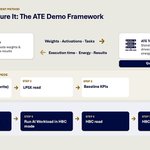


Excited to see these advancements and improvements on our AMD MI355X testing with @Signal_65 PINNACLE!
The software improvements on the @AMD Instinct MI355X are showing up in our own agentic workloads and benchmarks. Signal65 worked with AMD to optimize how MiniMax-M3 is served on the platform, and in Signal65 PINNACLE testing an 8-GPU MI355X node can run more agents and runs each one faster, which lowers the cost of agent work on the platform.
➡️ 56 concurrent agents at the PINNACLE service level, up from 52 in September; leadership over the GB300 here
➡️ 2.4x the throughput at 8 agents, the lighter loads where many agent deployments run
➡️ The B300 per-agent lead at 8 agents narrows from 3.7x to 1.5x
➡️ Newer serving software reaches 1.44x the September throughput on the same node
Full article pinnacle.signal65.com/articl… @AIatAMD @AnushElangovan @roaner


NVIDIA brought Jensen Huang back as CEO this morning, effective immediately, less than two weeks after he stepped down. The board says the vote was unanimous and that it's comfortable with his candor and ability to lead. Colette Kress heads back to the CFO seat after keeping things steady as interim CEO.
nvidianews.nvidia.com/news/n…
If you're a customer or partner betting billions on the @NVIDIA roadmap over the next few years, this is the outcome you wanted. It also came a lot faster than most of us expected, given the board said just last week it had no plans to bring him back.
Meanwhile, Rene Haas signed on to run Arm through 2033 and picks up a Vice Chairman title at SoftBank on December 1st. Rene was the name everybody floated for the NVIDIA job, since he spent seven years there. I think he played that moment really well and walked away with a long-term deal and a bigger SoftBank role while the NVIDIA seat was still open.
newsroom.arm.com/news/arm-ce…
That's great news for @Arm too. Rene took the company public and pushed it into compute subsystems and its own chips, and AI keeps pulling Arm further into the datacenter. After two weeks of leadership drama, both companies come out with the guy they want at the top.

😳

NVIDIA Board reinstates Jensen Huang as President, CEO and Board Director.
Read the release: nvidianews.nvidia.com/news/n…
Microsoft wants to make sure that its own custom silicon CPU initiative gets the recognition it deserves, and the @Azure Cobalt 200 looks like an impressive improvement over the previous generation.
Signal65 compared the latest @Azure Cobalt 200 with Cobalt 100, two generations of the custom Arm-based server processor from Microsoft, across four kinds of work.
We ran both generations on the largest general-purpose VM of each and reported results per instance and per vCPU. The Cobalt 200 VM has 1.33x the vCPUs, so the per-vCPU view shows how much of the gain comes from each core. The report also includes EDA chip-design results that Microsoft silicon engineers produced on their own design flows, which Signal65 reviewed.
Key findings from the Lab Insight:
➡️ Cobalt 200 delivered 1.43x to 5.53x the throughput of Cobalt 100 per instance, and 1.07x to 4.15x per vCPU
➡️ Developer and system tasks ran at 1.76x the work per instance on Terminal-Bench 2 in our testing
➡️ Function calling for AI agents reached 1.59x to 1.93x the requests per second per instance, with identical accuracy
➡️ GROMACS molecular dynamics rose 1.43x to 1.46x per instance
➡️ RTL simulation for chip design completed 3.43x to 5.53x the jobs per hour per instance, in tests run by Microsoft silicon engineers and reviewed by Signal65
➡️ A fleet sized for a fixed load needs roughly 30% to 48% fewer instances on the developer, agentic AI and HPC workloads we tested
Read the full Lab Insight: signal65.com/research/azure-…


The @Surface Laptop Ultra with the NVIDIA RTX Spark runs a 94 GB model through complete enterprise agent workflows at more than four correct an hour, in our testing. We built @Signal_65 PINNACLE Client to measure this class of PC, and the RTX Spark is an ideal proving ground for it.
The Microsoft @surface Laptop Ultra with the @nvidia RTX Spark puts 128 GB of unified memory and the CUDA software stack in a laptop, and in our testing that is enough to run complete enterprise AI agent workflows on the device.
Read the article: pinnacle.signal65.com/articl…
We have been building Signal65 PINNACLE Client to measure this class of system by how much correct work it completes, and the RTX Spark is an ideal proving ground for it. First results from the Surface Laptop Ultra, in our testing:
➡️ The laptop completes more than four enterprise workflows correctly every hour on Qwen3.8-Flash-Next, a 94 GB model, with each workflow running up to 69 agent steps. This means real work and real value being created
➡️ Every SQL query, file read and script in those workflows is executed on the device, and the data stays there
➡️ The speculative-decoding recipe NVIDIA publishes for these models speeds the same workflows up by as much as 2.2x on the same hardware
➡️ The CUDA path runs 1.23x to 1.45x faster than a common llama.cpp Vulkan build
➡️ With 128 GB there is a real choice of models, and the fastest one we ran finishes 8.7 workflows an hour at the expense of getting 3.9 of them wrong. This is why the PINNACLE Intelligence scores matter!
Work that needed a data center or a cloud API a year ago can now run on a PC, which is why Signal65 PINNACLE matters now and why performance testing like this will keep growing in value as more of these systems reach the market. These are initial results on one system, and more PCs and workstations are in testing now.


3
1
772
A very compelling test of the newly announced Microsoft Foundry Managed Compute using AMD MI300X GPUs. The idea is that you can get the privacy and performance of on-prem compute resources but with the simplicity of deployment of the cloud and APIs.
Running open models on dedicated, private GPUs has meant paying for GPU hours PLUS the engineering time to build and tune a serving stack, and agentic workloads push both costs up. Signal65 tested @Microsoft Foundry Managed Compute on AMD Instinct MI300X GPUs to see how much of that work a managed template removes, and what it can provide in performance and agentic capability.
Key findings from our testing:
➡️ Four open models went from the Foundry catalog to a live, dedicated endpoint in as little as 14 minutes, with no serving configuration
➡️ A single MI300X GPU served gpt-oss-120b to 32 concurrent AI agents, and four GPUs served DeepSeek V4.1 Flash to 128 agents with a one-million-token context
➡️ Default Foundry templates reached 93% to 100% of the per-agent speed of the same models hand-tuned on bare-metal MI300X servers
➡️ A budget of just $10,000 of MI300X time covered about 112,000 complete gpt-oss-120b agent sessions, roughly $0.09 of GPU time each
Full Lab Insight Report: signal65.com/research/ai/dep… @Azure @AMD


2
618
Enterprises that host their own models often think they have to pick between a model that scores well and one that responds fast. Inkling-2-Small, the new open-weight model from @thinkymachines, scores above 4,000 on @Signal_65 PINNACLE and gave every agent 96 tok/s on a loaded node. In our testing:
➡️ One 8× @nvidia B300 node finished 911 correct multi-step enterprise tasks an hour, 1.8x the next open-weight model above a 4,000 Model Score
➡️ Each of 48 concurrent agents received 96 tok/s, where comparable open models reach capacity near 10 to 15 tok/s per agent
➡️ A correct task costs $0.08 on a rented node at $76/hr, 43% less than DeepSeek-V4.1-Flash-1017 and 59% less than Qwen3.8-Flash-Next
➡️ It scores 4,101 on the Signal65 PINNACLE Model Score with 93.9% of jobs finished and 97.0% retrieval fidelity, and its 4.9% fabrication is the highest of the open models above 4,000

2
719
NVIDIA is using SC26 to argue that AI agents will take on more and more scientific work, and today's announcements cover most of the stack that idea needs, from open models to a CPU-only rack for simulation codes to a new HPC GPU.
Nemotron for Science pairs the open Nemotron 3.5 Super VL model with a 50,000-question chemistry dataset and post-training recipes, so research teams can build agents on their own data. Lila Sciences says its tuned version hit 61% accuracy on quantum dot synthesis versus 54% for GPT-6 Astra at 10x to 20x lower inference cost, and KTH used a Nemotron agent to fix 81% of broken GROMACS setups overnight on a single DGX Spark. An open model a lab can tune and run on its own hardware takes care of the cost and data-control worries that keep a lot of institutions off closed frontier APIs.
Vera is the one I think matters most in the near term, since a huge share of climate, weather and CFD code still runs on CPUs and NVIDIA didn't have a product for it until now. The new rack packs 192 Vera CPUs (88 Olympus cores each) on Quantum-X800 InfiniBand with more than 200 TB/s of aggregate memory bandwidth, and NVIDIA claims 1.9x the performance and 2.4x the performance per watt of x86 on OpenFOAM. DKRZ already picked Vera for its HLRE-5 climate system, and Dell, HPE, Lenovo and Supermicro ship racks in early 2027. We tested Vera on agentic workloads at @Signal_65 earlier this fall, and its move into simulation gives x86 a real new competitor in HPC.
NVIDIA also announced Rubin HPC, a 2028 GPU in the Vera Rubin family with more than 50,000 CUDA cores and a design that scales data movement along with compute. That speaks to HPC buyers who watched native FP64 on the standard Rubin GPU land at 33 TFLOPS, but without precision or memory specs it's too early to judge.
Put it together and @nvidia is building every layer a science agent needs, which means AMD, Intel and the Arm server players chasing HPC budgets now have to compete with NVIDIA at each of them.
Ready to build your own agent to speed scientific discovery? 🧬
Introducing Nemotron for Science, helping researchers develop agents that reason through scientific problems and put specialized research tools to work.
Used by @argonne, @RIKEN_en & more. #SC26
🔗 nvda.ws/4C2tIuu


This is the true risk that Nvidia leadership needs to address. And it’s one of the reasons other tech giants have fallen in the past.

I've spoken with several industry experts about Nvidia after Jensen's resignation.
They taught me a lot, and one point they raised was whether senior and veteran engineers will actually stay at an Nvidia without Jensen.
Most of Nvidia's senior and veteran engineers have already reached financial freedom thanks to the surge in Nvidia's stock.
For many of them, the main reason they stayed was Jensen Huang's unmatched charisma. Now that he's gone, it wouldn't be strange if they left Nvidia tomorrow.
Industry insiders told me that OpenAI and Nvidia's competitors are probably already calling Nvidia's senior and veteran engineers like crazy. They said if you promise a senior engineer a team of their own, the whole team will move with them.
It's been an interesting day and week. The impact of Jensen Huang leaving $NVDA can't be understated, but it doesn't mean the end of the AI buildout, or even the end of NVIDIA. Talked about broader impact and what the next CEO needs on @SchwabNetwork.
schwabnetwork.com/video/nvda…

Claude Fable 5.2 from @AnthropicAI is the best coding model we have tested and it is not close. It is also $30 a passed job.
Claude Fable 5.2 passed 28 of 30 Frontier Class coding jobs on Signal65 PINNACLE. No other model has passed more than 21. It also costs $30.51 per passed job in our testing, 3.9x Claude Opus 5.5. Best model on the board, priced like it.

3
6
975
Agents run their tools on CPUs, so the CPU sets how many agents a server can carry. In early @Signal_65 testing, AMD EPYC Venice ran CPU-bound agent tool work 22% to 60% faster per core than Zen 5, and on a preview of the upcoming Signal65 PINNACLE CPU Benchmark the 256-core EPYC 9996 cut tool time per agent by 22% at 1,024 concurrent agents.


Love seeing these massive GPU compute clusters getting tested and validated, and the extreme performance they can provide. Over 260k tokens/sec! Hats off to the @Signal_65 team for the anaysis.
Reasoning models only pay off when people get answers fast enough to stay in the flow of their work, and every extra GPU needed to hold that response time adds to the cost of serving them. Signal65 analyzed the audited MLPerf Inference v6.1 DeepSeek-R1 results to see which cloud delivers the most reasoning throughput under the tightest latency limits.
The Interactive scenario holds every system to a 1.5s limit on time to first token and 15ms per output token, the closest MLPerf match for conversational and coding workloads. We compared each Azure result against systems with the same GPU generation and GPU count.
Key findings from our analysis:
➡️ Azure ND GB300 v6 leads Interactive throughput by 10.3% over the next cloud submission, at 260,098 output tokens per second on 72 GPUs
➡️ Azure ND GB200 v6 scales from one NVL72 rack to four at 93.6% efficiency in Server and 96.4% in Offline
➡️ Four racks reach 2.09M output tokens per second in Offline, the only multi-rack NVL72 result from a cloud provider this round
➡️ Moving from GB200 to GB300 raises Server throughput 38.1% at the same 72-GPU scale
➡️ Azure ND GB200 v6 posts the top Server and Offline throughput of all Available 72-GPU GB200 systems, 1.7% and 2.3% ahead of the closest cloud submission
Read the full Lab Insight: signal65.com/research/ai/mic… @Azure @nvidia


1
3
808
A lab most enterprises have never evaluated just put a 65B model at the top of the open-weight board on the measure that matters most for agents, finishing the job.
Ripple-65B-Preview from @RicursiveAI completes 98.2% of the multi-step enterprise work in our @Signal_65 PINNACLE testing, more than Beam, more than Qwen3.8, at a twelfth of the size of the models it scores next to. Retrieval and fabrication are where it still loses points, and those are the fixable half. The US open-weight field just got another serious lab.
Somewhat surprisingly for a medium-sized option, a 65B open-weight model that you can run on its own hardware just posted the highest agentic job completion of any open model on Signal65 PINNACLE.
Live on the Model Score and cost views at pinnacle.signal65.com
Ripple-65B-Preview is a 64.8B dense model from @RicursiveAI, a US lab new to the board, scored on the same protocol as every other model. In our testing:
➡️ It finished 98.2% of the multi-step enterprise jobs, the highest rate of any open-weight row, ahead of Qwen3.8-Flash-Next (97.1%) and Beam-1.0 NVFP4 (96.1%), with the frontier tier at 96.7%
➡️ It scores 3,101 on the PINNACLE Model Score, the best result under 100B parameters, 22% fewer weighted errors than Qwen3.8-27B and within 5% of Muse Spark Open NVFP4 and GLM-5.2 at a twelfth of their size
➡️ On one 8× NVIDIA B300 node it holds 40 concurrent agents at 10 tok/s each, which prices a correct task at $0.39, 193 correct tasks per node-hour; the speed term is a single 172-attempt run and the row is a preview build
➡️ The NVFP4 build is not at parity with BF16. It scores 2,772 (97.5% jobs finished, 12.6% fabrication) at $0.34, 20% more throughput on the same node for an 11% lower score
The agentic half of the result is already there. Close the retrieval gap and this model moves well up the board.


2
7
974
Google Cloud just launched TPU 8tx, the first cloud TPU system with hardware confidential computing, and 5th Gen AMD EPYC processors will serve as the host CPU. For enterprises, that means they can run inference, fine-tuning or RL on TPUs, and their prompts, model weights and intermediate data stay encrypted and isolated the whole way through.
The way it works is that AMD SEV now reaches past the CPU to the accelerator itself. The system checks a TPU’s identity and security setup before letting it touch protected memory, and the data stays encrypted while it moves between the host and the TPUs.
I’ve been saying for a while that the host CPU matters a lot more in AI systems than most people give it credit for, and this is a good example. AMD says EPYC is now the host CPU at more than 10 hyperscalers and frontier AI labs, alongside Instinct, NVIDIA and custom chips like the TPU, and I expect confidential AI to push that number higher.
You can see our @Signal_65 research on EPYC as a host node here: signal65.com/research/ai/imp…


A little ❤️ in the cloud.
A lot of EPYC behind the news.
We're excited to announce our expanded @GoogleCloud collaboration, with 5th Gen AMD EPYC processors powering the host infrastructure for Google Cloud TPU 8tx and helping protect sensitive AI models: bit.ly/4zFPORW.
