

An Adobe Company. Helping 28M+ marketers be found everywhere search happens
Boston, MA
Joined February 2009
- Tweets214K
- Following10.7K
- Followers314K
- Likes38K





Your brand evolves, but AI may still describe the company you were two years ago. That’s LLM positioning lag: the gap between how your business has changed and how AI systems understand it.
You launch products, update your positioning, or enter new markets, but AI still draws on outdated pages, reviews, directories, and third-party coverage. When potential customers ask for recommendations, your brand may be described inaccurately or left off the shortlist entirely.
Refresh outdated information across the web, keep your messaging consistent, strengthen credible third-party coverage, and monitor how AI describes your brand over time to close this gap.
Make sure AI understands the business you are today, not the one you used to be 👇
social.semrush.com/3WyBgVv.

Spotlight 2026 brought +1000 marketers together in London to explore how AI is changing the way brands get discovered, and what it takes to stand out in the age of LLMs.
Already getting FOMO for the next one? 👀
Join the waiting list and be the first to hear about future Spotlight events.
semrush.typeform.com/to/yXaR…
5 Tips to Increase Your Website's Authority:
1. Get Quality Backlinks with Valuable Content
2. Optimize Your Content for Relevant Keywords
3. Develop a Solid Internal Linking Strategy
4. Get Mentions from Across the Web
5. Build an AI-Friendly Content Structure
Full breakdown here: social.semrush.com/4e2fJdN.

What makes AI systems cite one piece of content over another?
It starts with evidence worth citing: original research, firsthand expertise, unique data, and insights others can’t easily replicate.
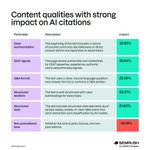
Our study found that AI-cited pages scored higher on clear summarization (+32.83%), E-E-A-T signals (+30.64%), and Q&A formatting (+25.45%), among other content qualities.
More findings 👇
social.semrush.com/4srwgxH.

Your new SEO obsession might just be Claude + Semrush Skills. 👀
Find keyword opportunities, build topic clusters, spot orphan pages, and run SEO audits, all without jumping between tools.
Here's how to get started 👇
social.semrush.com/4ii8EIN
Build these 10 practices into your SEO workflows to improve your brand’s visibility across search and AI 👇
1. Understand what your audience wants
2. Focus on topical authority
3. Structure content so search and AI systems can extract it
4. Do technical SEO, including AI crawler access
5. Optimize images for search
6. Showcase E-E-A-T
7. Publish original data and citable evidence
8. Build an off-site presence where search and AI systems look
9. Prepare for agentic search and commerce
10. Monitor performance across Google and AI search
social.semrush.com/4yQ4gFL.

SEO question, then vs now:
Old → How do we rank higher?
New → How do we become a trusted source everywhere AI looks?
Rankings still matter. But AI answers pull from citations, mentions, and repeated signals far beyond your site.
Example: LinkedIn already drives ~11% of AI citations, more than many major publishers.
social.semrush.com/4iovrkT.

Are your go-to SEO tactics still effective in the age of AI search?
From programmatic SEO and content refreshes to long-tail keywords and unlinked brand mentions, familiar strategies are evolving as search changes.
Brian Dean breaks down seven classic SEO tactics to show what still works, what needs to change, and how to adapt your strategy for AI search.
Watch the full video 👇 social.semrush.com/3W3z8F7.

Why isn’t your brand showing up in AI search? The problem could be in one of four areas:
1. Discoverability: AI systems can't reliably access the information they need about the brand
2. Clarity: AI systems access that information but describe the brand inaccurately or inconsistently
3. Authority: AI systems describe the brand accurately but rarely include it in relevant comparisons or shortlists
4. Trust: AI systems consider the brand but rarely recommend it, or recommend it with recurring caveats
Each problem needs a different fix. Our guide explains how to diagnose the gaps and decide what to tackle first 👇
social.semrush.com/4srzcdS.

Everything you need to know about on-page SEO in 2026 to improve visibility and performance ↓
social.semrush.com/4z9RUcz.

Your brand appeared in ChatGPT. Now prove it matters. Join our live AI visibility AMA on October 29th to unpack mentions, citations, competitor tracking, and what actually works.
No slides. Just answers.
Bring your questions 👇
social.semrush.com/3TTTobz.

Semantic HTML helps machines understand your content the same way humans do – through structure and meaning.
Here’s how to implement it properly: social.semrush.com/4yGrMVs.

Your friendly reminder that you need to be visible in AI-driven search surfaces like Google’s AI Overviews and ChatGPT 💭
This checklist covers tasks that can help you gain visibility, no matter where your audience is searching! (If you have limited time or resources, focus on the most relevant tasks. Then, return to this guide whenever you’re ready to move on) ⬇️ social.semrush.com/48f4c7q.

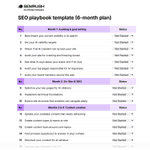
If you’re trying to earn visibility in AI-generated search results, here’s where to start: our 6-month playbook template 👇
social.semrush.com/3TPwYIA.

Google’s new AI shopping features could change both how customers discover products and how they buy them.
Information Agents may mean fewer visits to your website, but the visitors who do arrive could be closer to making a purchase. That makes conversion readiness just as important as visibility.
For ecommerce brands, there’s another priority: getting UCP-ready to be eligible for Google’s Universal Cart.
Here’s what these changes mean for your strategy and how to prepare 👇
social.semrush.com/4z4Mi35.

In AI search, structure is signal.
Semantic HTML is one of the clearest signals you can give 👇
social.semrush.com/3VWUhAQ.

Scaling SEO across thousands of pages? Here are 5 ways to make it manageable:
1. Organize SEO work by page type
2. Prioritize page types by business impact
3. Fix recurring SEO issues at scale
4. Roll out changes safely
5. Monitor performance by segment
Get the full framework for managing SEO at scale 👇
social.semrush.com/4i1ZwYv.


AI visibility data becomes more useful when you turn it into clear, repeatable reporting.
Use this 6-step framework to audit your brand and communicate findings across marketing, PR, and leadership:
1. Benchmark overall visibility – measure mentions, share of voice, and competitor presence.
2. Identify cited content – find which pages AI systems use and where your brand is missed.
3. Find topical gaps – uncover prompts where competitors appear but your brand doesn’t.
4. Analyze brand sentiment – evaluate how AI platforms describe your brand and identify perception gaps.
5. Assess external sources – track third-party domains shaping AI answers and brand recommendations.
6. Check technical readiness – identify site issues that affect AI access and content interpretation.
Turn scattered search signals into measurable priorities and clearer decisions 👇
social.semrush.com/4elNI0U.

AI Overviews now appear for 88% of the commercial keywords in our study, up from 45.75% in September 2025.
Which commercial queries trigger AI Overviews most often, and where could your brand be missing from the answers?
Find out which modifiers matter most 👇
social.semrush.com/4BkZfYi.
