






ALT This image shows the orbital pathway of newly discovered dwarf planet candidate 2026 ED138 (ED138), as observed by NSF–DOE Vera C. Rubin Observatory. This image is a composite of multiple images captured by Rubin between 4 March and 11 July 2026 at intervals indicated by the teal circles. ED138 is visible at the center of each circle. ED138 was found by Rubin Operations team member and in-Kind contributor Matthew Holman (Center for Astrophysics | Harvard & Smithsonian), who contributes to improving Rubin's algorithms that search for distant moving objects in our Solar System. Its distance from the Sun places it beyond the orbit of Pluto, and initial analysis indicates that it may be among the largest and brightest bodies scientists have discovered in this region of the Solar System. Credit: NSF–DOE Vera C. Rubin Observatory/NOIRLab/SLAC/AURA Image Processing: M. Jurić (UW), D. de Martin & M. Zamani (NSF NOIRLab)

ALT A vibrant image of the cosmic Chamaeleon I cloud complex. Bright stars are scattered throughout, surrounded by swirls of red, blue, and dark nebulae, creating a colorful and mesmerizing scene in space.Two years ago this month, NSF–DOE Vera C. Rubin Observatory’s engineering test camera, named the LSST Commissioning Camera (ComCam), began capturing images of the sky to prepare for the revolutionary Legacy Survey of Space and Time, which began earlier this year. This image featuring the head of the Seagull Nebula was one of many ComCam images that led to the success of Rubin First Look and helped to document the observatory’s excellent performance. Credit: NSF–DOE Vera C. Rubin Observatory/NOIRLab/SLAC/AURA Image Processing: T.A. Rector (University of Alaska Anchorage/NSF NOIRLab), D. de Martin & M. Zamani (NSF NOIRLab)


ALT Gray cover with the title "Genesis Agent Skills." The logos for Genesis Mission and the U.S. Department of Energy are at the top. A white, curved line pattern spans the lower half.


ALT Map of the U.S. with the title Genesis Agent Skill Contributors with 10 labs labeled

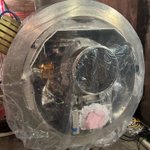
ALT A large, round piece of machinery is covered partially with clear plastic, revealing intricate components inside (an open cryomodule). Cables and wires surround the base, and the machine is positioned in an industrial setting. Credit: SLAC/Lara Streiff

ALT A complex scientific apparatus with multiple circular openings and metallic components, including a prominent central cylindrical structure. The device is an open cryomodule, and features various wires and connectors. Credit: SLAC/Olivier Bonin

ALT A large, circular piece of machinery (an open cryomodule) wrapped in protective plastic with various hoses and components visible inside. Credit: SLAC/Lara Streiff


ALT Photo of a woman in a fleece jacket with her back to the camera who is working on a computer. There is an automated robotic setup in front of her.



ALT A digital artwork showing a concept of network connectivity and data flow. On a blue background, interconnected nodes are centrally displayed, surrounded by icons representing various technologies. An upward-pointing arrow connects the nodes to a prism lit by a beam of light. Credit: Greg Stewart/SLAC

ALT A smiling child with light hair, wearing a striped shirt with a dark collar. Text on the image reads: "This is who helped build the world's largest digital camera."

ALT A framed photo of a newborn resting peacefully. The background has a light pattern with soft colors. Text above the photo humorously reads, "This is who is getting to the core of Earth’s magnetic field.

ALT A child is playing on grass in a yard, wearing a light blue dress. In the background, there is a yellow object and a green kiddie pool. Text overlay reads, "This is who is blazing the path to a fusion future."