

Verifiable data platform for distributed compute. Built to make data work wherever compute takes you. Private Beta is live.
Joined May 2025
- Tweets932
- Following16
- Followers33.3K
- Likes1.5K










Compute may be the most important constraint in the agent era. But data is increasingly the constraint on compute.
Batching, off-peak hours, cheaper GPU-hours wherever they are: these compute optimizations depend on workloads being able to run where capacity is available. If every change in compute means another cycle of moving, copying and staging data, those efficiencies get harder to realize.
Compute is dynamic. Data needs to keep up.

If you're building in AI, the most important thing to master is the economics of compute. My take: respect the GPU or the GPU will humble you.
We're in a compute shortage. A GB300 costs roughly $7/hour on the spot market so depending on the frontier model, that hour buys you some millions of output tokens.
The only question is: how much customer value can you create with those tokens?
If it's less than $7, you have a problem. Customer won't pay you, so you won't be able to afford more compute, and VCs can subsidize you forever. Eventually, someone who creates more value per GPU-hour will outbid you.
The same GPU-hour could be spent generating another meme or helping discover a cancer treatment. The economic value of those outputs is wildly different.
My take is that you have to design your entire product around this equation. What's the smallest model that can do the job? Can you batch the work? Run it asynchronously during off-peak hours? Avoid generating tokens you don't need?
Every architecture decision, every feature, every token changes your compute economics. The entire roadmap has to be decided for the compute equation.
What's hard is that in traditional software eng, you could often treat compute as practically free but the agent era, compute is the most important constraint.


3T-class open weights are a useful reminder that model portability is also a data problem.
Move across GPU environments and terabytes of weights become another copy, another staging job, another thing to keep in sync.
Shelby: a single S3-compatible address across supported locations.

Releasing the model weights of Kimi K3.1 Pro: huggingface.co/moonshotai/Ki…
We'll keep advancing open intelligence.

Available compute and productive compute aren’t the same thing.
A GPU can sit idle because demand isn’t there. It can also sit idle because the workload is waiting on data: another copy, another sync job, another environment to stage.
The fixed-cost maths looks the same either way. The fix doesn’t.

Idle GPUs can still produce an expensive AI bill.
In VentureBeat Intelligence’s Q3 survey, 79% of respondents reporting GPU use said their GPUs were busy half the time or less. Yet 70% of that low-use group planned a new, additional or replacement AI platform.
A platform change can mean moving workloads, replacing an inefficient stack or buying access to a different model. It does not automatically mean ordering more GPUs.
An enterprise can also pay twice: once for owned or reserved compute, then again for a hosted model API. Spare capacity on its own hardware does not automatically offset the API invoice. Moving that work requires a suitable model and a functioning deployment.
The fixed-cost arithmetic is unforgiving.
At 20% busy time, each busy GPU-hour carries 5x the fixed capacity cost of a fully used hour. At 50%, that falls to 2x. At 80%, it is 1.25x.
Moving from 20% to 50% cuts fixed cost per busy hour by 60%, with no change in hardware prices. The total fixed bill stays the same; more work shares it. This is an illustrative model, not a measured saving.
The return still needs proving. In September, 58 of 64 respondents planning a platform change lacked finance-reviewed ROI figures. That means unverified returns, not necessarily losses.
For investors, follow three different tests:
• Hardware suppliers: orders converting into collected cash.
• GPU clouds: utilization alongside realized pricing and contract costs.
• Enterprise buyers: cost per successfully completed task.
A busy GPU can run an unprofitable workload. An idle enterprise GPU does not establish a shortage of demand everywhere else.
Survey caveat: self-selected respondents, not a representative census of the world’s GPUs.

Renting from anyone with capacity is the hedge.
Using that capacity fast is a data question: a new provider shouldn’t mean another full copy, another endpoint and another sync job.
That’s the layer Shelby is built for, across supported Shelby locations.

the neocloud boom is really an anthropic boom
of the $157B in publicly priced deals neoclouds signed this year, anthropic signed $90B (57% of total)
anthropic's revenue grew 7x in a year and unlike most companies, they actually can use any chip. and they are.
they use amazon's trainium, google's tpus, nvidia's gpus, AND signed a deal with amd
because it can use any chip, it can rent from anyone with capacity, which protects them from any shortage
meta came second at $48B with @nebiusai and @CoreWeave. but where's openAI? this year it signed just $10B with @cerebras
- (but in 2025 openai signed ~$610B with @Oracle, @Microsoft, @awscloud and @CoreWeave, while anthropic only signed ~$80B)
as long as anthropic keeps growing, the biggest neoclouds will continue to have a great customer

Moving compute is often the easy part. The overhead starts when the data setup has to move with it.
Every new copy, endpoint and sync process adds cost before the workload can even start.
Shelby keeps workloads connected to the same data across supported locations, helping more of the compute you pay for stay productive.
A journey starts as video. At scale, it becomes spatial intelligence.
@PathPulse_AI is building a real-time picture of road conditions, movement and safety from video captured across the physical world. As that footprint grows, the data layer behind it has to keep up.
As the PathPulse team puts it:
“To map the world in real time, you need a powerful foundation. Shelby has been an amazing partner for PathPulse.ai, giving us the reliable, global network we need to stream live road insights and keep our drivers moving safely.”
The infrastructure behind spatial intelligence matters as much as the intelligence itself.

Rendering is becoming less tied to where compute lives.
@pictor_network is building a distributed 3D rendering network across changing compute. Their engineering team described onboarding to Shelby as “exceptionally smooth and straightforward.”
The bigger story is what that consistency enables once the workload is running:
“Shelby’s data layer keeps the assets behind every render accessible across distributed compute, giving Pictor’s users a consistent way to work with their data as compute moves. We’re excited to explore how this can support more flexible, scalable 3D rendering and AI workloads.”
Flexible rendering starts with a consistent asset layer.

Enterprise AI starts with the data no one else has.
@teepin, formerly Flashback Labs, is building around proprietary enterprise data, open-source models and changing compute.
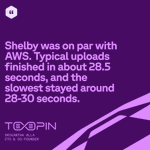
Teepin CTO & Co-Founder Srikanth Alla, previously at Amazon, ran internal tests comparing Shelby with AWS S3 on 1-2 GB files:
“In our internal testing on 1-2 GB files, Shelby’s hot storage was on par with AWS. Typical uploads finished in about 28.5 seconds, and the slowest stayed around 28-30 seconds. On S3, typical uploads were about 25.7 seconds, but the slowest 5% stretched to 32.5 seconds. Shelby’s speeds were surprisingly consistent, despite still being in private beta.”
Early proof that the data layer can keep pace as the rest of the stack changes.

Shelby retweeted

Yes, blockchain coordinated infra can match cloud performance.. Shelby private beta is humming along and have already done a sustained load of
> 1000 requests/sec
> 1-2 TB/Hour/customer
Barely making a dent in total system capacity.


Shelby is built for workloads where:
→ compute moves between locations, providers or environments;
→ data is collected, processed or trained in different places;
→ new compute creates more staging, copying or pipeline work;
→ the same dataset needs to serve multiple workloads.
Sound familiar? Get in touch.
What “live” already looks like.

Shelby is live!
Eight DCs across US and EU. > 500 TB of data stored in a month. 100s of concurrent uploads/downloads. Lower subsecond TTFB.
We have been head down building a global data network coordinated on a high performance blockchain, free of cloud silos, regional buckets, egress taxes. Plus cryptographic verifiability baked in. Single address with global access.
Customers are live and validating these claims. Developer access coming real soon.
Meet the first teams building:
shelby.xyz/news/shelby-priva…
