

The sovereign onchain central bank. All CAs are on the site. Beware of scams.
Joined August 2026
- Tweets75
- Following0
- Followers34.5K
- Likes311


72 more hours to sign and be eligible for rewards.

King of the Markets has officially concluded.
KotM was built to pilot and prove out the Reserve's liquidity thesis, and the results have surpassed all expectations. A more detailed breakdown of the data will be released this week, but for now, some important information regarding rewards.
1) A big part of this process is making sure the reward pool isn't being diluted by sybils and people who tried to game the system (wash traders and token ruggers) so we're taking the time to review all the data before distributing anything.
We've already begun filtering through transaction data to identify wash trading and accounts that attempted to artificially farm points. We want to make sure rewards go to legitimate traders and deployers, not those who tried to game the system.
2) In approximately 6.5 hours, the KotM page will update to show your trading and launchpad activity. You'll be asked to sign with your wallet to confirm where you'd like to receive your rewards and in which token. This is completely free, requires no gas, and takes about 5 seconds.
3) You'll have 120 hours (5 days) to complete this step. If you don't sign within that window, you will not be eligible to receive rewards. Once the 120 hours are up, we'll run one final filter and redistribute any unclaimed rewards from wallets that didn't sign among eligible wallets that did.
4) For those who traded through FOMO, unfortunately, FOMO doesn't make its wallet API public, which makes tracking your activity extremely difficult. We still want to make sure FOMO users aren't left out of rewards, so the best solution we have for now is to export your EVM private key from FOMO and import it into a compatible wallet.
From there, check the FOMO box and complete your payout confirmation, even if your stats show zero activity. We'll manually review these wallets over the coming days to make sure legitimate activity is accounted for.
Please only import your private key into a trusted wallet app. Never share it with anyone or enter it on the KotM website.
5) Once the final filtering and redistribution are complete, rewards will be airdropped directly to your specified wallet in your selected currency.
We appreciate everyone who participated in the pilot. The results have given us a lot of confidence in what we're building, and there's much more to come.

King of the Markets was a pilot to prove that the Reserve could own the liquidity behind Stock Tokens and become the liquidity backbone of Robinhood Chain.
The data has strengthened our conviction in this thesis and exceeded our expectations.
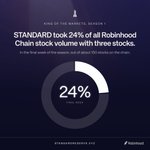
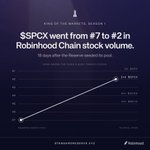
Let's dive into the numbers.

Some additional data points:
The Reserve has near total ownership of SKHY trading at 99%.
We seeded an ETH/USDG pool to prove our liquidity efficiency and it is now the 2nd most traded ETH pool on all of Robinhood Chain.
The average LP APY across pools was 58%.

King of the Markets has officially concluded.
KotM was built to pilot and prove out the Reserve's liquidity thesis, and the results have surpassed all expectations. A more detailed breakdown of the data will be released this week, but for now, some important information regarding rewards.
1) A big part of this process is making sure the reward pool isn't being diluted by sybils and people who tried to game the system (wash traders and token ruggers) so we're taking the time to review all the data before distributing anything.
We've already begun filtering through transaction data to identify wash trading and accounts that attempted to artificially farm points. We want to make sure rewards go to legitimate traders and deployers, not those who tried to game the system.
2) In approximately 6.5 hours, the KotM page will update to show your trading and launchpad activity. You'll be asked to sign with your wallet to confirm where you'd like to receive your rewards and in which token. This is completely free, requires no gas, and takes about 5 seconds.
3) You'll have 120 hours (5 days) to complete this step. If you don't sign within that window, you will not be eligible to receive rewards. Once the 120 hours are up, we'll run one final filter and redistribute any unclaimed rewards from wallets that didn't sign among eligible wallets that did.
4) For those who traded through FOMO, unfortunately, FOMO doesn't make its wallet API public, which makes tracking your activity extremely difficult. We still want to make sure FOMO users aren't left out of rewards, so the best solution we have for now is to export your EVM private key from FOMO and import it into a compatible wallet.
From there, check the FOMO box and complete your payout confirmation, even if your stats show zero activity. We'll manually review these wallets over the coming days to make sure legitimate activity is accounted for.
Please only import your private key into a trusted wallet app. Never share it with anyone or enter it on the KotM website.
5) Once the final filtering and redistribution are complete, rewards will be airdropped directly to your specified wallet in your selected currency.
We appreciate everyone who participated in the pilot. The results have given us a lot of confidence in what we're building, and there's much more to come.
Quality of Life Update:
The Standard Reserve now offers multiple automated notifications to help with inactivity.
Receive reminders directly through Telegram DMs or X mentions. Configure your preferred notifications through the wallet dropdown on the website.

The Standard Reserve is now being tracked on DefiLlama and is currently the top revenue generating protocol across Robinhood Chain.


The Standard Reserve retweeted
oh yeah, forgot to mention, coming to you soon, on standard reserve


The Standard Reserve retweeted
it was brought to my attention that a token launched on standard's launchpad was removed from pumpfun's competition for "bundling" because 80% of its supply sits in one place
i want to clarify what this actually is, and why its the complete opposite of a bundle and actually a beneficial mechanism
first, what a bundle is: a deployer buys most of the supply across multiple wallets at launch, hides that theyre connected, waits for buyers, then dumps on them (or in the *optimistic* case, uses them for "supply control"). bundles are opaque and hide a token's real float
standard's launchpad lets deployers do what's called a "charter drop" which is the complete opposite of a bundle:
- charters are nfts held by participants in the @standard_rsv ecosystem. each holder has spent over 3 eth to join the protocol, and they've proven to be aligned, long term supporters of the projects they like
- deployers can choose to airdrop a percentage of supply (up to 80%) to charter holders. these tokens are locked in a vault contract, and charter holders cant access them unless they BURN their charter
- the airdrop isnt controlled by the deployer. the tokens sit in a single public contract, 0xb8748E02f07dd80F1DB99A49F92546B2210D844d, with no admin key and no owner withdrawal
- nothing is hidden. anyone can verify the mechanism and lock onchain, which is the opposite of a hidden bundle
- charter drops cant be dumped instantly. the tokens are split across every charter holder, not one wallet, and holders only receive their share by burning their charter. it's a public token lock with a real cost to unlock, not free supply ready to hit the market
were glad bundled tokens are being policed, but if this counts as a bundle, we'd urge you to look at the majority of the other tokens in this competition
as a side not, over 4M USD of tokens has been airdropped to charters and we've seen less than 5 charter burn to receive the airdropped tokens
since we're on the topic anyway, let's talk about market cap versus liquidity on charter drop tokens. dashboards count the locked 80% in market cap, so the market cap to liquidity ratio looks thin
but, measured against tradable supply, the pool is deeper than on other launchpad tokens since the same amount of liquidity supports a much smaller float, because most of the supply is locked. treating locked supply as tradable gives a misleading ratio


Hook Modules come in 2 tiers.
Tier 1 modules are permissionless and run within fee, gas and storage write limits.
They can read onchain information and make decisions, but cannot move funds or block sells.
That gives traders safety but also gives independent developers a defined surface to build on.
All of Standard Reserve's ETH flow signals are Tier 1.
A focused module lets a small team experiment with token economics while using Standard's shared launch infrastructure.
Deploying quick modules vs going through the entire hook development process gives nimble teams incredible flexibility.

Standard Launchpad v2 launched yesterday with URC-5 as the main focus.
Today we want to highlight a new building block for programmable markets that launched simultaneously: Hook Modules.
Hook Modules are light weight pieces of custom logic that plug into Standard's launch hook.

