

Leading nonpartisan tax policy research and analysis
Washington, DC
Joined October 2008
- Tweets59.6K
- Following890
- Followers69.6K
- Likes14.6K






Pinned Tweet
Tax policy is all about trade-offs.
Our new guide analyzes 86 potential changes to the federal tax code, considering their impact on federal revenue, the long-term debt trajectory, the distribution of after-tax income, and the US economy.
Launch our interactive tool: hubs.ly/Q04r06M-0

Lawmakers can constrain the growth of property taxes without creating new problems. But the details matter.
Read more: hubs.ly/Q04CP3fw0

How do taxes in your state compare regionally and nationally? Facts and Figures, a resource we’ve provided to US taxpayers and legislators since 1941, serves as a one-stop state tax data resource that compares all 50 states on over 40 measures of tax rates, collections, burdens, and more.
Explore the latest data: hubs.ly/Q04CP2NK0

A recent report by the Government Accountability Office found the federal government loses $116 billion to $304 billion to tax fraud each year, more than many government agencies’ annual budgets.
Read more: hubs.ly/Q04CP0R90

If the U.S. taxed personal income in the same way that Denmark does, all income over $82,000 would be taxed at over 55 percent.
hubs.ly/Q04CN_TM0

🌎 The most competitive tax codes in the OECD:
1. 🇪🇪 Estonia
2. 🇱🇻 Latvia
3. 🇳🇿 New Zealand
4. 🇨🇭 Switzerland
5. 🇱🇹 Lithuania
6. 🇱🇺 Luxembourg
7. 🇨🇿 Czech Republic
8. 🇦🇺 Australia
9. 🇹🇷 Turkey
10. 🇭🇺 Hungary
See full rankings: hubs.ly/Q04CP00J0

Wealth taxes make states less competitive, increase revenue volatility, discourage investment, and risk accelerating outmigration of talent and capital. Many top-earners are already leaving high-tax states for Florida, North Carolina, and other low-tax jurisdictions.
Read more: hubs.ly/Q04Cx0Mr0

🌎 The most competitive tax codes in the OECD:
1. 🇪🇪 Estonia
2. 🇱🇻 Latvia
3. 🇳🇿 New Zealand
4. 🇨🇭 Switzerland
5. 🇱🇹 Lithuania
6. 🇱🇺 Luxembourg
7. 🇨🇿 Czech Republic
8. 🇦🇺 Australia
9. 🇹🇷 Turkey
10. 🇭🇺 Hungary
As scrutiny over data center investment and AI rises, some commentators are concerned about how expensing interacts with these ongoing investments. Most of these concerns misunderstand what expensing does.
Read more: hubs.ly/Q04Cx0-50

Tax Foundation retweeted

New from @EconoWill and I @TaxFoundation: the government loses hundreds of billions of $ to tax fraud each year.
That's a lot! The low estimate is > SNAP funding and the high is > veterans' funding.
What would it take to fix it?
(1/3)

Tax Foundation retweeted

New op-ed from @andrew_lautz and me -
If we want to ensure that AI fuels future growth, we shouldn’t be pursuing tax policies that are stuck in the past, like proposals to tax tokens or bits. @TaxFoundation @CityJournal

Hall’s research helped economists understand how taxes distort investment decisions, while his work with Rabushka shows how to minimize those distortions. Although the US remains far from a pure consumption tax, Hall’s work informs efforts to reduce the tax burden on investment, improve neutrality, and promote long-run economic growth.
Read more: hubs.ly/Q04Cw-T30

Cigarette smuggling is costly for states. We estimate that the forgone revenue from smuggled cigarettes totaled more than $4.6 billion in 2024. California lost nearly $1.4 billion in cigarette excise tax collections, and New York missed out on more than $1.2 billion.
Read more: hubs.ly/Q04Cw-VW0

While the government will never close the tax gap or fully eliminate tax fraud, lawmakers and the IRS can institute several reforms to reduce the gap, including simplifying the tax code, increasing third-party information reporting, and coordinating anti-fraud efforts.
Read more: hubs.ly/Q04Cw-HV0

Jock taxes on highly paid athletes and entertainers are here to stay, but states could make life easier for the rest of us, at very little cost, by adopting reasonable nonresident filing and withholding thresholds for ordinary taxpayers.
hubs.ly/Q04Cmj_D0 #NFL #Football #PatrickMahomes

Data from 151 countries from 1963 through 2014 shows higher tariffs reduce output and productivity, increase unemployment, and worsen inequality.
Read more: hubs.ly/Q04CmjXP0

How do taxes in your state compare regionally and nationally? Facts and Figures, a resource we’ve provided to US taxpayers and legislators since 1941, serves as a one-stop state tax data resource that compares all 50 states on over 40 measures of tax rates, collections, burdens, and more.
Explore the latest data: hubs.ly/Q04CmgMT0

Tax policy is all about trade-offs.
Our new guide analyzes 86 potential changes to the federal tax code, considering their impact on federal revenue, the long-term debt trajectory, the distribution of after-tax income, and the US economy.
Launch our interactive tool: hubs.ly/Q04Cmhbx0
No one enjoys paying taxes, but the property tax serves an important purpose, and Wyoming has already implemented significant property tax relief. Proposition 1 would undercut local finances to a degree that would likely force reliance on worse taxes (local or state) and prompt spending cuts that reduce homeowners’ property values.
Read more: hubs.ly/Q04CmgM60

Nearly half of all hospitals are exempt from paying US corporate income taxes. As healthcare spending rises, lawmakers have questioned whether hospitals are providing as much in community benefits as they derive from tax exemptions.
Read more: hubs.ly/Q04CmgHv0

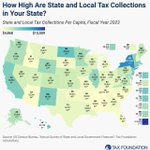
📈 Highest tax collections per capita:
DC ($15,009)
New York ($12,506)
North Dakota ($9,834)
Hawaii ($9,758)
Connecticut ($9,388)
New Jersey ($9,178)
Read more: hubs.ly/Q04C94NP0
