




⚠️ Operational Status Alert
📍 Normandy American Cemetery
📆 Nov. 16, 2026 – August 2027
🚧 Travel impacts along A13 autoroute from Paris to Normandy
👉 A portion of the A13, the main autoroute servicing Normandy from Paris, will be closed from November 16, 2026, to August 2027. Visitors should prepare to follow alternate routes or plan other modes of transportation.
🌐 To check the current operational status of ABMC commemorative sites, please visit: abmc.gov/cemetery-operationa…

Today we remember WWII U.S. Army Air Forces Staff Sgt. Carroll N. Abrahamson, buried at Sicily-Rome American Cemetery.
Abrahamson fought with 97th Bomber Squadron, 47th Bomber Group (Light).
He was awarded the Air Medal with 4 Oak Leaf Clusters and the Purple Heart Medal.
Sicily-Rome American Cemetery holds the remains of nearly 8,000 of our war dead, most of whom died in the liberation of Sicily, in the landings in the Salerno Area and the heavy fighting northward, in the landings at Anzio Beach and expansion of the beachhead, and in air and naval support in the regions.
We remember their service and sacrifice.
Discover Sicily-Rome American Cemetery in 360: virtual360.abmc.gov/florence
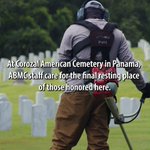
At Corozal American Cemetery in Panama, ABMC staff care for the final resting place of those honored here.
They clean each headstone. They maintain the grass. They preserve the beauty and dignity of this sacred place.
Across these 16 acres rest more than 5,000 American veterans and others. They served in conflicts spanning generations, from the Mexican-American War and the Civil War to the World Wars and other major conflicts.
This memorial also honors those who contributed to the construction, operation and maintenance of the Panama Canal.
Since 1982, ABMC has been responsible for the care and maintenance of this cemetery.
A commitment carried forward through the work of its staff, day after day.
Their service is remembered. Their legacy. Our promise.
🌐 Learn more about Corozal American Cemetery: abmc.gov/cemeteries-memorial…
Today we remember WWI U.S. Army Pfc. Maurice W. Akabas, buried at Meuse-Argonne American Cemetery.
Born in the Russian Empire, Akabas immigrated to the United States with his family and later settled in Boston, where he graduated, and later to Laredo, Texas, where he worked as a clerk.
Akabas registered for the draft in June 1917 and deployed to France in the summer of 1918. After training at Camp Bowie, Texas, he was assigned to the 143rd Infantry Regiment, 36th Division. On Oct. 18, 1918, while at regimental headquarters in Vaux-Champagne, Akabas was killed in action when an enemy shell exploded near him.
He was awarded the Purple Heart Medal with Oak Leaf Clusters.
In June 2026, in coordination with Operation Benjamin, his headstone at Meuse-Argonne American Cemetery was one of five to be changed from a Latin cross to a Star of David headstone
Meuse-Argonne American Cemetery contains the graves of over 14,000 American service members, making it the largest American military cemetery in Europe from World War I. Most lost their lives during the Meuse-Argonne Offensive, the largest military operation in U.S. history at the time. Nearly 1,000 missing are memorialized on the Walls of the Missing.
We remember their service and sacrifice.
Discover Meuse-Argonne American Cemetery in 360: bit.ly/4yTJw0O
Learn more about the headstone exchange ceremony: bit.ly/4ykxigA
Today we remember WWI U.S. Army Pvt. Hyman Aronoff, buried at Meuse-Argonne American Cemetery.
Hyman Aronoff was born in the Russian Empire and later moved to Philadelphia, Pennsylvania, in 1911. He registered for the draft in Chicago, Illinois, was inducted into the U.S. Army in September 1917, and after training with the 343rd Infantry at Camp Grant, Illinois, he transferred to the 129th Infantry Regiment, 33rd Infantry Division.
Aronoff deployed overseas in May 1918 and saw heavy combat during the Meuse-Argonne Offensive. On Oct. 17, 1918, near Consenvoye, France, he was killed in action by shrapnel during intense combat.
In June 2026, in coordination with Operation Benjamin, his headstone at Meuse-Argonne American Cemetery was one of five to be changed from a Latin cross to a Star of David headstone
Meuse-Argonne American Cemetery contains the graves of over 14,000 American service members, making it the largest American military cemetery in Europe from World War I. Most lost their lives during the Meuse-Argonne Offensive, the largest military operation in U.S. history at the time. Nearly 1,000 missing are memorialized on the Walls of the Missing.
We remember their service and sacrifice.
Discover Meuse-Argonne American Cemetery in 360: bit.ly/4yTJw0O
Learn more about the headstone exchange ceremony: bit.ly/4ykxigA
Today we remember WWI U.S. Army Pfc. Barney Bardman, buried at Meuse-Argonne American Cemetery.
Barney Bardman, born Boruch Burd, immigrated to the United States at age 17 in 1913, joining relatives in Brooklyn, New York. By 1917 he was living on the Lower East Side, supporting his father, before he was drafted into the U.S. Army in December.
Serving with the 307th Infantry Regiment, 77th Infantry Division, Bardman saw intense combat in France. In June 1918, he was severely wounded by phosgene and mustard gas and was hospitalized along with dozens of men from his regiment. After recovering, he was wounded again in September during operations along the Aisne. In early October, the 307th Infantry Regiment, particularly Company B, played a decisive role in breaking through German defenses to rescue the surrounded “Lost Battalion” in the Argonne Forest, an action in which Bardman directly participated and that saved nearly 200 survivors.
On Oct. 16, 1918, while scouting ahead for his platoon during the advance toward Grandpré, Bardman was mortally wounded by machine-gun fire but warned his comrades to withdraw, saving their lives.
Bardman was awarded the Distinguished Service Cross for extraordinary heroism.
In June 2026, in coordination with @OperBenjamin, his headstone at Meuse-Argonne American Cemetery was one of five to be changed from a Latin cross to a Star of David headstone
Meuse-Argonne American Cemetery contains the graves of over 14,000 American service members, making it the largest American military cemetery in Europe from World War I. Most lost their lives during the Meuse-Argonne Offensive, the largest military operation in U.S. history at the time. Nearly 1,000 missing are memorialized on the Walls of the Missing.
We remember their service and sacrifice.
Discover Meuse-Argonne American Cemetery in 360: bit.ly/4yTJw0O
Learn more about the headstone exchange ceremony: bit.ly/4ykxigA
On Oct. 20, 1944, the U.S. Sixth Army landed on the beaches of Leyte. It was the beginning of a massive amphibious operation in the Pacific Theater during World War II – and the start of the campaign to liberate the Philippines.
Over 200,000 Americans fought alongside their Filipino allies across rough, mountainous terrain and dense, thick jungles against a proven Japanese enemy. The fighting was fierce.
The skies and seas roared with battle – culminating in the Battle of Leyte Gulf, one of the largest naval battles in history.
By year’s end, any effective Japanese resistance on Leyte had collapsed. The U.S. sustained more than 15,000 casualties securing victory.
Their courage and sacrifice hastened the war’s end and paved the way for the ultimate liberation of an entire nation.
Today, the Manila American Cemetery honors them all.
Today we remember WWII U.S. Army Air Forces Pfc. Harvey A. Manley, buried at Netherlands American Cemetery.
Manley was awarded the Purple Heart Medal.
One of 26 ABMC cemeteries worldwide, Netherlands American Cemetery is the only American military cemetery in the Netherlands. The U.S. 30th Infantry Division liberated this site on Sept. 13, 1944. A temporary American cemetery was established here on Nov. 10, 1944.
Today, the cemetery contains the graves of more than 8,000 of our military dead, most of whom lost their lives in World War II.
The names of the 1,722 missing service members of the Army and Army Air Forces are engraved on the walls flanking the reflecting pool of the Court of Honor.
We remember their service and sacrifice.
Discover Netherlands American Cemetery in 360: virtual360.abmc.gov/netherla…
⚠️ Operational Status Alert
📍 Suresnes American Cemetery
📆 Oct. 14-16, 2026
👉 Please note that the reception room at Suresnes American Cemetery will be closed from Wednesday, Oct. 14, through Friday, Oct. 16.
Our staff will remain available to assist visitors during this period.
We appreciate your understanding and apologize for any inconvenience.
🌐 To check the current operational status of ABMC commemorative sites, please visit: abmc.gov/cemetery-operationa…

ALT A serene view of Suresnes American Cemetery, showing white gravestones lined up on a green lawn. In the background, there is a small stone building. A banner at the bottom indicates the reception room closure from October 14–16.
Can you name this World War I American cemetery?
◽The site nestles among military cemeteries and monuments of the British Commonwealth and other nations.
◽ Those who rest here were members of the American Expeditionary Forces who lost their lives in the British Isles or surrounding waters.
◽ The flagpole stands at the center of the four plots of graves, anchoring the cemetery’s symmetrical design.
🎥 Take a virtual tour of the cemetery to discover which ABMC site this is: virtual360.abmc.gov/brookwoo…


Today we remember WWII U.S. Army Pfc. Carl F. Staudacker, buried at Epinal American Cemetery.
Staudacker fought with the 30th Infantry Regiment, 3rd Infantry Division.
He was awarded the Bronze Star Medal and the Purple Heart Medal with Oak Leaf Cluster.
Epinal American Cemetery holds the remains of over 5,000 of our war dead, most of whom lost their lives in the campaigns across northeastern France to the Rhine River and beyond into Germany.
We remember their service and sacrifice.
Discover Epinal American Cemetery in 360: virtual360.abmc.gov/epinal
Three things about Meuse-Argonne American Cemetery ⤵️
1️⃣ It is the largest American military cemetery in Europe, with over 14,000 graves, and nearly 1,000 memorialized on the Wall of the Missing.
2️⃣ In 1921, a ceremony took place in Chalons-sur-Marne where one unidentified service member was selected, out of four. He was repatriated and is now the Unknown Soldier at Arlington National Cemetery, while the other three were reburied next to each other at Meuse-Argonne American Cemetery.
3️⃣ It is one of two ABMC cemeteries to have a robot that engraves headstones. Each year, about 350 headstones are engraved and dispatched to other cemeteries.
💬 Have you ever visited? Do you know other interesting facts about this WWI cemetery?
🌐 Visit Meuse-Argonne American Cemetery virtually: virtual360.abmc.gov/meuse-ar…


Today we remember WWII U.S. Army Pvt. Paul H. Hertz, buried at Epinal American Cemetery.
Hertz fought with the 180th Infantry Regiment, 45th Infantry Division.
He was awarded the Purple Heart Medal with Oak Leaf Clusters.
Epinal American Cemetery holds the remains of over 5,000 of our war dead, most of whom lost their lives in the campaigns across northeastern France to the Rhine River and beyond into Germany.
We remember their service and sacrifice.
Discover Epinal American Cemetery in 360: virtual360.abmc.gov/epinal
Today we remember WWII U.S. Army Staff Sgt. Elmer J. Kuehner, buried at Brittany American Cemetery.
Brittany American Cemetery holds the remains of over 4,000 of our war dead and memorializes 500 missing on its Walls of the Missing. Most lost their lives in the Normandy and Brittany Campaigns of 1944.
We remember their service and sacrifice.
Discover Brittany American Cemetery in 360: virtual360.abmc.gov/brittany
Can you name this unique American cemetery?
◽ It was established in 1851 by Congress to gather the American dead of the Mexican-American War (1846-1848) that lay in the nearby fields.
◽ Its monument marks the common grave of 750 unknown American soldiers killed during the fighting and recovered from battlefield graves.
◽ After the cemetery area was halved in 1976, the remains of over 800 more Americans were moved to a columbarium with their original headstones. Some of these soldiers, too, served in the Mexican-American War, while others were veterans of the Civil War and the Spanish-American War.
🎥 Take a virtual tour of the cemetery to discover which ABMC site this is: bit.ly/4bZjzn9


Traveling east instead, visitors may want to stop by Pont-à-Mousson and its Place Duroc where a large public square with a memorial fountain honors the American Field Service.
From there, one can travel further south to discover the city of Nancy, known for its UNESCO-listed Place Stanislas and its Art Nouveau heritage, and continue south to Epinal American Cemetery, where more than 5,000 American service members from World War II are laid to rest.
🌐 Visit Epinal American Cemetery virtually: virtual360.abmc.gov/epinal
📸@lestrepublicain | @envato | @usabmc


Travelers wanting to explore World War II history can travel further east to Lorraine American Cemetery, the largest World War II American military cemetery in Europe.
Traveling through Lorraine and discovering these commemorative sites, one can better understand both World War I and World War II and their lasting impact.
🌐 Visit Lorraine American Cemetery virtually: virtual360.abmc.gov/lorraine
📆 Plan you visit: bit.ly/4yL22IJ
