









Pinned Tweet
The economic consequences of the second Trump administration: A preliminary assessment
@GaryGensler @baselinescene @upanizza @bweder
ow.ly/XMzZ50WbrAk

Adult social care can be better value than the health care we already fund
Joan Costa-i-Font @LSEHealthPolicy @LSEnews @LSEInequalities, Sergi Jimenez-Martin @sergijm64 @UPFBarcelona, Cristina Vilaplana Prieto @UMU
ow.ly/WT1L5101eQY

For more than 1,300 years, China chose its top officials through competitive written exams. But was success determined by merit alone?
In this episode of #VoxTalks Economics, Ruixue Jia (@UCSanDiego and CEPR) joins Tim Phillips to discuss new research with Ying Bai tracing the careers of 24,269 graduates of China’s imperial examination during the Qing dynasty, from 1644 to 1905.
They explore how exam performance and the lasting networks formed between successful candidates and their examiners worked together in shaping who reached the top of the imperial state.
🎧 Listen now: ow.ly/mN5V50ZTShB
📄 The research: Ying Bai and Ruixue Jia, “Meritocracy and the Networks It Forged: China's Imperial Examination”, CEPR Discussion Paper 21814.
#VoxTalksEconomics #EconomicHistory #PoliticalEconomy

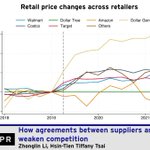
How agreements between suppliers and retailers can weaken competition
Zhonglin Li & Hsin-Tien Tiffany Tsai @NUSingapore
ow.ly/cppU5101eHH

What can hot milk, cows and crying tell us about monetary policy?
Quite a lot, according to new research discussed in one of the EP episodes of #VoxTalks Economics. Martín Uribe (@Columbia) and Nicolás Magud (@IMFNews) join host Tim Phillips to discuss the long-term effects of populist governments on central banks.
Their research examines what happens when governments lean on central banks to finance fiscal deficits. They find that the consequences can persist long after those governments have left office: central banks with a history of populism respond more aggressively when inflation rises above target.
As Nicolás puts it, there’s a saying in Spanish: “if you get burned with milk, you see a cow and you start crying.”
This was the second of four special VoxTalks Economics episodes featuring research commissioned for the 2nd Economic Policy: Papers on European and Global Issues Conference. The paper, Fiscal Populism and Monetary Policy Rules, is by Luis Jácome, Nicolás E. Magud, Samuel Pienknagura and Martín Uribe, and is forthcoming in Economic Policy.
Listen now: ow.ly/KEbR50ZGBHX
#VoxTalks #EconomicPolicy #CentralBanking #MonetaryPolicy

Private equity beyond the target: How buyouts reshape supply chains
Olivier De Jonghe @ecb @NBB_BNB_FR @NBB_BNB_NL, Cédric Huylebroek @HuylebroekC @bundesbank @LeuvenEconomics
ow.ly/b2K35101eCI

Washing away the US: Tariff evasion on the other side of the US–China trade war
Huijia Liu, Enze Xie, Linhui Yu @ZJU_China Miaojie Yu @PKU1898
ow.ly/rJmb5101eyc

Oil shocks no longer hit the US economy as they used to
Diego Känzig @drkaenzig @NUEconomics, James Stock @Harvard, Luca Zanotti @NUEconomics
ow.ly/oZKy5100T2n

Historic monetary tightening, benign output dynamics: Rising R-stars across the Atlantic
Mátyás Farkas, Zoltan Jakab, & Jesper Lindé @IMFNews
ow.ly/jyC45100SUS

Changes in the health and longevity of the elderly in the US
Liran Einav @Stanford, Amy Finkelstein @MIT
ow.ly/VuvX5100Srq

Chasing far-right does not pay for the centre-right parties: Evidence from Germany’s 2025 election
Nina Nikiforova @Unibocconi
ow.ly/Wanm5100S9q

Global imbalances, the status of the dollar, and the stability of bond markets are putting pressure on the international financial system. But are we witnessing a rupture, or a transition?
In the latest episode of #VoxTalks Economics, Valentina Bruno (@KogodBiz, CEPR) and Cédric Tille (@GVAGrad, CEPR) join Tim Phillips to discuss the findings of the 29th Geneva Report on the World Economy.
They examine why stocks, the dollar, and US Treasuries all fell following Liberation Day in April 2025, why this could happen again, and what can be done about it.
🎧 Listen to the podcast: ow.ly/VfEE5100zk8
📖 Read the 29th Geneva Report on the World Economy, Changing Structure and Challenges of the International Financial System: Imbalances, Currencies, and Financial Stability, available to download for free from CEPR: ow.ly/6Fk05100zk7
#InternationalFinance #FinancialMarkets

Crypto capture of foreign aid
Sumit Agarwal @sumit_prof @NUSingapore, Peiyi Jin @NUSingapore Eswar Prasad @EswarSPrasad @Cornell, Daniel Rabetti @NUSingapore
ow.ly/Ux3k5100oYb

The returns to viral media
Johannes Böken @warwickecon, @mirko_draca @warwickecon, @mastrorocconick @Unibo, @ariannaornaghi @thehertieschool
ow.ly/w2zk5100owc

Mind the gap: Bringing EU debt into the Stability and Growth Pact
Astrid Lemmer, Alexander Mahle, Karsten Wendorff @bundesbank
ow.ly/Ssqe50ZZYTU

Establishment-level evidence on California’s fast-food minimum wage
Vitor Melo @ArchbridgeInst @RANDCorporation, David Neumark @NeumarkEcon @UCIrvine, Liam Sigaud @WestVirginiaU, @_WagnerG_
ow.ly/gcQu50ZZYzL

Investment screening reshapes rather than shrinks foreign investment
Feicheng Wang @univgroningen, Vera Eichenauer @ETH_en
ow.ly/taSA50ZZApE

Lower capital requirements are no shortcut to European competitiveness
Suzanne Vissers & Henrik Zaunbrecher @CPBnl
ow.ly/nxsc50ZZAll

Taming original sin redux: The role of benchmark-driven flows
Serkan Arslanalp @IMFNews, Stijn Claessens @YaleSOM, Daniela Klingebiel
ow.ly/PRyr50ZZckS

What happens to innovation after Big Tech buys a startup
Florian Ederer @florianederer @BUQuestrom, Regina Seibel @ReginaSeibel4 @UofT, Timothy S. Simcoe @BUQuestrom
ow.ly/fTSM50ZZcaL

Here, there, and everywhere: Remote work and the employment of disabled and older workers in the UK
Ian Burn @LivUni, Melissa Gentry @USouthFlorida, Joanna Lahey @TAMU
ow.ly/K4rg50ZZc8C
