

Setting the standard for Bitcoin-backed loans.
New York City
Joined October 2022
- Tweets4K
- Following1.8K
- Followers7.6K
- Likes4.6K




Pinned Tweet
Last quarter we shipped the first transparent, size-based rate table in crypto lending.
Today we go further.
Arch is dropping rates platform-wide and simplifying the size-tier structure for our clients.
We now have the lowest qualified custodian rates in our industry!

Arch retweeted

What’s scarier right now: selling your BTC or getting liquidated?
Oct 28, 5 PM UTC. @knycksutherland from @ArchLending joins us to talk:
🔹 Bitcoin-backed loans
🔸 Custody without rehypothecation
🔹 Liquidation risks
RSVP
xitter.cf/i/spaces/1pKkOXlvMljKj…

Bitcoin holder buys 2 BTC for $8,000 in 2019.
Worth $160,000 today.
Tuition is due in January: $60,000.
If she sells, she has to sell about 0.875 BTC to net $60,000.
Roughly $10,000 goes to capital gains tax.
If she borrows $60,000 against her 2 BTC,
she keeps both coins and owes nothing until the loan ends.
The loan starts at 37.5% LTV and
costs about $5,700 in interest over 12 months.
Illustrative: BTC at $80,000, 15% federal long-term rate, no state tax, 9.50% (10.99% APR). Tax treatment depends on your situation, so review it with your tax professional.
You can mine Bitcoin with a volcano, cow manure, or the water heater in your basement.
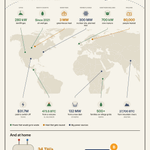
Here are 12 ways people mine it today:
First, the basics. About every 10 minutes, miners race to find the next block, and the winner earns 3.125 BTC plus fees. The main cost is electricity, so miners go where power is cheap, surplus, or wasted.
1. Geothermal power
Underground heat drives turbines. El Salvador has mined 473.5 BTC on volcano power since 2021 (as of May 2024).
2. Flare gas
Gas that oil wells would burn off runs generators instead. Exxon ran a pilot in North Dakota from 2021.
3. Landfill gas
Methane from rotting waste becomes electricity. A 280 kW pilot runs in Utah.
4. Farm biogas
A digester turns cow manure into methane, then power. A dairy farm in Northern Ireland mines with its surplus, up to 700 kW.
5. Village hydro
Miners buy spare power from small rural grids, which lowers what families pay. Example: Kenya.
6. Big hydro
Dams and mountain rivers. Ethiopia hosts 132 MW of mining. Bhutan has mined about 27,700 BTC.
7. Nuclear
A mining site wired directly to a nuclear plant in Pennsylvania, planned up to 300 MW.
8. Grid balancing
Miners switch off when the grid is strained and get paid for it. One Texas miner earned $31.7M in credits in August 2023.
9. Town heating
Almost all the power a miner uses comes out as heat. In Finland, that heat warms homes for about 80,000 people.
10. Greenhouse heating
360 miners preheat water for a tomato greenhouse in Manitoba.
11. Home water heater
A tank element with 20 mining chips heats the water while it mines. 34 TH/s, shipping Q1 2027.
12. Solo “lottery” mining
A small home device mines alone and keeps the whole reward if it wins. In July, a $150 Bitaxe beat 18,300-year odds to win a $200,000 block. Only four such wins are confirmed since 2024.
Coming next: Space.
One startup plans to mine on a satellite later this year.
However it’s mined, the schedule stays the same. New supply runs about 0.8% a year and halves in 2028.


Rome’s silver coin was 95-98% silver under Augustus.
By the 260s, it was about 5%.
That’s the pattern behind most of money’s history. Money works until someone finds a cheaper way to make more of it. Here are 2,600 years of examples:
630 BC, Lydia: The first coins, stamped from electrum, a gold and silver mix.
27 BC to AD 268, Rome: The denarius.
Emperors stretched the silver until little was left.
AD 309, Byzantium: Constantine’s gold solidus, 4.5 grams.
Its gold content held for about 700 years.
1252, Florence: The gold florin. Venice’s ducat followed in 1284.
They became the coins of trade and banking.
1637 to 1661, New England: wampum, shell beads that were slow to make by hand.
Dutch workshops with metal tools made tens of millions. It stopped being legal tender in 1661.
1870s, Yap: Rai stones, quarried hundreds of kilometers away and brought home by canoe.
Captain David O’Keefe arrived with ships and modern tools. New stones became easy to make.
1870s to 1914: The classical gold standard.
Paper notes could be swapped for gold, so gold sat in vaults and paper did the circulating.
1914: War. Governments suspended the swap.
1944 and 1971: Bretton Woods pegged currencies to the dollar, and the dollar to gold at $35 an ounce.
In 1971, the US ended the gold link. Since 1959, US M2 has grown 6.7% a year on average.
January 3, 2009: Bitcoin. The supply is capped at 21 million by code.
New supply runs about 0.8% a year and halves every four years.
Nothing new has joined this list since.
These are projections at today’s rates, so the assumptions matter.
Gold reaches 9.1x only if mine output keeps growing with the stock. At a flat 3,300 tonnes a year, it’s 3.2x.
M2’s yearly growth has ranged from below zero to above 25%. 6.7% is the 67-year average.
In 2017, Jamie Dimon called Bitcoin “a fraud.” It traded at $4,131 that day.
On Oct 19, J.P. Morgan Asset Management published its first long-term Bitcoin forecast: 10% a year over the next 10-15 years. That’s above its forecasts for U.S. stocks, private equity and gold.
Here is the record, with Bitcoin’s price on each day:
Nov 2015: “That’s going to be stopped.” $412
Sep 2017: “It’s a fraud.” $4,131
Jun 2018: “Just beware.” $7,678
Oct 2021: “I personally think that Bitcoin is worthless.” $57,485
Sep 2022: “They are decentralized Ponzi schemes.” $18,547
Jan 2023: “Bitcoin itself is a hyped-up fraud, a pet rock.” $21,087
Dec 2023: “If I was the government, I’d close it down.” $43,746
Jan 2024: “I call it the pet rock.” $42,743
Jan 2025: “Bitcoin itself has no intrinsic value.” $94,488
May 2025: “I defend your right to buy bitcoin.” $105,606
The shift started in 2025.
In May, JPMorgan said it would let clients buy Bitcoin.
In October, Bloomberg reported it would accept Bitcoin as loan collateral for institutional clients.
Then the forecast. JPMorgan’s 2027 Long-Term Capital Market Assumptions put Bitcoin’s base case at 10% a year.
Private equity: 9.8%
U.S. large-cap stocks: 7.5%
Gold: 5.5%
None of this says what Bitcoin does next year. It does show how far the conversation has moved inside JPMorgan in nine years.
Arch lends against Bitcoin, so holders can get dollars without selling. If you want to see what that looks like for your position, our team can walk you through it.


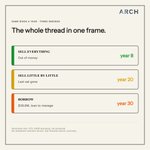
7/ The number to watch is LTV.
It starts near 12%, peaks at about 54% in year 11, and then falls every year as the price growth outruns the interest. It is 44% at year 20 and 30% at year 30.

