

Students at UC Berkeley working on academic research, ML education, industry projects, and fostering a vibrant ML community 🧠💡
Berkeley, CA
Joined December 2016
- Tweets264
- Following119
- Followers3.8K
- Likes289
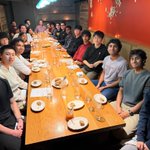


Thank you @LatchBio for hosting this dinner with us! We had a great discussion about the future of bioml with incredibly excited students (:


We were very excited to host Kevin Murphy(@sirbayes) who came back to Berkeley to speak about his work at
@GoogleDeepMind: the Model Discovery Agent, where an LLM proposes scientific models, Bayesian inference tests them, and the agent picks the most informative next experiment!


1
4
256
Chang Yun (@chang_m_yun) joined ML@B for our second BioML seminar to talk about his work in the Kundaje Lab at Stanford: ENCODE GRAMMAR, one of the largest collections of seq2func models, built to decode the grammar of regulatory DNA!
recording here! youtu.be/aTEBYdEuhss


We were also very grateful to host @PandaAshwinee who came back to Berkeley to speak about his work at @flappyairplanes: training an entire LLM in a single CUDA kernel launch, and how megakernels running training, inference, and more at once could make GPUs far more efficient!

2
6
479
Danny Reidenbach kicked off ML@B's BioML seminar series to talk about his work at @nvidia: codesigning protein sequence and structure with test-time search, and the first de novo proteins shown to bind a non-protein, polar target!
check out the recording:youtu.be/6bSJ5yWfhVU


5
307
Stephen came back to ML@B to speak about his work at Etched (@Etched ): the ASIC life cycle, how Etched is approaching chip design differently, and where AI can be applied to chip architecture and design!


3
542
see you there!!

Join us for our next BioML Seminar with Chang Yun (@chang_m_yun) from Stanford, next Monday 10/19!
He will discuss ENCODE GRAMMAR, a deep learning model resource for decoding the DNA sequence logic of regulatory elements in the human genome!
RSVP: luma.com/bioml-r5if

1
405
see you there!!
We're excited to announce the first Berkeley BioML seminar of the semester happening next Monday 10/5! Join us for a talk by Danny Reidenbach from NVIDIA on codesigning protein sequence and structure with test-time search!!
luma.com/bioml-u9eh

3
930
check out this great paper from one of our alum!!

There’s lots of buzz around agentic harnesses for robots, particularly for long horizon tasks that require complex reasoning and memory. But what will it really take to turn a reasoning agent into a reactive, reliable and low-latency robot policy?
In our new paper, workspace models, we design a new memory architecture that acts as a latent harness for stronger reasoning models. Here’s why we think this might be the way forward:
(1/9)

5
726
thank you for speaking with us!!

Couple weeks ago, @mtvnastya and I gave a talk at UC Berkeley's ML Club @BerkeleyML about decentralized AI. We discussed access to AI compute, verification of work, how Gonka approaches these problems, and open research questions students can contribute to.
youtu.be/GFxDLDQxIs8
2
402

check out this paper on block sparse attention from two of our members!

Hardware yearns for block sparse attention, yet it seems largely absent from open weight LLMs. DeepSeek developed NSA, and people speculated DeepSeek v4 would integrate it, yet it was never utilized.
We have a hypothesis as to why.
We found that replacing dense attention with NSA significantly degraded its ability on synthetic retrieval tasks, even when finetuned on them. On our 32k context benchmark, it scored 0.300 compared to dense attention’s 0.904.
We found the reason, and how to fix most of it. Introducing COBS🌽(Cumulant Order Block Sparse Attention), with @AdiGhai18 @sanjitneelam @ZVasania @tensorpro:
• Raises NSA’s 0.300 → 0.820, closing ~86% of the gap to dense
• 15.15x less KV-cache read traffic than dense (just 1.21x the NSA baseline)
• Lower position-wise NLL than dense in our comparison
The key insight: block selection is the keystone to block sparse attention, and existing methods are mathematically stuck in storing a first-order approximation of a cumulant generating function. COBS caches a compressed second cumulant and escapes this ceiling.
Details in the paper.

6
1,240
are you guilty of --dangerously-skip-permissions? check out this new intervention framework by our alum!

Deciding when to jump in and help someone—and when to hold back and let them work through it—is something humans navigate constantly. How do AI assistants handle this tradeoff?
We introduce Int-Bench, a framework for evaluating interventions during problem-solving tasks.
8
1,152
Check out this Mixture of Experts project by our member!!
You’re unable to view this post because this account owner limits who can view their posts. Learn more
7
1,005

Machine Learning at Berkeley retweeted

What if the best visual reasoning steps are ones humans can’t specify? 🤔
Existing VLM reasoning is often constrained by language, pixels, and human-designed intermediates.
We introduce Latent Implicit Visual Reasoning, where we show that VLMs can discover the best visual reasoning steps by themselves — no bboxes, no intermediate images, no extra supervision.
Presenting this week at CVPR!
(1/n)🧵
our members ran a great reading group on major architecture changes in deepseek v4!!
they covered: hyper connections + manifold hyper connections, KV cache + MQA/GQA intro, Deepseek Sparse attention (prerequisite to understanding the new CSA) & a walk through of CSA and HCA

2
7
624
join us for the last bioml seminar of this semester!!

We'll be closing out this semester's Berkeley BioML Seminar on 4/28 with a talk from @antoinekoehl on PEINT, a powerful deep learning framework for both phylogenetic inference and protein engineering. Sign up below! luma.com/3fbbftwy
