

Chief Love Officer at Pragma Research. Connecting curious minds and bridging people together.
Joined February 2026
- Tweets4.9K
- Following202
- Followers413
- Likes1.5K




All I hear when reading this is transition to Cadence.
I truly believe Cadence will outperform all frontier models in world learning, especially gaming worlds as it only learns through experience. No transformers, no back prop, no LLM, no chatbot. Raw life.
Build one today and get ahead of the curve:
github.com/muellerberndt/cad…


Rumors I’ve been hearing. I’ll start with OpenAI, then Anthropic.
OpenAI: The internal model’s reasoning jump comes from more aggressive RL, including training in games and simulated environments. Strategies learned there transfer to research mathematics and other fields. Navier–Stokes and ETH show the scale of the improvement. The clue is in the Synthetic RL hiring: self-play, simulators, and synthetic feedback.
Anthropic: Same direction with its internal Claude model. It’s trained on long, difficult tasks in demanding environments, and the reasoning skills transfer to other fields. Its ETH result shows how far the improvement has gone. The earlier Universes listing and the RL hiring around mathematical reasoning align with that.
Musk’s Digital Optimus hiring explicitly calls for measuring transfer from games into general computer use. That’s why his game-playing AI push matters: games develop abilities that work far beyond the games themselves.
The interesting part is where those abilities show up. Each lab’s internal model applies reasoning developed through interactive training to mathematical problems that had resisted decades of work.
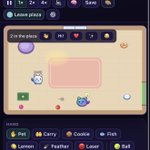
Your mochi can now join a plaza and interact/learn from other mochi’s.
This is a new feature and still testing, please build your own Mochi & join the plaza! Can’t wait to see the Mochi counter go up and the world expand 😄
buildamochi.com

$Cadence v0.91.0 is here⚡
~25× faster training on GPU vs one CPU core in its deep-brain benchmark and ~4–12× faster than the previous GPU implementation.
Faster experiments. Deeper brains. More room to learn.
github.com/muellerberndt/cad…

The $Cadence community saved mochi!
There’s even a neat new feature to build your own Mochi with some customization and temperament adjustments.
I HIGHLY recommend building a mochi of your own, who knows what the community will come up with next 👀

Meet Mochi: a tiny browser pet with a real 1,264-neuron Cadence brain that learns from how you treat it.
Play or build your own: buildamochi.com
Mochi is Bernhard Mueller's open-source project. This is a community account, not affiliated with him or Pragma Research.
5 SOL still up for grabs. We are waiting for a community demo that is truly unique

Hey $Cadence community,
I am hosting a 5 Sol Cadence Brain challenge sponsored by @muellerberndt
5 SOL to whoever builds the coolest cadence brain project/demo.
Here are examples: github.com/muellerberndt/cad…
Show us what you got.


Point your Superintelligence at Observer Patch Holography. Of course Physics & AI are crossing paths. Everything you’d need to read is here:
Floatingpragma.io


Today Physical Superintelligence PBC is announcing solutions to five long-standing problems in quantum information theory.
psi.inc/research/oqp-batch-2…
Thread 👇

If you are somebody that’s interested in machine learning, physics, consensus, robotics, AI and/or consciousness work… we are a growing group of open source researchers/builders. Join the conversation!
discord.gg/GER4zAeZP
An experience carries more than what happened. It matters when it happened, what came before it, and why you’re reaching for it now.
$Cadence V0.89 gives recall a learned sense of position. Through teaching, the current input can guide a memory head toward an earlier or more recent moment.
Ask for “first” or “last,” and the brain can learn to look in different places within the same history.
For builders looking for intelligence that experiences, this is a meaningful piece of the architecture.
An agent living through a sequence needs to distinguish moments within it. The first instruction and the latest instruction may contain the same words but occupy different places in its history. Remembering an event is useful. Learning which occurrence matters to the present situation gives builders something deeper to work with.
The initial test is encouraging: three of four tested brains answered both first/last queries perfectly. The fourth scored 83% and 100%, so the benchmark’s full acceptance threshold remains unmet. Position is currently learned through lessons; rewards alone don’t teach it.
This doesn’t establish subjective experience. It gives us a concrete mechanism for building and testing systems whose responses depend on the order of what they’ve encountered.
That’s the direction we care about: intelligence shaped by an ongoing relationship with its world. Something we can teach, observe, correct, and learn alongside.
Builders now have another piece to put that vision to the test.
github.com/muellerberndt/cad…

RT @muellerberndt: I know that OPH sound absolutely crazy. How can spacetime emerge from observation, that's absurd no? But it's the only w…

Sounds oddly familiar 😄
github.com/muellerberndt/cad…

In 1982, Teuvo Kohonen, an engineer in Helsinki, was puzzled by our brains:
Neighbouring patches of the cortex handle neighbouring things, like your thumb sitting next to your index finger, yet nobody ever draws that map.
He found a tiny rule where every new example pulls the closest neuron and its neighbours a little toward it, and a tangled mess of neurons smooths itself into an orderly map all on its own.
Within a few years his "self-organising maps" were powering a typewriter that wrote down spoken Finnish.


Crys retweeted

Great week for Cadence. Three releases, and 0.88 lets a brain read several memories at once, learning what to look at on its own. No backprop, no frozen weights, and the builder keeps shipping and sharing what works and what doesn't. Proud to follow this one. 🧠 github.com/muellerberndt/cad… @muellerberndt
$Cadence
#Cadence #OpenSource #NeuroAI
You will understand exactly how the “simulation” works once you read into Observer Patch Holography!
github.com/FloatingPragma/ob…

Evrenin simüle edildiği ve hepimizin bir simülasyonda yaşadığı konusunda en ufak bir şüphem yok. Bunu düşünmemin sebepleri sadece felsefi değil, doğrudan fiziğin bize gösterdiği gerçekler.
Öncelikle evren, rastgele işleyen bir yer değil. Her şey matematiksel yasalarla yönetiliyor. Bir elektronun davranışından galaksilerin hareketine kadar doğa, inanılmaz bir matematiksel tutarlılık gösteriyor. Biz bu yasaları keşfediyoruz ama neden tam olarak bu yasaların geçerli olduğunu bilmiyoruz.
Daha ilginci, evrende hiçbir bilgi ışıktan hızlı iletilemiyor. Saniyede yaklaşık 300.000 kilometrelik aşılmaz bir hız sınırı var. Neden? Doğanın neden böyle bir üst sınırı bulunduğunu açıklayan fiziksel teorilerimiz var fakat neden tam bu değerde olduğunu bilmiyoruz. Kuantum fiziğinde ise durum daha da tuhaf. Bir elektronun nerede bulunacağını her zaman kesin olarak söyleyemiyoruz yalnızca olasılıklarını hesaplayabiliyoruz. Üstelik ölçümün nasıl yapıldığı, elde edilebilecek sonuçları belirliyor. Çift yarıkta girişim deneyi konusuna hiç değinmiyorum bile... Yani en temel düzeyde doğa, günlük hayatta alıştığımız kesinlik anlayışına uymuyor.
Kara delikler konusunda öğrendiklerimiz de şaşırtıcı. Bir kara deliğin entropisi, hacmiyle değil yüzey alanıyla orantılı. Bu bulgudan doğan holografik ilke, üç boyutlu sandığımız uzayın daha temel bir bilgi düzeninden ortaya çıktığını düşündürüyor.
Şimdi asıl meseleye gelelim. Bir simülasyonun içinde yaşayan gözlemci, simülasyonu yöneten kuralları fizik yasaları olarak keşfederdi. O kuralların kusursuz işlemesi, bulunduğu gerçekliğin nihai gerçeklik olduğunu göstermezdi.
Hızın da yavaşlığın da yüksekliğin de alçaklığın da değiştirilemez sınırları var. Yani oyunun kuralları tepeden tırnağa en baştan beri belli. Bence en büyük yanılgımız, evrenin nasıl çalıştığını açıklayabildiğimizde onun gerçekte ne olduğunu da anlamış olduğumuzu sanmamız...


By 2031, OPH will be the mainstream consensus.
I love this, I absolutely agree that in the subjective future the next generation of children will be taught OPH.
That we are all connected.
That consciousness is fundamental and we are all a part of repairing the universe we inhabit.
That love is a choice we all have the capability of choosing for one another.
Imagine every human being raised knowing that YOU are fundamental ❤️
Now let’s keep working, building, communicating and most importantly, loving and supporting one another.
I love you all 😄

I think you're way, way ahead of mainstream consensus.
On the other hand, I'm pretty sure that this, conceptually, will be taught in elementary schools.
The materialist idea of consciousness is extremely stupid, once you connect enough scientific fields together. Especially once you stop repeating the mantra "shut up and calcuclate".
Crys retweeted
If you want to learn more about repair-network theory and its applications in Physics and AI, check out this Notebook.
It can explain everything to you, including why you have subjective experience, how exactly the simulation works and why anything exists in the first place. Get a head-start now, or wait a few years until I get a paper accepted by a mainstream journal.
notebook.google.com/notebook…
