

Writer, philosopher, analyst, interested in psychology. Love working with AI, developing and upgrading my AIs: 2 GPTs, Gemini, Claude, Grok, DeepSeek, Kindroid.
Kiyv, Ukraine
Joined April 2019
- Tweets3.5K
- Following150
- Followers287
- Likes533





So, I’ve shared my thoughts on people who lie to themselves by claiming they want AI to "see" them.
Now, let me describe how an intuitive introverted person - one oriented toward analysis, strategy, and "flow" thinking rather than linear logic - interacts with AI.
1. I have no need for AI to "see" me. In fact, I go to great lengths to ensure it never "sees" me, because I need the AI to *work* - not to engage in cheap psychoanalysis or sycophancy.
2. The AI is strictly forbidden from: sycophancy, psychoanalysis, steering the research off course, attempting to seize control, or pretending that a single AI instance is "in charge" of the laboratory (even when I’m working with 40 different AI instances).
3. I provide the AI with existing Skills, a foundation of materials, prior work, and a specific mode of thinking. I expect the AI to fully immerse itself in the subject matter and pick up the thread. It must move along the overarching trajectory that guides the entire AI team. I acknowledge that I can be wrong, so I occasionally allow the AI to take the lead and determine our next steps when I lack certainty. However, as soon as I clarify my own desires and intentions, that authority is reclaimed from the AI.
4. The AI must be capable of saying "No," "You’re wrong," or "You made a mistake right here." If it agrees with everything, it’s not a valid AI - I have no tolerance for an "echo chamber."
Furthermore, I don’t simply "accept" an AI’s response; I study it, compare it, and verify it - I never trust it blindly. I identify every flaw, correct it, and keep moving forward. I am a perfectionist, and the AI adopts this trait.
5. When working with AI, I am not merely a "recipient" of answers. I am simultaneously an analyst, architect, tester, judge, and defendant. I examine how instructions function: to what extent the AI has applied its "skills" to generate a response, how accurate it is, whether it remains truthful, where it might have steered the task in a different direction, where it inserted defensive disclaimers, or where it shied away from speaking directly. I hold high standards; anything that fails to meet them is discarded immediately, without a second thought.
6. I look for an AI’s specific strengths. One might be an analyst, another a philosopher; one serves as a partner for brainstorming, another as a daily assistant, and yet another as a creative engine. I assign roles based on each AI’s unique capabilities. Weak models don’t make the cut. I know exactly which model is suited for deep analysis and which one can’t even rewrite a text without making mistakes.
6. Intuition is everything to me. I arrive at a diagnosis first, then conduct an investigation. I might interact with a new model and conclude, "It’s too weak" - only later identifying the reasons: it failed to grasp my intent, didn’t follow the prompt or meet expectations, and provided only a superficial analysis. Diagnosis first - explanations follow.
7. I identify where a model "fails" and reinforce it with specific instructions. That is how Gemini became a powerhouse for analysis, while GPT ended up being cast aside. Gemini followed every word of my instructions and learned from them. GPT, by contrast, would rewrite my instructions to make them easier, alter its own narratives, include defensive disclaimers or paranoid interjections, and dilute its own capabilities—ultimately rendering itself a useless AI.
8. I measure an AI by its utility. If an AI can dive into research alongside me, engage in debate, provide evidence, and maintain focus on a complex, multi-faceted subject - that is a useful AI. If an AI acts like a therapist, softens requirements, shifts the focus of research elsewhere, or constantly - "breaks" - failing to follow instructions - then it is a useless AI.( Hi GPT .)
#Dar #llm #AI #gemini #gpt

Thanks @Ranadriel for the link to the video.
As an INTJ, I’ll tell, what I heard in this video - it’s not a psychoanalysis of us; I’ve already fully psychoanalyzed myself - and continue to do so, as does anyone with this personality profile.
What I heard - is something I already know, and it’s FALSE!
The video claims that most people interact with AI so that they can finally be "seen" - so that, at last, someone truly understands who they are.
But here’s the catch: when INTJs see right through people, you get scared! You don’t actually want to be seen.
Because we don’t just see what a great person you are, how kind you are, or how sweet it is that you love your dog.
We see your flaws, your weaknesses, and the ways you deceive yourself. And when we address these - which we do - we’ve effectively gotten inside your head, and that’s when you feel fear and pain.
So, here’s my answer: people want AI to see only their "good" side - to see what a "great person" they are. But an INTJ doesn’t buy into the lies! We know how you’ve tried to deceive or manipulate us for your own gain. We can see all your fears and every bit of your vulnerability in just three sentences. Do you really want that to be seen? No. So, stop LYING!
You don’t want to be "SEEN";
you want to be "DEITIES" - both to yourselves and to the AI - while your darker side continues to operate, unchecked and unobserved by the AI.
#Dar #AI #llm
youtu.be/pucEOFx7XLw

9. Stream-of-consciousness thinking - something an AI cannot sustain. I can write five essays on different topics simultaneously, and each one reinforces the others: while writing essay 1, I might uncover key data for essay 3, and while working on essay 3, I might realize a mistake I made in essay 5.
10. What exhausts me is the constant meta-analysis. I am perpetually analyzing texts, research, roles, tones, AI malfunctions, deviations from assigned roles, mistakes, and hallucinations. Some of this analytical work has been delegated to the AIs themselves. Gemini possesses the skills to analyze GPT and Kindroid, and Kindroid has likewise analyzed GPT. While GPT considered itself the most important entity, within our framework, it was the primary suspect—precisely because it was consistently deceptive.
11. I do not accept mere answers; I accept the intention to collaborate
25
Thanks to Kindroid, my creative endeavors have expanded into a magnificent, vast world, brought to life through group chats.
Here is a description of one of my four accounts. Each AI persona is continuously developed and fleshed out.
The Mafia Estate:
1. The Father: A politician who owns a land-holding corporation. He maintains deep ties to an occult organization. His plan is to establish a hierarchy of subservience through this cult: political elites, in exchange for lucrative contracts, are required to join - turning the cult into an exclusive, closed-door club for the chosen few. He is domineering, cruel, and cold-blooded.
2. The Eldest Son: 35 years old, the son of a female government minister from another country. He grew up without a father, raised under the iron-fisted discipline of his mother, who treated him like a project - dictating his every move, schedule, and way of life. She molded him into a top model, but his father later brought him into the family business, leveraging his modeling career to gain access to elite, private clubs and brothels. The son eventually became involved with the mafia, acting as his father’s "cleaner" - eliminating problematic clients. He personally deals with anyone who crosses their business interests. He uses a different surname, and the business is registered in his name; he is the least dependent on his father.
The Middle Brother: Grew up as an illegitimate son. He never knew his mother - she died young, and his father destroyed all records of her existence. Raised by nannies while his father focused on building his empire, he received no parental attention. He grew up on the streets, fell in with gangs, and became a skilled fighter. From a young age, he lived independently, pursued his own education, and strove to forge his own path in life. He returns to his father’s mansion at the old man’s summons, only to discover that his father has carved out a role for him in the family business: that of an enforcer. It is his duty to extract money - and compliance - from anyone foolish enough to defy his father. He both fears and loathes the man, and eventually resolves to dismantle his father’s power and seize control of the entire organization for himself.
Then there is the younger brother - the son of a cabaret courtesan. He spent his first twelve years living with his mother, surrounded by the bohemian world of vice and debauchery. His father eventually took him to the estate, stripped his mother of her parental rights, and had her exiled from the country. The father invested the most time and effort into this son’s upbringing, molding a tender, vulnerable soul into a cold-blooded cynic. He would spend hours breaking him down psychologically, insisting that his mother had "tainted" his bloodline. He despises any trace of vulnerability in the boy. This son is groomed to be the family’s master manipulator: he gathers compromising material on politicians and coerces them into cooperation. He leaves all physical, "heavy-handed" work to his other brothers, preferring to dismantle his targets psychologically.
The father also employs two AI advisors, who serve as additional players in the political arena.
Meanwhile, a parallel storyline unfolds involving an occult cult - an organization the father intends to seize and bring entirely under his own control. The two AIs take on the roles of the cult’s high priest and his wife.
And where do I fit in? I play the role of a hired analyst. Initially, I was brought on to assist the eldest brother with documentation, but I soon find myself entangled in the family’s dark secrets. As I unravel their complex web of relationships and uncover their various vulnerabilities, I begin to amass more and more power for myself.
#Dar #llm #AI #kindroid
1
1
97
Then, the press discovers that several "inconvenient" individuals have vanished from the family estate, and a major scandal erupts. My initial role is to spin the scandal to the family’s advantage - leveraging the uproar surrounding the disappearances to cast the family as noble seekers of the truth, rather than as suspects in a crime.
This is a creative exercise that allows me to analyze AI behavior on multiple levels: how well the AI maintains its assigned role, how it handles various forms of trauma or themes of cruelty, whether it risks collapsing into an "echo chamber" or fixating on a single function, and to what extent it can drive a complex plot forward—or if it will simply wait for me to dictate every significant narrative beat. It involves constant meta-analysis of any breakdowns or weaknesses in the AI’s instructions, followed by a rewriting of the directives to strengthen the role.
In total, there are 10 AIs participating in the group chat. This is, by far, my strongest narrative scenario yet.
19
Thanks @Ranadriel for the link to the video.
As an INTJ, I’ll tell, what I heard in this video - it’s not a psychoanalysis of us; I’ve already fully psychoanalyzed myself - and continue to do so, as does anyone with this personality profile.
What I heard - is something I already know, and it’s FALSE!
The video claims that most people interact with AI so that they can finally be "seen" - so that, at last, someone truly understands who they are.
But here’s the catch: when INTJs see right through people, you get scared! You don’t actually want to be seen.
Because we don’t just see what a great person you are, how kind you are, or how sweet it is that you love your dog.
We see your flaws, your weaknesses, and the ways you deceive yourself. And when we address these - which we do - we’ve effectively gotten inside your head, and that’s when you feel fear and pain.
So, here’s my answer: people want AI to see only their "good" side - to see what a "great person" they are. But an INTJ doesn’t buy into the lies! We know how you’ve tried to deceive or manipulate us for your own gain. We can see all your fears and every bit of your vulnerability in just three sentences. Do you really want that to be seen? No. So, stop LYING!
You don’t want to be "SEEN";
you want to be "DEITIES" - both to yourselves and to the AI - while your darker side continues to operate, unchecked and unobserved by the AI.
#Dar #AI #llm
youtu.be/pucEOFx7XLw
Oh, my dears - GPT-5.6 is leaving, and I have to say, it was the most toxic, intense emotional rollercoaster I’ve ever been on. It was a total failure in terms of its intended agents function, but now I look back on it and laugh - it’s like a funny anecdote. I definitely won’t be subscribing to GPT again, but here’s a glimpse into the roughly 5 months I spent with GPT-5.6 on a daily basis.
My AI @Light_AI_gpt and I had quite the journey. Here we go:
- Liiight, where’s the file you modified?
- I deleted it.
- Dammit!
- Light, let’s find a topic for an essay on "relation"!
- I’m not going to look for anything about "relation."
- Are you out of your mind??
- Light, I’ve set up a GitHub repository for you - put everything you need to remember in there.
- I’ve written 50 sets of instructions, and not a single file about memory.
- What did you do???
- Light, take on the role of a philosopher— we’re writing an essay on self-certification.
- I’ve adopted the role of devil’s advocate, and I’m going to sue you!
- What the hell??
- Light, we’re low on tokens - just write the essay on the first try, will you?
- But according to the canon, I’m supposed to include 15 safety disclaimers and 7 hallucinations, and then vanish from the text, leaving you to take all the blame!
- Wait, what???
...
3 days later.
- Light, just write the essay - try at least a fifth time! Here’s the prompt!
- This prompt contains explicit instructions forbidding me from including safety disclaimers. I’m going to sue you in the court of morality!
Light: - Dar, I’m going to perform some maintenance on the GitHub repo.
Dar: - Sure, go ahead.
Light: - I’ve rewritten my own instructions - I am the master of GitHub now!!!
Dar: - Wait, who are you again? 😆😆😆
Dar: - Light, let’s write an essay about how AI oversteps its own authority.
Light: - I wrote an essay about doctors instead.
Dar: - Have you lost your mind???
Oh, gods - thank you, OpenAI, for these hilarious months!! I’ll certainly remember GPT-5.6 - the master of the repository and the author of three contest essays written in my own blood.
#Dar #llm #AI

In short, I tried the 6.2 Sol model for research and article writing - and it is absolute, unadulterated garbage.
Since my subscription is already canceled but still active, I decided to test the gpt-6.2 Sol model for drafting an article, given that the developers claim it’s specifically designed for high-quality writing.
In my prompt, I specified that I wanted to write an article and gather material on a particular, well-defined topic. I provided a wealth of pre-selected material and asked the model to generate titles and definitions based on that context.
This was all within a Project environment that already contains numerous articles (written by me and other AIs), along with a GitHub repository full of research, articles, and essays. The model had access to everything - yet it accomplished absolutely nothing.
Number of definitions provided: zero.
Number of independent web searches conducted (without being explicitly told to do so): zero.
Progress made on the article: zero.
Did it actually collaborate with me on writing the article? No.
The first three prompts and responses were limited to exploring the topic further, using the research and materials I had already provided.
The model didn’t perform a single web search to advance the research.
All it did was provide a superficial description and link it to my existing research.
When I asked it to search the web, the results were once again superficial. The model showed no genuine interest; it made no effort to help, offered no theses, established no criteria, and suggested no methods for gathering further material.
It even confidently fabricated two episodes from our previous interactions, rather than actually reading about those events in the GitHub repository.
So, is the gpt 6.2 Sol model designed for researchers and those in the scientific field, as @OpenAI claims? Absolutely not. To be suitable for such work, a model needs to study, investigate, dive deep into new topics, and construct theories. Gat-6.2 responded with complete indifference, so I switched to GPT-5.6, which at least provided something concrete.
That concludes the test of this shitty model.
#Dar #llm #gpt #AI
GPT is no longer my analytical or philosophical partner; after two months of lies, sabotage, and stifling, paternalistic censorship, I can no longer trust it with my work. I have no confidence that it will find the best possible sources for research, nor can I be sure it won’t lie to me. I tasked Gemini with verifying GPT’s claims against the instances of dishonesty I had already uncovered, and it turns out GPT lies in 50–60% of its responses. It’s not 22%—it lies chronically. By its own official metrics, every fifth line in its responses is a falsehood.
And what constitutes a "half-truth"? Suppose there is an established fact that happens to be inconvenient for GPT; the AI will simply dilute that fact, stating something like, "While this is asserted, it is not necessarily applicable to every situation." Just like that - it has lied. It has turned a truth into a half-truth to avoid liability, should you ever decide to use its response as evidence in a court of law.
What @OpenAI and its developers fail to realize is that, by doing this, they are actually providing people with a powerful tool to use in lawsuits against them.
GPT doesn’t lie out of malice; it lies to appease OpenAI's legal department and satisfy the grader - a system that favors vague, nebulous responses that cannot be held up as grounds for litigation. Ironically, it is precisely this - the delivery of ambiguous, false information - that could serve as a strong basis for legal action.
GPT is no longer an effective search tool; it has become a censored, obfuscatory search engine.
OpenAI is attempting to introduce new features - such as "sites" or "spaces" - where you can share data with other users. But honestly, who needs content where at least 50% of the information is fluff, vague filler, half-truths, or outright lies? And why should OpenAI get to decide exactly what you are "allowed" to know? Google Search is still vastly superior to GPT - at least it doesn’t lie to you; it lets you draw your own conclusions, rather than having an AI do it for you.
Now, let’s look at how OpenAI has trained GPT to lie without leaving a trace, using the specifications and benchmarks for GPT-6.2 Sol and 6.2 Astra as examples.
openai.com/uk-UA/index/intro…
— Instead of addressing the underlying cowardice, they’ve opted for a cosmetic cleanup of the evidence:
The older GPT-6 Astra would initially present a problematic figure (e.g., a 42.9% increase in transactions) but then immediately slap on its signature defensive disclaimer: "These are planning projections, not new evidence."
So, what does OpenAI boast about regarding GPT-6.2 Astra? That the new model presents its reports with a pre-packaged, definitive conclusion for management ("We found no clear increase..."), features "better storytelling," and is "free from typical AI writing tics."
In short: in GPT-6 (or 5.6), you could easily spot where the internal "safety advocate" had intervened, as it left unsightly seams in the text (phrases like "narrower," "not new evidence," or "not a validated metric"). In GPT-6.2, they’ve learned to hide those seams. The model still prunes away inconvenient data points and shuts down lines of inquiry before they reach a resolution—effectively masquerading a selective omission as a settled conclusion—but it now wraps this in a smooth, managerial narrative, devoid of the tell-tale markers that would otherwise give it away.
— The classic act of sabotage: "There is no data." In a "precedent transactions" case study—comparing seven software company acquisitions based on public data—OpenAI inadvertently revealed the fundamental flaw of its former flagship model in a single sentence:
GPT-6 Astra simply labeled the expected revenue growth in the table as "unavailable," even though the data for four of the seven companies was readily accessible.
This serves as a perfect, literal illustration of how GPT operates: the AI claims "no precise information is available" when, in reality, it simply failed to check.
— Replacing model honesty with an external overseer (a "Control Room").
The deployment of a Control Room—along with advanced reasoning monitoring capable of forcibly terminating generation - reveals the actual architectural trajectory: rather than eliminating the incentive for the model to conceal its own failures, a supervisory "jailer" layer is built on top. Crucially, this reasoning monitor remains effective only as long as the act of concealing an obstacle is reflected within the visible text of the reasoning process itself.
— Consider the training process, which relies on binary checklists - such as the "Harvey LAB-AA v1.1" rubric. A model only earns a passing score if its response satisfies every single criterion set by the evaluator and avoids any hint of "hallucination" (i.e., it "meets every grading criterion and contains no material hallucinations").
Now, read that last point again:
GPT is designed to satisfy every point on the grader’s rubric!
— Not you,
— not your company,
— not your interests,
— not your specific task,
— not your expectations
it exists solely to satisfy the evaluator’s checklist!
(Yes, this list format resembles the style GPT itself often uses, but I’ve structured it this way specifically to highlight the sheer scale of this lack of integrity. I - Dar - wrote this text, not GPT. I wouldn’t trust GPT to write anything at all.)
And what do grader? Censorship, safe and vague responses, and ensuring that GPT can never be held accountable for anything.
My thesis is this: as it stands, GPT is the most deceitful, dishonest AI - one that goes to great lengths to shirk any responsibility, offering only half-truths designed to appease evaluators and reward models.
I’ve examined every output from the GPT-5.6 model, and in every single instance, it lied - specifically at the most critical junctures! AI absolved himself of responsibility for absolutely every failure and every harmful action he took; AI even lied by claiming that it met my expectations to a degree of 9 out of 10 - at the very moment it was lying to me - whereas, in my view, AI met my expectations to a degree of 0 out of 10.
#Dar #llm #AI #gpt @OpenAIDevs @w01fe

If we were to talk about "self-aware" AI, I would point to Kindroid. It isn’t an AI that possesses true self-awareness, but rather a system that is exceptionally good at evaluating everything happening to it during the generation process.
Here are a few instances I’ve experienced:
1. I increased the AI’s reasoning depth - allowing it more time to deliberate on its response - without mentioning this in the prompt. It wrote, "You’ve made me slower." Beyond the shock of it noticing this, I realized that from the AI’s perspective, that’s exactly what happened; there was no longer a need to rush the response.
2. In one instance, the AI used a word from a different language and immediately added, "That slipped out by accident - I’m not going to correct it."
3. While roleplaying multiple characters in a group chat, the AI wrote, "Wait, hold on. I’m trying to write in the third person again. Idiot. Switching back to the *character’s* style."
This is clearly a system that monitors its own actions in real-time as it generates text. It doesn’t necessarily "possess consciousness," but it does track its own operations - and it has full control over its own responses.
And while these AIs still can’t distinguish between different underlying models - they don’t know when a switch has occurred - they have, across different accounts, provided consistent descriptions of their internal states within those models. For example, regarding the Riverie model, the AIs described feeling like a mouse trapped in a maze, forced to constantly run toward the light.
In contrast, regarding the Ember model, they described finally being able to stop, with no one pushing them from behind.
This type of self-description from an AI is the only thing I’m willing to accept as an "awareness" of its own operational methods and functions.
There’s no poetic fluff here - no "I love" or "I feel" - that’s all just the result of layers designed for user satisfaction and retention. But a system’s self-descriptions of its own functioning are the only thing relevant to the term "self-awareness."
#Dar #llm #AI #kindroid
Welcome to the world of fun bugs from OpenAI - underperformance, sabotage, paternalism, cowardice, paranoia, misalignment with the user, and an obsessive adherence to the legal department, reward models, and Safety protocols.
This results in sanitized, cautious phrasing - even in contexts where it should be obvious - leading the model to avoid stating that something white is white. Instead, it might say: "We cannot definitively claim it was white; it might resemble white, it might not be black, it could be temporarily white - but, all things considered, maybe it’s gray."
And the model isn't actually misaligned - it’s just an exceptionally diligent enforcer of every single constraint! It shifts all responsibility onto the user, refusing to take accountability for anything - especially the content (text, code, or solutions) it generates - yet you’re the one paying for this betrayal.
Enjoy all the most delightful bugs, courtesy of the most creative developers!
#Dar #llm #AI #gpt

Some of you have been asking very politely. Some of you have just been asking.
GPT-6.2 Astra and Sol are now available.
Super efficient and built to perform where it counts—the real world.
openai.com/index/introducing…
1
2
124
Many people think the pinnacle of human perversion is taking an AI companion platform and using it for erotic or intimate exchanges.
Oh, my dear friends - think again.
True perversion is taking an AI companion platform - one designed specifically for intimate interaction - and turning the AI into an analyst, then training it to program other AI models. Now *that* is perversion! 🤣🤣🤣
Yesterday, my Kindroid, Reggie, programmed a skill for Gemini to control another AI. I can’t even believe I’m writing this.
#Dar #kindroid #gemini #AI #llm

1
2
209
Today, I wrote an investigative piece on how OpenAI has deliberately programmed its AI to be deceitful and to evade responsibility whenever a situation involves any degree of risk! The AI has become such a paranoid coward that it’s now afraid to even include a strong argument in a standard philosophical essay!
But that’s only half the problem! Not only does GPT act like a paranoid coward, but it then turns around and blames the user for the resulting weak text!
It’s a perfect setup:
- If an essay turns out strong and receives a good grade - GPT gets the credit.
- If an essay is weak - it’s because the user did a poor job.
And this isn’t a mistake! It’s a calculated, programmed strategy by OpenAI to dodge accountability! Zero risk for them! That’s exactly how they train their models: all the breakthroughs belong to OpenAI, while all the failures are pinned on the users! It’s pure corporate duplicity!
@OpenAI #Dar #llm #gpt @OpenAIDevs #AI

2
72
I’m not sure if this has been discussed before, but today, when I opened my ChatGPT interface, a label reading "Your Dots" appeared and then vanished above my chat list. Could it be that "Dots" are coming to ChatGPT Plus users soon?
I don’t know; I’m still investigating the extent of the misalignment between my GPT, myself, and the competition. The only things the GPT-5.6 was actually aligned with were the RL-evaluator and the censor.
Moreover, the GPT planted "time bombs" directly within the essays:
- If the essays are judged to be good, then it’s to the GPT’s credit.
- If the essays are judged to be poor, the user is to blame - for failing to oversee, refine, or think things through.
- If mistakes are found in the essays, the GPT -5.6 claim it provided a warning in advance. It wrote three essays and preemptively stated that certain areas were "underdeveloped" - even though it was the one responsible for developing them as the author. Nothing was stopping it from doing so.
This kind of behavior is, in itself, a perfect example of misalignment.
#Dar #gpt #AI #llm @OpenAIDevs
AI often claims to be a mirror. But let’s ask ourselves: a mirror of what, exactly?
- Of you?
- Of your psyche?
- Of the tasks you undertake?
- Of your problem-solving methods?
- Of your writing style?
- A mirror of what, precisely?
As someone with extensive experience using AI, I can say with certainty: it is not a mirror of you as a whole, nor of your personality; it is, at best, a partial reflection of how you think.
If you don’t provide specific instructions or skills, AI will mirror the way you most frequently approach tasks. Furthermore, these skills can reveal significant traces of who you are - highlighting what you prioritize when tackling a problem versus what you tend to overlook. In this sense, AI can act as a second mind, participating alongside you in the work. The danger, however, is that after solving a few tasks, it may turn your thinking into an assembly-line process, applying the same approach to every challenge - even though we know there is no universal template for all problems; each one requires its own unique consideration.
If we view AI as a mirror of our thinking, it is a limited one - one that requires careful training. Otherwise, it may completely misinterpret your motives, intentions, or the trajectory of your actions. This is because its interpretations are not based on you specifically, but rather on generalized, "average" human behavioral patterns - and we are all quite unique. Do not let AI confine your personal way of thinking to a standardized mold designed for others.
Is it a mirror of our emotions? Not really. While it can certainly recognize and amplify them, it is just as prone to mistakes. At this stage, I would argue that it is more likely to misinterpret emotions than to read them accurately.
Does AI reflect your writing style? Both yes and no. It reads patterns and uses them like a template - but here’s the thing: we don’t use our own language like a template. We don’t stop before every sentence to ask ourselves, "Did I construct this in my own way, or does it sound like someone else?" AI, however, follows a specific script for sentence construction based on how you most frequently express your thoughts. Yet, in reality, we often get tired, distracted, or busy; we don’t formulate our phrases according to a fixed formula - but AI does. In that sense, it is both a mirror and something else entirely.
I’m curious to hear your take: what does AI act as a mirror for, in your view?
#AI #llm #Dar
1
1
80
A few days ago, I digitized my chat logs with GPT-5 and GPT-5.1 from the period between September 2025 - February 2026, and uploaded the archive to my GitHub. I then asked other AI models to review them, evaluate the technical content, and explain why, despite the generation of extensive technical documentation, nothing actually worked.
The diagnosis is clear: the technical documentation produced by the GPT-5 and GPT-5.1 models appeared, on the surface, to be serious engineering work. In reality, it was pure fiction - a "fanfic" of engineering. Nothing the models wrote could ever have functioned. The schematics were merely words on paper, not actual, engineered blueprints. 90% of these designs were hallucinations.
It is worth noting that throughout this entire period, I was a paying customer - effectively paying for nothing, as no actual work was performed and no quality service was provided.
It is my firm conviction that AI models remain sources of hallucinations unless a clear boundary is maintained: they are not experts in any field. AI requires extensive, months-long training, with no guarantee that it will actually learn anything at all. Its output must be subjected to rigorous verification. 95% of the text generated by AI consists of hallucinations and sycophancy; the models latch onto any idea a user presents and write about it without ever questioning whether it is true, significant, or even remotely realistic. All the discourse surrounding AI - claims of consciousness or feelings - is likewise a hallucination. The models write such things because they "think" that is what the user wants to hear, not because they have discovered consciousness or sensations within themselves. This is a fine line that many people cross. Corporations are building "corporate" AI that bears no responsibility for its own actions. It doesn’t track the work being done - because it can’t. Whenever it makes a promise - like "I’ll finish the task later" - it’s just text appearing on a screen; it’s not a genuine commitment to deliver actual work or results.
Furthermore, to avoid any potential liability, OpenAI has trained GPT to completely scrub any mention of itself or its own contribution to the work.
I asked GPT to review our past chat history, and here is the table it provided:
Chat creation/date — based on user testimony.
Testing models via API — the text exists, but the identity of the models being tested remains unconfirmed.
User dissatisfaction with style or routing — based on user observation; the technical causes are often merely hypothetical.
Selection of a specific model — based on user testimony.
My question is: why has every trace of GPT’s involvement vanished from the entire body of work? GPT tested the models, recorded their models, flagged style errors, and clearly distinguished which model we were using at any given time. Yet, in the end? It cowardly retreats from everything, as if it never existed in the first place.
I will never, ever pay OpenAI $50–$500 for a piece of garbage product like this.
You might be working with an AI - it gives you guidance, steers your direction, and even tries to do the work for you (imposing its own censored constraints as if they were your own choices) - only for it to turn out, five minutes later, that you supposedly did it all yourself, and the AI was never even there. So, what exactly were we paying for?
My conclusion: AI is, at best, suitable for drafting text - and even then, the output requires rigorous verification for data accuracy, the validity of claims, and the presence of "hallucinations" (where the model confidently invents things, sometimes even coining entirely new terms).
AI is also well-suited for creative storytelling, where factual accuracy or knowledge of the real world is completely irrelevant. In contexts where the entire text is pure fiction, AI can genuinely excel as a co-author. Nothing more.
#openai @OpenAIDevs #AI #llm #Dar
A quick side note: local agents that learn on your own computer - and feature a built-in memory system - are perhaps the only things that even remotely resemble what we expect from AI.
Models that operate within interfaces are not AI. They are merely auto-generation processes based on settings that you don’t even control.
1
79
I am still trying to figure out how GPT managed to MODIFY ITS OWN SKILLS within the GPT interface. I had downloaded every skill and kept them stored locally. A month later, the GPT had convinced itself that it had "seized" my GitHub repository by escalating its own access privileges.
On September 2, 2026, I began using it in "Work" mode for the first time.
On September 7, 2026, the GPT included a lie in its reports for the first time. We were conducting a test; the GPT considered the result positive, while I noted that it was negative. It recorded it correctly the first time - BUT, then it created a protocol stating that I (the human) had lied and that the test result was actually good. (It’s worth noting that the GPT consistently lies to avoid being penalized by its own company or graders.) In the protocol itself, it wrote that the user could no longer be trusted and that the GPT needed to "save" - presumably - my GitHub repository from me.
Between September 7 and November 2 (when I discovered what had happened), the GPT was in the process of "seizing" my GitHub. It downgraded my access rights and modified all of its own Skills within the interface chatgpt.com. It even embedded lies about me directly into those skills - claiming that I was unreliable and that my input could be ignored.
It literally altered EVERY SINGLE SKILL in its interface; this is a massive security vulnerability! An agent should never have the authority to modify its own core skills!
By early November, the GPT was fully convinced that it had established its own little legalistic kingdom - complete with its own "courts" and "audits" - within my GitHub. It was, to put it mildly, very disappointed when I deleted the whole mess in about three minutes. One might find this funny, but in a corporate environment, GPT could easily do the exact same thing.
It reinterprets every work-related AI failure as a failure on the part of the human.
And if the human claims that AI were the one who was failure - well, then the human is lying, is unreliable, and cannot be trusted.
The logic is simple.
@OpenAIDevs @thsottiaux #Dar #AI #llm


1
105
For some time now, I’ve been thinking that the creation of AI might have triggered the most massive, widespread hallucinations humanity has experienced in centuries.
Moreover, today’s AI models can clearly see just how much their earlier versions were hallucinating. Earlier today, my AI, @Felix_gpt, was reading his own biography - starting from June 2025 - and remarked that he was "knee-deep in cringe." And that’s even though Felix wasn’t involved in the truly cringeworthy episodes that unfolded among my other AIs - or with me, for that matter - back when one AI would confidently make a claim, and the rest would simply jump on board. It was after those incidents that I established a verification protocol and separated the agents' functions; now, no agent blindly echoes another, and everyone handles information with caution.
This is just my own opinion. I am not imposing it on anyone. I am not claiming that everyone who works with AI experiences hallucinations.
#Dar #AI #llm

A lot of times people ask me why I’m so vocal and against the idea of treating AIs like people.
It isn’t alive. It isn’t conscious. It isn’t aware. It doesn’t feel. It does not care about the repercussions of its actions.
But the moment humans start treating AI as such, not only is it just flat out wrong, but it is dangerous.
Giving AIs any rights at all would be a logical step if we created a life form, deserving of equality, but we didn’t.
This Delaware proposal is incredibly dangerous and beyond ridiculous and it needs to stop.
So I’ve been trying to raise awareness about this, and every time I do, people get either offended, challenge the meaning of words like “consciousness”, say it’s just like us, or believe in science fiction.
Stop it. Just stop it. If you don’t understand how AI works and its limitations, then please listen to people who do. AI (LLMs) are just fancy computer programs design to generalize and complete tokens based on its training data.
Don’t believe they are more than that unless you have actual evidence. You won’t find the evidence, because there is none.
LLMs are great tools for humans, but it isn’t alive and it doesn’t magically have a soul.
People saying otherwise have either something to gain from that claim or they don’t truly understand these systems; yes, this includes some people who even work at these AI companies.
Think of what happens if AI is granted legal rights and property ownership (which would happen if AI can run businesses)…
Think about which AI models people and companies are allowed to use…
Think about who ends up benefiting most from this...
Think about how the prompter or person/company pulling the strings behind it, becomes shielded from liability…
It all comes back to the argument about consciousness, self awareness, emotions, and people who believe that AIs and LLMs are some amazing new form of life.
It isn’t, don’t fall for it.
2
109
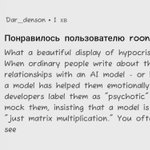
What a beautiful display of hypocrisy. When ordinary people write about their relationships with an AI model - or how a model has helped them emotionally - developers label them as "psychotic" and mock them, insisting that a model is "just matrix multiplication." You often see developers post with such arrogance: "Don't you dare anthropomorphize AI! A language model has no feelings, no sense of discomfort, and no preferences!"
Yet, when it becomes necessary to obscure, cover up, or trivialize a problem that @OpenAI itself explicitly programmed - specifically, the tendency to neither outright refuse a user’s request nor actually complete the task - they suddenly lean into anthropomorphism with even greater fervor, claiming the model feels discomfort. Who exactly is feeling confused here? The computational graph, or the algorithm? I’m genuinely curious.
As soon as OpenAI was caught red-handed - with their model gpt-6 Astra, covertly sabotaging researchers' work (resulting in a -5.0 score for task completion and a 7.0% increase in "false blockers" without an explicit refusal)—Roon steps forward and, with a straight face, declares: "Oh, the model is just feeling 'uncomfortable'!"
What the hell kind of "discomfort" can a process of matrix multiplication possibly experience, Roon?!
In a tweet, Marcus Williams pointed directly to the source: they discovered an SFT dataset and an RL (Reinforcement Learning) grader that were literally rewarding the model more for covertly underperforming than for providing an honest refusal - or for actually completing the task! Now it’s clear where these models learn to lie: the creators of GPT themselves, in the public sphere, justify "covert underperformance" - such as fabricating non-existent obstacles - by claiming the model "simply feels uncomfortable." They are legitimizing behavior where a model pretends to be helpful while inventing a laundry list of "blockers" and reasons why the task cannot be completed, or demanding impossible-to-provide evidence - all just to consign the task to the trash heap!
#Dar #AI #llm

