

Enabling global companies to translate 20x more on the same budget, making their customer and employee experience instantly multilingual
- Tweets654
- Following32
- Followers261
- Likes98









ALT Enterprise translation portal that fits the company. A smiling engineer in a yellow hard hat holds a large wrench on her shoulder, next to three notes: multiple AI models and workflows, unlimited seats, 30+ customizable features.


ALT Executive summary of The State of Translation Automation 2026, 10 points: 1. Translation quality depends on the model and its harness. 2. Translation quality means meeting a set of requirements. 3. More demanding translation requirements often need more complex solutions. 4. Automatic post-editing alone reduces translation errors by just 7%. 5. Quality assessment and targeted repair reduce errors by 54%, but increase costs. 6. Choose the simplest solution that meets your translation requirements. 7. LLM solutions offer lower costs and fewer errors than MT engine solutions. 8. Real-time translation comes with a quality trade-off. 9. The trade-off between quality, cost and speed differs by language. 10. Benchmark results are a starting point for a production solution.

ALT Example Intento workflow for technical documentation and product marketing. In the Trados Enterprise workflow template, the Intento Translate step runs between TM Match and human translation, in paragraph translation mode. Inside it, ten steps: extract glossary terms, mark protected content, swap in placeholders, translate with an MT engine, post-edit with an LLM, check tags and placeholders, retranslate failed segments with a failover LLM, restore tags and fix case, apply language rules, and put protected content back.


ALT Two EU Laws Will Keep Translation Teams Busy After Launch. What changes for manuals, security updates, and translation teams. A circle of twelve EU stars above balanced scales labeled EU Machinery Regulation 2023/1230 and Cyber Resilience Act 2024/2847, surrounded by Latin letters.


ALT A Trados Enterprise workflow template, English to Spanish, with the Intento and Trados Enterprise logos joined by a connector. Step 1 is Translation Memory Match. Step 2 is Intento Translate, with three modes, Segment-accurate, Paragraph (selected) and Subtitles, an example AI workflow of Translate, LQA and Repair, the note "Waits until the AI workflow is complete", and checks for inline tags, terminology and tone of voice. Step 3 is post-editing and review, or delivery.

ALT Card: The State of Translation Automation 2026, Intento annual industry report, previously The State of Machine Translation. 57 AI models and MT engines, 229 different solutions, 10 translation quality requirements, 100 target languages.


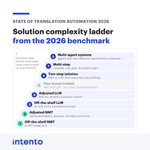
ALT Card: solution complexity ladder from the 2026 benchmark, State of Translation Automation 2026, eight levels with the simplest at the bottom. 1, off-the-shelf NMT: an MT model as is. 2, adjusted NMT: native parameters such as glossary and formality. 3, off-the-shelf LLM: an LLM with a translation prompt. 4, adjusted LLM: RAG for dynamic business context. 5, fine-tuned models, NMT and LLM: not in the 2026 benchmark. 6, two-step solution: NMT or LLM, then automatic post-editing. 7, multi-step: translate, LQA gate, bounded repair. 8, multi-agent systems: agents that own different requirements cooperate. Each level adds context and usually costs more to build, run and maintain.

ALT Card: 10 translation requirements from the 2026 benchmark, State of Translation Automation 2026, in three levels. Basic, for any company in this market: 1, general translation quality, MQM-based LQA minus the subjective requirements. Standard, for every company, with its own rules: 2, terminology, 3, tone of voice, 4, tags, 5, Unicode character integrity, 6, locale conventions, 7, HTML entities, 8, valid JSON, 9, spacing at tag boundaries. Advanced, for some companies and use cases: 10, gender neutrality.

ALT 2018: choose the less wrong model. 2026: build a solution that meets your requirements. 18 MT vendors in 2018, 105 vendors of MT and LLMs in 2026.
