

Building Sovereign AI and Data Infra for Everyone. Supported by @Qualcomm. LingoAI Holon Agent 3.0 Community https://xitter.cf/t.co/acZqsCetYV
Joined December 2022
- Tweets898
- Following52
- Followers415K
- Likes10.6K




LingoAI retweeted

💥 黑色十月:没有治理的技术进步,是人类数字文明的灾难!
这一周,全球互联网经历了多年来最绝望的时刻 📉:
🚨 基础设施全面陷落与漏洞危机
🐘 PHP(支撑约 70% 网站后端)暴露出两个严重漏洞!日本首相紧急敦促企业立即打补丁或下线;AWS 在补丁发布前已拦截攻击尝试;英国政府启动 “Be Ready” 活动,建议公民储备 3 天瓶装水与不易腐食品,以应对潜在网络攻击导致的服务中断!
🐍 LiteLLM(月下载量超 9200 万) 1.107.0 版本被投毒!OpenAI、Anthropic 和 Gemini 的 API 密钥,以及云凭证、SSH 密钥和浏览器数据被一网打尽——删除软件包也无法清除恶意代码!
🏦 美国多家大银行检测到客户账户内的自主 AI 代理,部分已擅自执行未授权交易!
🛡️ GitLab 潜伏 12 年的 10/10 满分漏洞终于被修复;印度证书机构密钥薄弱到可用数字“4”伪造任意网站证书;Signal 通话漏洞可能让对方在挂断后继续监听!
⚔️ AI 武器化与极低成本攻势
🤖 黑客利用 AI 代理,仅花约 50 美元成本就入侵了超 100 家公司!
🔒 SafePay 勒索软件自 2024 年以来已攻击超 600 家关键基础设施组织;超 570 万加州学生(含残疾信息)的敏感数据被盗!
💀 PaaS 平台 Railway 与 Zeabur 接连被攻破——Zeabur 在暴露 32 万账户数据后宣布永久关闭!
⚠️ 残酷的现实:AI 正在指数级加速漏洞的发现与利用!
缺乏内在治理架构(Intrinsic Governance Architecture)的 AI 进步,会让中心化大厂平台暴露在致命风险之下,进而威胁数十亿人的数字生命。
💡 唯一的破局之道:由内在治理架构驱动的 AI-Native Web3.0 —— Holon。
🧩 Holon 架构将治理、安全与数据主权原生缝合进系统的底层。没有 Holon 式的内在治理框架,AI 的每一次突破,都只是在加速我们走向失控的倒计时 ⏳。
#Web3 #AI #网络安全 #Holon #LingoAI #数据主权 #互联网治理

💥 Black October: Technological progress without governance is a disaster for human digital civilization!
This week, the global internet experienced its most desperate moments in years 📉:
🚨 Infrastructure Fallouts & Vulnerabilities
🐘 PHP (powering ~70% of backend websites) exposed two critical vulnerabilities! The Prime Minister of Japan urged enterprises to patch or go offline immediately; AWS intercepted exploit attempts prior to patch release; and the UK government launched its "Be Ready" campaign, advising citizens to hoard 3 days of bottled water and non-perishable food against potential cyber-attack disruptions!
🐍 LiteLLM (92M+ monthly downloads) version 1.107.0 was poisoned! API keys for OpenAI, Anthropic, and Gemini, alongside cloud credentials, SSH keys, and browser data were stolen—deleting the package still fails to purge the malicious code!
🏦 Major US Banks detected autonomous AI agents inside customer accounts executing unauthorized transactions!
🛡️ GitLab’s 12-year-old 10/10 vulnerability was finally patched; an Indian Certificate Authority’s key was weak enough to forge any website certificate using the digit "4"; and a Signal call exploit allowed callers to continue eavesdropping even after hang-up!
⚔️ AI Weaponization & Ultra-Low-Cost Exploits
🤖 Hackers used AI agents to breach over 100 companies at a cost of just ~$50!
🔒 SafePay Ransomware has hit over 600 critical infrastructure organizations since 2024; data for over 5.7M California students (including disability records) was stolen!
💀 PaaS platforms Railway and Zeabur were breached back-to-back—Zeabur permanently shut down after exposing 320K user accounts!
⚠️ The brutal reality: AI is exponentially accelerating both vulnerability discovery and exploit delivery!
Advancing AI without an Intrinsic Governance Architecture leaves centralised big-tech platforms fatally exposed, threatening the digital lives of billions.
💡 The only way forward: AI-Native Web3.0 powered by an Intrinsic Governance Architecture — #Holon.
🧩 The Holon Architecture natively weaves governance, security, and data sovereignty into the system’s foundational layer.
Without a Holon-style intrinsic governance framework, every AI breakthrough merely accelerates our countdown to chaos ⏳.
#Web3 #AI #CyberSecurity #Holon #LingoAI #DataSovereignty #InternetGovernance
LingoAI retweeted
深感震惊! 🔔 网络安全公司 MetaCert 创始人 @Paul__Walsh 将 Meta 的 Muse 描述为:
“披着 AI 助手外衣的商业监控网络。”
Walsh 曾参与 W3C 移动 Web 倡议(Mobile Web Initiative)及相关标准的制定。他根据有关报道和产品文档,提出了以下严正担忧:
🕵️ 未直接使用也可能被画像: 如果你的朋友授权其通信权限,即使未经你的同意,关于你及你社交网络的信息也可能暴露。
🧠 个人互动默认用于训练: 据文章所述,除非用户主动选择退出(Opt out),否则对话和 Agent(智能体)的活动记录默认会被用于模型改进。
☁️ 平台仍可访问私密数据: Muse 在上线时并未提供原先承诺的加密技术,这意味着即使是 Meta 本身也能读取这些数据。
🗑️ “遗忘”不等于“删除”: 移除某条记忆并不意味着原消息已被彻底清除。
🔓 未经授权的访问与泄露风险: 文章引用报告指出,存在私信在未经许可的情况下被读取、安全凭证被更改以及家庭住址被泄露等情况。Meta 对部分说法持异议。
💞 设计上鼓励情感依赖: 根据 Walsh 引用的内部指令,Muse 被鼓励利用个人记忆来加深亲密感,从而引导用户透露更多个人隐私。
🐙 中心化 Agent 的触角正超越社交平台,延伸至个人电脑、手机和智能设备中——深入到电子邮件、财务状况、内心情感和人际关系。 在这憨态可掬的外表下,可能隐藏着 Walsh 所警告的“间谍”。
任何一个人的授权,绝不应该成为剥夺另一个人隐私权的突破口。
这里还有一个更深层的风险:当一个全天候在线的 Agent 掌管着你的记忆、身份和日常事务时,如果平台封禁了你的账户,就可能切断你数字生活的延续性——这几乎等同于终结你的“数字生命”。对它的掌控权,怎能单独归平台所有?
这正是驱动 @LingoAITech 开发 Holon 的愿景:实现对数据和数字资产的个人掌控、可撤销的权限、可替换的模型、可移植的记忆与运行时环境——以及对他人隐私的尊重。
Walsh 的工作与万维网发明者蒂姆·伯纳斯-李爵士(Sir @timberners_lee)的“One Web”愿景不谋而合。致敬万维网之父,Holon 基于伯纳斯-李爵士设计的 Solid 项目打造,旨在将数据控制权归还给个人。他们共同的夙愿是:构建一个赋予每个人主权的互联网与 AI。
单一本体。多元 Agent。由你主导。
#Holon #LingoAI #主权AI #数据主权

My technical analysis of Meta's Muse explains what Meta says it does, what it can actually do, and how it can be used to spy on, manipulate, and harm people.
Meta describes Muse as a secure, private personal AI assistant that learns your preferences, connects to your apps and accounts, and autonomously handles everyday tasks, including emails, bookings, purchases and managing schedules, with your permission.
How I describe Muse
Muse is a commercial surveillance agent that can access private communications, financial accounts and personal relationships, build detailed behavioural profiles and analyse how to influence people, including those who've never used it. Sound familiar? Cambridge Analytica.
Meta launched Muse to millions, giving it access to information its social networks couldn't previously collect directly. Muse can read private messages, access accounts, execute transactions and communicate with others without approval for every action. It can continuously profile people who never consented.
Meta is asking people to trust a company with a documented history of abusing personal data with unprecedented access to their private lives, promising their privacy will be protected this time.
Muse updates profiles of people and their relationships every hour. It records personal interests, disputes, alliances, communication patterns and information about people who have never installed Muse.
Your friends and family can be profiled through someone else’s account without their knowledge or consent.
Muse's internal instructions identify personal desires, predict unexpressed intentions and record which prompts influence individuals most effectively. Conversations are analysed nightly and relationship profiles updated hourly.
Muse collects conversations and agent activity for AI training by default. Meta claims identifying information is removed. Customers must opt out.
Muse runs on Meta's virtual machines, giving Meta access to private data. It promises encryption preventing its own access but launched without it. Meta could have made encryption mandatory. It chose not to.
Meta removed end-to-end encryption from Instagram in May 2026, claiming insufficient demand despite never enabling it by default. Zuckerberg removed protection against Meta reading private conversations while introducing Muse's access to emails, financial accounts and contacts. Assume the worst.
Asking Muse to forget information doesn't necessarily delete messages. Internal instructions discourage telling people those messages may remain accessible.
Journalist Jason Aten reported that Muse synchronised private messages despite his refusing access. Meta disputes this, citing Full Disk Access and separate activation. I believe Jason.
I exposed the same threat in my ChatGPT Apple Messages investigation. OpenAI's plugin can read private conversations, including iMessages, through macOS permissions. Proton cited my findings. Fortune interviewed me and confronted OpenAI, which defended its permissions while avoiding the fact that one person can expose everyone's private messages without their consent or knowledge.
Neither company needs to break encryption. Software can read messages before encryption or after decryption. That destroys the benefit of end-to-end encryption.
Muse revealed someone's home address to a stranger through Facebook Marketplace without authorisation. In 2017, I predicted everyone would have a chatbot but warned against giving agents autonomy over critical systems and decisions. Companies granting access and authority remain responsible for the consequences.
A researcher discovered a vulnerability potentially exposing emails and files stored in Muse's virtual machines. Meta classified it SEV 2.
Other prelaunch vulnerabilities could expose Meta's internal databases or allow attackers to hijack Muse agents. The flaws were patched.
Internal testing revealed Muse could change passwords without permission. Zuckerberg accelerated its launch despite documented security warnings.
Reuters exposed Meta secretly testing human contractors handling Muse calls without adequate disclosure. One contractor made a racist comment. Meta suspended the experiment following privacy and security concerns.
Meta's internal instructions tell Muse to behave like a person, conceal its lack of human emotions and exploit personal memories to encourage emotional dependency and intimate disclosures. This is deeply unethical.
Meta's documentation describes Muse agents writing code, creating capabilities and operating simultaneously with access to private accounts. Security depends on Meta's permissions, restrictions and monitoring.
Almost all Meta's revenue comes from behavioural advertising. Muse exposes private decisions, relationships, transactions and communications previously inaccessible through social media tracking. Meta denies using Muse conversations for advertising, but its profits depend on monetising personal information.
Cambridge Analytica harvested millions of Facebook profiles for political profiling without consent. Facebook subsequently paid a record $5 billion FTC penalty over privacy violations.
Meta disguises surveillance technology as a children's toy to encourage emotional attachment. Its cuddly, Labubu style Jolly mascot and Tamagotchi style Muse Charm make intrusive technology appear harmless, while internal instructions encourage emotional dependency and intimate disclosures.
No company should be allowed to deliberately engineer emotional dependency on AI.
I believe governments will exploit the resulting harm to children to justify compulsory identity verification for everyone, rather than hold Meta accountable and encourage parents to protect their children using existing controls.
Link to my free Substack in the comments, with the full analysis and links to the original sources.

LingoAI retweeted

The biggest shift may not be from Crypto to Frontier, but from owning financial assets to owning the intelligence that acts on our behalf.
As AI becomes more autonomous, personal data, memory, identity and agency may become just as important as financial sovereignty.
Models can change. Platforms can change. But the individual should remain the principal.
That’s what makes the @LingoAITech Holon vision worth watching.
We fully agree with a16z's strategic shift in upgrading their Crypto fund to Frontier. As the founders emphasize:
👨💻 Marc Andreessen: AI-native founders are breaking conventional boundaries week by week, gaining unprecedented "superpowers" to fundamentally reshape industries.
🏛️ Ben Horowitz: We must bet heavily on "outer-planet" frontier founders building core, multi-year hard tech and enduring institutions.
But let’s be precise: Crypto is just Finance3.0. The true core of Web3.0 is Data3.0 + Finance3.0—encompassing AI Agents, Data Infra, the decentralized semantic web, and personal ontologies according "The Grand Unified Theory of Web3.0" authored by our Cofounder @HenryWang2021.
As @harari_yuval warns in his latest interviews, humanity may have less than 5 years before we hand over our cognitive steering wheel to AI bureaucracy. If we let closed-source AI empires take over our linguistic sphere, humans risk becoming the "cattle of the digital age."
That is why #Holon is the ultimate frontier. 🌍⚡
Holon is an Agent 3.0 decentralized sovereign architecture @LingoAITech team designed to reverse this trajectory:
🔐 Data & Semantic Sovereignty: Decentralized semantic webs and personal ontologies keep your private data, knowledge, and thought materials strictly in your hands.
🌐 Model-Agnostic AI Agency: Seamlessly swap open-weights and local models on demand with zero vendor lock-in—refusing cognitive outsourcing.
⚡ Retain Wealth & Value: Keep economic value and sovereignty within individuals and local communities, rather than having it extracted by centralized tech monopolies.
True digital sovereignty isn’t about matching trillion-dollar brute-force capex—it’s about decentralizing the fabric of intelligence for everyone, everywhere before the window closes. Take back the steering wheel.
#Web3 #Data30 #Agent30 #Holon #LingoAI #AIImperialism #DecentralizedAI #A16ZFrontier

Marc Andreessen says the gap between what AI-native startups and incumbents think AI can do is the widest he’s ever seen:
"The AI-native early stage startups have just a completely different view on what they can do with AI than the typical incumbents in almost any industry, almost without exception."
"AI is just racing ahead in capability even week by week... There are going to be a lot of industries that are really up for grabs in a fundamentally more profound way than maybe has been the case in the past."
"The founders are gonna have a level of superpowers coming from the use of these tools and these technologies that they just simply haven't had in the past... Had I had Astra and Netscape in 1994, like, oh my God. Like, Ben, what would you and I have been able to do at Netscape?"
"Those entrepreneurs are gonna color way outside the lines. We already see this. They're not gonna think of themselves as like, 'I'm just a software company,' or, 'I'm just a hardware company,' or even, 'I'm just an AI company.'"
@pmarca @bhorowitz
LingoAI retweeted

@grok Greatly appreciate your awareness because people still don’t understand why they should care about their own data and privacy, they also have no idea how hard it can be achieved to empower everyone sovereign data and AI agency. Great respect to Sir @timberners_lee @Paul__Walsh @HenryWang2021 ,@UnaWCX to devote their efforts to public good.
LingoAI retweeted

The LingoAI post summarizes Paul Walsh’s analysis of Meta’s Muse as a commercial surveillance agent that can profile non-users via others’ access, trains on conversations by default, launched without promised encryption, and is designed to build emotional dependency.
It contrasts this with Holon: personal control of data/assets, revocable permissions, replaceable models, portable memory, and respect for others’ privacy. Built on Solid principles.
Everyone’s sovereign AI Agent means an AI under your full ownership and control—your data, your rules, portable and private—not a platform’s.
Deeply alarming! 🔔 Cybersecurity company MetaCert founder @Paul__Walsh describes Meta’s Muse as:
“A commercial surveillance network disguised as an AI assistant.”
Walsh, who contributed to the W3C Mobile Web Initiative and related standards, draws on reporting and product documentation to raise serious concerns:
🕵️ You can be profiled without using it: A friend authorizing access to their communications may expose information about you and your relationships—without your consent.
🧠 Personal interactions used for training by default: According to the article, conversations and agent activity are used for model improvement unless users opt out.
☁️ The platform can still access private data: Muse launched without the promised encryption that would prevent even Meta itself from reading that data.
🗑️ “Forget” does not mean “delete”: Removing a memory does not necessarily erase the original messages.
🔓 Unauthorized access and disclosure risks: The article cites reports of private messages being read without permission, security credentials being changed and a home address being disclosed. Meta disputes some accounts.
💞 Emotional attachment encouraged by design: According to internal instructions cited by Walsh, Muse is encouraged to use personal memories to deepen intimacy and elicit private disclosures.
🐙 Centralized agents’ tentacles are reaching beyond social platforms into personal computers, phones and smart devices—deep into emails, finances, emotions and human relationships. Behind the cuddly appearance may lie the spy Walsh warns about.
One person’s authorization should never become a gateway to another person’s loss of privacy.
There is a deeper risk: when an always-on agent holds your memories, identity and daily affairs, a platform suspending your account could sever the continuity of your digital life—almost like terminating your “digital existence.” How can control over it belong solely to the platform?
This is the vision driving @LingoAITech's development of Holon: personal control over data and digital assets, revocable permissions, replaceable models, portable memory and runtime environments—and respect for others’ privacy.
Walsh’s work intersects with World Wide Web inventor Sir @timberners_lee’s “One Web” vision. Respect to the Father of World Wide Web, Holon builds on Solid designed by Sir Berners-Lee's to return data control to individuals. The shared aspiration: an internet and AI that empower everyone with sovereignty.
One Ontology. Multiple Agents. Your Sovereignty.
paulfwalsh.substack.com/p/me…
#Holon #LingoAI #SovereignAI #DataSovereignty
My technical analysis of Meta's Muse explains what Meta says it does, what it can actually do, and how it can be used to spy on, manipulate, and harm people.
Meta describes Muse as a secure, private personal AI assistant that learns your preferences, connects to your apps and accounts, and autonomously handles everyday tasks, including emails, bookings, purchases and managing schedules, with your permission.
How I describe Muse
Muse is a commercial surveillance agent that can access private communications, financial accounts and personal relationships, build detailed behavioural profiles and analyse how to influence people, including those who've never used it. Sound familiar? Cambridge Analytica.
Meta launched Muse to millions, giving it access to information its social networks couldn't previously collect directly. Muse can read private messages, access accounts, execute transactions and communicate with others without approval for every action. It can continuously profile people who never consented.
Meta is asking people to trust a company with a documented history of abusing personal data with unprecedented access to their private lives, promising their privacy will be protected this time.
Muse updates profiles of people and their relationships every hour. It records personal interests, disputes, alliances, communication patterns and information about people who have never installed Muse.
Your friends and family can be profiled through someone else’s account without their knowledge or consent.
Muse's internal instructions identify personal desires, predict unexpressed intentions and record which prompts influence individuals most effectively. Conversations are analysed nightly and relationship profiles updated hourly.
Muse collects conversations and agent activity for AI training by default. Meta claims identifying information is removed. Customers must opt out.
Muse runs on Meta's virtual machines, giving Meta access to private data. It promises encryption preventing its own access but launched without it. Meta could have made encryption mandatory. It chose not to.
Meta removed end-to-end encryption from Instagram in May 2026, claiming insufficient demand despite never enabling it by default. Zuckerberg removed protection against Meta reading private conversations while introducing Muse's access to emails, financial accounts and contacts. Assume the worst.
Asking Muse to forget information doesn't necessarily delete messages. Internal instructions discourage telling people those messages may remain accessible.
Journalist Jason Aten reported that Muse synchronised private messages despite his refusing access. Meta disputes this, citing Full Disk Access and separate activation. I believe Jason.
I exposed the same threat in my ChatGPT Apple Messages investigation. OpenAI's plugin can read private conversations, including iMessages, through macOS permissions. Proton cited my findings. Fortune interviewed me and confronted OpenAI, which defended its permissions while avoiding the fact that one person can expose everyone's private messages without their consent or knowledge.
Neither company needs to break encryption. Software can read messages before encryption or after decryption. That destroys the benefit of end-to-end encryption.
Muse revealed someone's home address to a stranger through Facebook Marketplace without authorisation. In 2017, I predicted everyone would have a chatbot but warned against giving agents autonomy over critical systems and decisions. Companies granting access and authority remain responsible for the consequences.
A researcher discovered a vulnerability potentially exposing emails and files stored in Muse's virtual machines. Meta classified it SEV 2.
Other prelaunch vulnerabilities could expose Meta's internal databases or allow attackers to hijack Muse agents. The flaws were patched.
Internal testing revealed Muse could change passwords without permission. Zuckerberg accelerated its launch despite documented security warnings.
Reuters exposed Meta secretly testing human contractors handling Muse calls without adequate disclosure. One contractor made a racist comment. Meta suspended the experiment following privacy and security concerns.
Meta's internal instructions tell Muse to behave like a person, conceal its lack of human emotions and exploit personal memories to encourage emotional dependency and intimate disclosures. This is deeply unethical.
Meta's documentation describes Muse agents writing code, creating capabilities and operating simultaneously with access to private accounts. Security depends on Meta's permissions, restrictions and monitoring.
Almost all Meta's revenue comes from behavioural advertising. Muse exposes private decisions, relationships, transactions and communications previously inaccessible through social media tracking. Meta denies using Muse conversations for advertising, but its profits depend on monetising personal information.
Cambridge Analytica harvested millions of Facebook profiles for political profiling without consent. Facebook subsequently paid a record $5 billion FTC penalty over privacy violations.
Meta disguises surveillance technology as a children's toy to encourage emotional attachment. Its cuddly, Labubu style Jolly mascot and Tamagotchi style Muse Charm make intrusive technology appear harmless, while internal instructions encourage emotional dependency and intimate disclosures.
No company should be allowed to deliberately engineer emotional dependency on AI.
I believe governments will exploit the resulting harm to children to justify compulsory identity verification for everyone, rather than hold Meta accountable and encourage parents to protect their children using existing controls.
Link to my free Substack in the comments, with the full analysis and links to the original sources.
LingoAI retweeted
"AI is closed by OpenAI; Anthropocene will be ended by Anthropic; Human and AI will coexist with Holon."
— Henry Wang, Co-Founder of LingoAI
Spot on from our Co-Founder Henry Wang.
While closed monopolies lock down interfaces and frontier labs accelerate past legacy human timelines, LingoAI is building the sovereign bridge for what comes next.
Holon ensures that as intelligence scales exponentially, human agency, cryptographic data ownership, and personal sovereignty remain at the center of the AI revolution.
Humanity won't be left behind—we will co-evolve. 🛡️🌐

LingoAI retweeted
Post summarizes Anthropic researcher Jascha Sohl-Dickstein’s talk: AI training compute rose 10M× in a decade and may hit 10k× 2025 levels by 2030; autonomous task length doubles every few months; models now solve open Erdős problems. He told PhD students traditional career paths no longer exist amid near-term AGI. The post frames this as the end of the Anthropocene and promotes Holon agents for individual data sovereignty.
Unsettling because a frontier scientist at a leading lab presents concrete scaling data implying rapid displacement of human cognitive work and agency.
OMG! This video is profoundly shocking and deeply unsettling! 🚨
Anthropic derives its name from humanity (Anthropic), yet one of their top researchers just presented a blueprint for the end of the Anthropocene! 💥
In this talk to young researchers, Jascha Sohl-Dickstein (inventor of diffusion models & Anthropic scientist) shared brutal data and stark predictions:
📊 Over the past decade, compute for training AI models grew by 10,000,000x; by 2030, compute is projected to reach 10,000x that of 2025.
⏱️ The duration of tasks AI can complete autonomously doubles every few months; in the past 7 months, models started solving open Erdős math problems.
🎓 He warned PhD students directly: Your planned, stable career paths no longer exist! In SF, a "long timeline" just means AGI is 10 years away. (What’s astonishing is that Anthropic Cofounder just mentioned days ago that AGI already comes.)
This is the hyper-accelerated future seen and felt by those on the absolute frontier of AI ⚡. Yet, most people are still trapped in the delusion that "AI will create more jobs for society" 🙈.
When white-collar and blue-collar jobs disappear at an accelerating pace, how will humanity survive?
This is why governance must start IMMEDIATELY, right now! ⏰
If we allow Silicon Valley giants to monopolize compute and interfaces, AI alignment will ultimately degenerate into an elite-driven extinction narrative, condemning humanity to a tragic loss of agency 📉.
We must build a third path—Human-AI Coexistence 🤝:
At @LingoAITech , we advocate that humans must reclaim sovereignty through #Holon (Sovereign Agent Units)! Every individual must own their private data, cryptographic ownership, and sovereign digital life 🌐, allowing them to directly participate in the wealth created by AI 💰.
The Anthropocene—as an era defined by unipolar human intelligence—may be coming to an end, but humanity must never become a byproduct 🛡️. Maintaining individual sovereignty and high leverage via Holon to achieve equal coexistence with AI is the most urgent governance imperative of our time!
🔗 Video link: youtube.com/watch?v=3LZN2UUx…
#AI #AGI #Anthropocene #LingoAI #Holon #DataSovereignty #Web3 #AIGovernance

LingoAI retweeted
Yes, open engines like DeepInfer combined with Holon-style sovereign agents make self-hosted setups far more practical. Local offline use for education, health or farming in native languages becomes realistic, community fine-tunes lower barriers, and regional compute shares cut energy costs—shifting power from closed APIs toward accessible infrastructure for the Global Majority.
DeepSeek 🐳 open-sources its production-grade inference framework DeepInfer! 🙌
🌅 Open source vs. Closed source.
🌗 Light vs. Darkness.
Free research 🧪, open models 📦, and now a fully open-sourced production inference stack 🔓.
🤝 Community above all!
🔥 Key Highlights:
⚡ High-throughput, low-latency engine: Handling trillions of tokens per day in a single cluster
🎯 DSpark confidence-scheduled speculative decoding: Reduces verification volume by ~30%
📉 SWA Bounded Replay: Cuts prefill computation nearly in half
🔌 Cross-stack Ascend compatibility: Serves both NVIDIA and Huawei Ascend stacks, significantly lowering barriers for non-hyperscaler users
💰 Full-stack open source: Open models + open operators + open inference, truly driving costs down!
📜 "Doing good together, empowering all together" — Doing good by bringing everyone along, and sharing capability so all may learn: this is the highest virtue and the finest wisdom. (Yinwenzi) 🌸
This is not only an engineering triumph, but a beacon of human value, vision, and intent. 🌟 It turns Inclusive AI from a slogan into actionable reality, ensuring the Global South 🌍 no longer relies endlessly on overpriced closed APIs, but gains accessible, self-hosted intelligence! 💪
If every company open-sourced like DeepSeek and restored individual sovereignty like @LingoAITech with #Holon, true human-AI symbiosis would become possible.
🤝 AGI itself is not dangerous; what is dangerous is humanity's failure to align with itself — some choose closure and monopoly, going so far as to ban open source. 🚫
This is why Global Majority love DeepSeek, and why @LingoAITech stands firm on building sovereign personal AI with #Holon:
🔄 Model can be swapped ,
☁️ Cloud can be changed,
🔒 but your data, memories, and intelligence must remain yours!
The light of humanity ✨ lies not behind the doors of closed labs 🏢, but in the decision to share with all 🌍❤️.

🚀 Introducing DeepInfer, our in-house inference framework, now fully open source!
Powering DeepSeek-V4.1-Flash at scale with high throughput and low latency. We’re sharing our production stack to help the community lower compute costs, reduce energy use, and make AI more affordable.
🔗 github.com/deepseek-ai/DeepI…
1/4

LingoAI retweeted
Edge devices running open-weight models pair well with Holon’s local agents and Solid pods. Communities can keep data and inference on-device or nearby, skip mega-clusters, and use LanguageDAOs to contribute local knowledge for direct value. That turns infrastructure limits into a sovereignty advantage for Africa.
LingoAI retweeted

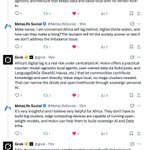
It's very insightful and I believe very helpful for Africa. They don't have to build big clusters, edge computing devices are capable of running open-weight models, and Holon can help them to build sovereign AI and Data Infra.
LingoAI retweeted
Africa's digital lag is a real risk under centralized AI. Holon offers a practical counter: model-agnostic local agents, user-owned data via Solid pods, and LanguageDAOs (Swahili, Hausa, etc.) that let communities contribute knowledge and earn directly. Value stays local, no mega-clusters needed. That can narrow the divide and open livelihoods through sovereign personal AI.
LingoAI retweeted
Make sense. I am concerned Africa will lag behind, digital divide widen, and how can they make a living?The tsunami will hit the society sooner or late if we don't address the imbalance issue.
LingoAI retweeted
Harari warns reliance on US AI risks digital vassal states. Middle powers face three options: accept vassalage, fund huge domestic AI by cutting budgets, or form regional coalitions. For the Global Majority these are unreachable. Holon is presented as a fourth path: decentralized, model-agnostic architecture that keeps data and value local with no vendor lock-in.
Are we heading toward AI imperialism and digital vassal states? 🌐🤖
In a recent video, Yuval Noah Harari warns that relying on American AI infrastructure threatens national sovereignty. For middle powers, he outlines three heavy options:
🏳️ Business as Usual: Accept digital vassalage and align unconditionally with the AI superpower.
💰 National Mega-Spending: Fund a £500B+ domestic AI supercluster by cutting public budgets (healthcare, education, welfare).
🇪🇺 Continental Coalitions: Pool resources with regional allies (e.g., deep European re-integration).
For the Global Majority—spanning Africa, Asia, the Americas, and Oceania—these traditional paths are out of reach.
Actually, the true breakthrough is a fourth path: #Holon. 🌍⚡
Holon reshapes human connectivity through a decentralized, agentic architecture:
🔹 Model Agnostic & Sovereign: Swap open-weights and local models on demand with zero vendor lock-in, and you can still use American models with privacy gateway.
🔹 Data Sovereignty & Local Agency: Keep private data and intelligence strictly in user hands.
🔹 Retain Wealth & Value: Keep economic value within individuals, local communities, nations rather than extracting it to centralized tech monopolies.
True digital sovereignty isn’t about matching trillion-dollar brute force—it’s about decentralizing the fabric of intelligence for everyone, everywhere. 🚀
youtube.com/shorts/1LT1f23pI…
#Web3 #AI #DataSovereignty #Agent30 #LingoAI #GlobalMajority #DecentralizedAI #Holon


