

DeFi Researcher | On-chain Alpha Finding opportunities before they trend Yields • Protocols • Narratives DM for collabs | Always DYOR.
Earth
Joined January 2014
- Tweets42.5K
- Following2.4K
- Followers31.5K
- Likes129K




Pinned Tweet
We all know @HyperliquidX trading ecosystem has grown considerably, but there’s another side of the ecosystem worth paying attention to.
Execution.
HyperEVM gives developers access to Solidity-based applications, but some applications need more block space and faster execution than it currently offers.
@Kinetiq_xyz ’s Elysium is built around that problem.
Here’s what I found interesting about it. 🧵

One thing I try not to do when researching a token is judge its entire price action from the last few hours.
A chart can look interesting on a short timeframe, but zooming out may give you a completely different perspective.
That’s why I like checking different timeframes on @GeckoTerminal.
I want to see how recent price movements fit into the bigger picture, rather than react to every sudden move.
Short-term activity matters, but context matters just as much.
Sometimes the more useful information isn’t in the latest candle, but in what happened before it.
Download the GT app:
iOS: apps.apple.com/us/app/geckot…
Play Store: play.google.com/store/apps/d…

A sudden increase in trading volume is worth investigating,But it shouldn’t automatically be interpreted as growing market interest.
Context matters. ▼
When I notice unusual activity around a token, I prefer to look at the underlying DEX pool rather than rely on the volume figure alone.
A few things I want to understand:
➜ Is the increase in volume accompanied by meaningful price movement?
➜ How much liquidity is available in the pool?
Is the activity concentrated in a particular trading pair?
➜ Does the broader market activity support what I’m seeing?
This is where @GeckoTerminal becomes useful in my research workflow.
⤷ I can explore Token pools, Price movements, liquidity and trading activity without treating one metric as the entire story.
A volume spike is a signal to investigate, not a conclusion.
That’s an important distinction when researching onchain markets.
My thoughts on @jumperapp and the Future Of Onchain :
<> I Think One Of the biggest problems in DeFi isn’t necessarily a lack of protocols, liquidity or Financial Products.
It’s How Fragmented the experience still is .
Think about what a user has to do today to move between ecosystems.
You might need one platform to swap tokens, another to bridge assets, another to access yield, and a completely different interface to trade perps or discover new assets.
Each additional step introduces more friction.
And this is where I think Jumper’s approach becomes interesting.
➜ Jumper is built on LI.FI infrastructure, aggregating liquidity sources, DEXs and cross-chain bridges into a single interface. It doesn’t need to operate every underlying protocol itself. Instead, it connects users to existing infrastructure and abstracts away much of the complexity But the ambition goes beyond swapping and bridging.
Jumper is expanding into
→ yield
→ perpetual trading
→ And access to different asset classes, including tokenized stocks and RWA
▸ The idea is simple: users shouldn’t have to understand every protocol or liquidity venue just to interact with onchain finance.
The numbers also make the expansion worth watching.
According to the DeFiLlama snapshot, Jumper recorded approximately:
• $737.42M in bridge aggregator volume over 30 days.
• $185.46M in DEX aggregator volume.
• $69.29M in perpetual volume.
These are different activities, but together they show the range of onchain transactions being routed through the platform.
Jumper also reports more than $40B in lifetime volume and over 100,000 monthly active users.
Of course, aggregating these services doesn’t automatically make Jumper the winner. Execution quality, routing efficiency, liquidity, fees and user retention will matter.
But I think the bigger question is worth asking:
As more financial products move onchain, will users continue navigating dozens of individual applications, or will they gravitate towards interfaces that bring these experiences together?
If the latter happens, aggregation could become one of the most important layers of the onchain economy.
That’s the part of @jumperapp I’m paying attention to.
Just my two cents. could be wrong tho

Looking at a token’s price is one thing. Understanding where its trading activity is taking place is another.
I took a closer look at $HYPE on @GeckoTerminal and compared two of its trading pairs: $HYPE/ $USDC and $HYPE / $USDT.
The difference in the displayed market data was worth investigating.
The $HYPE/ $USDC pool showed approximately $56.41M in 24H volume, with 341 transactions.
The $HYPE/ $USDT pool showed approximately $30.58K in 24H volume, with no transactions displayed at the time of checking.
Both pairs represent exposure to the same underlying token, but the trading activity shown across them was very different.
This is why I don’t like looking at a token’s headline market data in isolation.
When researching a market, I also want to know:
→ Which trading pairs are active?
→ Where is most of the reported volume taking place?
→ How many transactions are actually being recorded?
→ Are different pools showing similar levels of activity?
These details help put a token’s market activity into better context.
With @GeckoTerminal, I can move from the token page into individual pools and examine the data behind each trading pair.
A useful reminder: the token’s ticker is only the starting point. The individual markets deserve attention too.


I’ve been testing something interesting with @LightchainAI.
Most AI platforms make the experience pretty straightforward: create an account, log in, and start asking questions.
Lightchain takes a different approach.
I connected my wallet, accessed Lightchain Chat and explored the available open models without needing an email, password or subscription.
↳ What’s interesting isn’t just the chat interface.
➜ Lightchain uses independent operators to serve open models, with the blockchain selecting an operator for each job.
➜ You also get an onchain record of the job, including the operator and transaction details.
I think the more interesting question is what AI infrastructure looks like when access isn’t tied to a single company’s platform.
Still exploring, but this is worth looking into.
Try it: chat.lightchain.ai

4
382
A sudden increase in trading volume is worth investigating,But it shouldn’t automatically be interpreted as growing market interest.
Context matters. ▼
When I notice unusual activity around a token, I prefer to look at the underlying DEX pool rather than rely on the volume figure alone.
A few things I want to understand:
➜ Is the increase in volume accompanied by meaningful price movement?
➜ How much liquidity is available in the pool?
Is the activity concentrated in a particular trading pair?
➜ Does the broader market activity support what I’m seeing?
This is where @GeckoTerminal becomes useful in my research workflow.
⤷ I can explore Token pools, Price movements, liquidity and trading activity without treating one metric as the entire story.
A volume spike is a signal to investigate, not a conclusion.
That’s an important distinction when researching onchain markets.
A watchlist should be more than a collection of tokens you might buy.
I use mine to keep track of where different onchain narratives are developing and which markets deserve another look.
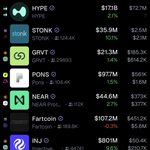
My setup on @GeckoTerminal is called Macky_defi Alpha.
It currently covers a mix of markets, from $HYPE and $INJ to $NEAR, $GRVT, $STONK, $NVDAx and $FARTCOIN.
The selection isn’t built around one particular sector.
I prefer having exposure to different corners of the market on my radar, especially when researching how liquidity, trading activity and market attention are distributed.
When I revisit the list, I look beyond price movement.
➜ Market cap gives me a sense of valuation, while volume and liquidity help put trading activity into context.
➜ These metrics don’t tell the whole story, but they give me a starting point before going deeper into a particular pool or asset.
That’s what makes the Watchlist useful.
Instead of rebuilding my research dashboard every time I open the app, I have the markets I care about already organised.
This is how I use GeckoTerminal as part of my daily onchain research.
You can build your own Watchlist here: geckoterminal.com/watchlist?…
Curious to see what other people are keeping on their radar.


Most people look at institutional blockchain adoption as a technology story,But there’s another question worth asking.
If banks start moving financial activity on-chain, how does that activity translate into value for the underlying ecosystem?
@zksync is exploring an interesting answer with Prividium Connect.
The product addresses a problem that existing interoperability solutions haven’t fully solved.
Connecting two blockchains is one thing. Making sure both institutions complete an asset exchange without trusting a middleman is another.
Think about two banks exchanging tokenized dollars for euros across separate private blockchains.
Neither wants to expose its internal records or send assets first and simply trust the other side to deliver.
→ Prividium Connect uses zero-knowledge proofs to enforce the agreement.
Both transfers happen, or neither does. If the deadline expires, each institution can recover its assets.
↳ The interesting part is that this happens without a third party holding the funds, while confidential records remain private.
Institutions can also continue using infrastructure such as Hyperledger , Besu and Prividium Ledger,But the technical side isn’t the only reason I’m paying attention.
➜ There’s a potential $ZK value-accrual mechanism attached to this.
@zksync is proposing that fees from canonical public deployments of Prividium Connect be converted into $ZK and allocated through governance decisions.
The fee switch is already built and being audited, but activation still requires governance approval.
Nothing is guaranteed yet. Banks still need to adopt the infrastructure, and the proposed fee mechanism needs to be activated.
Still, I think the bigger picture is worth watching.
@zksync is trying to connect institutional financial activity with the $ZK economy.
That’s a different conversation from simply bringing more institutions on-chain.
And it’s one I wouldn’t overlook.
🤝 Paid partnership

Introducing Prividium Connect.
Institutions can now privately exchange assets across blockchains without a trusted intermediary.
For the $ZK economy, this opens an opportunity across global financial markets.
There is a difference between building a quantum-resistant blockchain and building one that is ready for the transition to post-quantum cryptography.
I’ve been looking at this distinction in the context of @Starknet
Quantum resistance is about the cryptographic assumptions a system relies on.
For example, Starknet’s STARK proofs use hash-based cryptography rather than elliptic-curve assumptions. That gives its proving layer an important advantage against the type of quantum attacks associated with Shor’s algorithm.
But quantum readiness goes further.
It asks whether the entire system can adapt when existing cryptographic standards need to be replaced.
Think about the different layers:
→ Proofs: Are the underlying cryptographic assumptions resistant to known quantum attacks?
→ Wallets: Can users move away from vulnerable signatures without losing access to their accounts?
→ Contracts: Can existing applications migrate without breaking their storage or functionality?
→ Infrastructure: Are bridges, data availability and external dependencies covered too?
This is where cryptographic agility becomes important.
Starknet’s programmable accounts provide one example. Each account controls its own signature verification logic, making it possible to adopt a different signature scheme without requiring a network-wide protocol upgrade.
But that does not automatically solve every dependency.
That’s the distinction I find important when evaluating $STRK and the wider Starknet ecosystem.
Having quantum-resistant components is a strong starting point. Having a credible path to upgrade every component is what makes a network quantum-ready.
Starknet’s roadmap is interesting because it addresses both sides of that problem.


One thing that stands out when looking at @Starknet ‘s post-quantum roadmap is that replacing signatures is only one part of the job.
The harder part is migrating an entire ecosystem without breaking the infrastructure users already depend on.
A few areas are worth watching:
→ Wallets: Falcon-512 has been demonstrated on Starknet mainnet, but wallet integration, key management, recovery and audits still need work.
→ Smart contracts: Existing contracts may rely on cryptographic components that need replacing. Migration tooling is still being researched.
→ Protocol cryptography: Starknet has already moved its OS program and configuration hashes to BLAKE2s. Other changes remain on the roadmap.
→ Ethereum dependencies: Starknet still relies on Ethereum for settlement and data availability. KZG commitments are another part of the post-quantum challenge.
The important distinction is that having a post-quantum signature option does not make the entire network quantum-resistant.
Every layer needs to be addressed, tested and audited.
@Starknet is targeting full post-quantum security in 2027. I’ll be watching how the roadmap translates into production upgrades.
For $STRK, the longer-term point worth following is whether this technical work strengthens Starknet’s infrastructure and its position as an ecosystem.

One detail worth paying attention to in @Starknet post-quantum approach is where signature verification actually happens.
On Starknet, every account is a smart contract. Its __validate__ function determines which signature is accepted before a transaction can execute.
That means the signature scheme is not permanently hardwired into the network. An account can change its verification logic and adopt a different scheme without waiting for a network-wide protocol upgrade.
▸ This matters because quantum readiness is not just about choosing a stronger signature. It is also about having a practical way to replace the cryptography already protecting users.
———————
↳ Starknet has demonstrated this with a Falcon-512 account transaction on mainnet. The implementation is still experimental and unaudited, so it should be seen as proof of concept, not production-ready protection.
There is still work around wallet support, key management, recovery and migration of existing accounts.
⤷ But the architectural point is clear: @Starknet gives accounts the flexibility to change how they verify ownership, rather than tying every wallet to one signature scheme.
That is a useful design choice as cryptographic standards evolve.

A closer look at token economics reveals an interesting shift: 11 projects are now generating $1M+ in weekly holder revenue.
For a long time, crypto had a value-capture problem.
Protocols could generate millions in trading fees, attract millions of users and grow their ecosystems, while their native tokens had little or no direct connection to that economic activity.
That is beginning to change.
Here are 11 projects worth watching and how they are connecting protocol activity to token value.
1. @HyperliquidX | $HYPE — $13.97M/week
99% of eligible perpetual trading fees go toward HYPE purchases through the Assistance Fund. More trading activity creates more buyback demand.
2. @trondao | $TRX — $5.30M/week
TRON burns transaction fees, permanently removing TRX from circulation. Its massive stablecoin transfer activity makes this particularly interesting.
3. @pumpdotfun | $PUMP — $5.19M/week
Revenue from Pump’s ecosystem funds open-market PUMP buybacks. Its launchpad, trading and swap products contribute to the economic engine.
4. @ethereum | $ETH — $4.40M/week
Ethereum’s EIP-1559 mechanism burns base transaction fees and blob fees. Network demand can translate into reduced ETH supply.
5. @Papertrade_xyz | $PAPER — $3.69M/week
Half of eligible closing and liquidation fees, alongside qualifying LP profits above its $5M threshold, are distributed in USDC to PAPER stakers.
6. @Uniswap | $UNI — $1.40M/week
Uniswap directs a portion of eligible protocol fees toward UNI buybacks and burns across supported deployments.
7. @Lighter_xyz | $LIT — $1.09M/week
Lighter uses protocol fees to buy LIT from the market. Its derivatives and spot ecosystem provide the underlying activity.
8. @AerodromeFi | $AERO — $1.36M/week
Aerodrome connects liquidity activity, swap fees and bribes to rewards for eligible sAERO holders.
9. @SkyEcosystem | $SKY — $1.28M/week
SKY combines token buybacks with staking rewards, linking its broader stablecoin and lending ecosystem to token value capture.
10. @OREProtocol | $ORE — $1.04M/week
99% of ORE fees are allocated to buybacks and burns, alongside distributions to ORE stakers.
11. @chainlink | $LINK — $1.06M/week
Chainlink funds LINK buybacks through revenue from onchain and offchain sources, connecting infrastructure demand to token economics.
⸻⸻
↳ The bigger picture:
These protocols operate in completely different sectors, but they are moving toward the same idea.
Protocol revenue should not end with the team or treasury. A credible mechanism should connect some of that economic activity to token holders.
Buybacks, burns and direct distributions are becoming increasingly important parts of token design.
Going forward, I think one of the most important questions when researching a crypto project will be:
The protocol is generating revenue, but how much of it actually flows back to its token?


Why is @Starknet exploring the possibility of becoming an independent L1?
The answer goes beyond quantum computing. It comes down to who controls the migration when cryptographic security needs to change.
Starknet already has two important advantages:
→ STARK proofs use hash-based cryptography rather than relying on elliptic-curve assumptions.
→ Native account abstraction allows accounts to adopt new signature verification methods without requiring a protocol-wide upgrade.
But there’s a limitation.
As an Ethereum L2, Starknet still depends on Ethereum for parts of its security architecture, including blob data availability, which uses KZG commitments.
That creates a dependency Starknet cannot resolve entirely on its own. Even if its own infrastructure is ready to adopt new cryptography, Ethereum’s migration path still matters.
➤ This is the reasoning behind exploring an independent L1: greater control over core security upgrades and the ability to determine its own migration path.
On October 22, Starknet’s non-binding governance poll closed with 93.52% of voting power supporting further research into this direction.
That is a mandate to investigate the proposal, not approval to make the transition.
And there’s a trade-off worth watching: moving away from Ethereum also means reconsidering the security guarantees Starknet currently inherits from it.
The real question is whether greater control can deliver a more manageable path to post-quantum security without introducing bigger security or decentralization challenges.


One thing that stands out about @PythNetwork is how its relevance is expanding beyond crypto-native markets.
Having ICE bring up Pyth in an earnings call puts its data infrastructure in front of an entirely different audience.
That’s the kind of exposure that can open some very interesting doors for onchain finance.
Definitely worth watching what comes next.


Quantum security isn’t just about choosing stronger cryptography. It’s also about whether a blockchain can actually change the way it secures transactions.
↳ That’s where @Starknet gets interesting.
Its STARK proving system uses hash-based cryptography rather than relying on the elliptic-curve assumptions targeted by Shor’s algorithm. But the proving layer is only one part of the picture.
→ Account security is another.
Starknet’s programmable accounts allow developers to implement alternative signature verification methods without requiring a network-wide upgrade. An experimental Falcon-512 account has even completed a transaction on mainnet, although the implementation remains unaudited and isn’t proof that Starknet is fully quantum-safe.
The migration work goes beyond accounts, too. Starknet has already replaced Pedersen with a BLAKE2s-based construction for its OS program and configuration hashes, while other changes remain on the roadmap or under research.
→ Then there’s Ethereum.
As an L2, Starknet still has cryptographic dependencies tied to Ethereum, including the KZG commitments used when publishing state diffs through blobs. That creates migration challenges Starknet can’t resolve entirely on its own.
This helps explain why an independent L1 is being explored: it could give Starknet greater control over its core security upgrades.
The bigger question isn’t simply which cryptographic methods a network uses today. It’s how much flexibility it has to change them, what has actually shipped, and which dependencies still need to be addressed.
That’s what I’m watching in Starknet’s approach to quantum preparedness.
⤷ Conceptual illustration. Post-quantum account implementations remain experimental; this does not mean Starknet is fully quantum-safe.

went through the @blockworksres report on $APT, one of the charts i liked was issuance vs burns.
- @Aptos reduced staking emissions, set a 2.1B hard cap, and raised gas fees 10x. since then daily transactions have doubled.
- Oct 13 marked the end of unlocks for investors and core contributors, so all four years of scheduled supply is now out.
So now Aptos has lower issuance, no more investor/core team unlocks, and burns scaling with usage. Aptos could become deflationary as long as usage keeps growing.
🤝 Paid partnership

Where $APT tokenomics stand after the updates first proposed in February.
Approved through onchain governance:
• Gas fees set 10x higher
• Staking rewards halved from 5.19% to 2.6%
• Supply hard-capped at 2.1B APT
Per @blockworksres, burns now cover ~10% of issuance, up from 0.2% under the previous gas rate, and daily transactions doubled after the change.

Large trades onchain shouldn’t mean worse execution.
Imagine trying to move $100K in an altcoin when liquidity is thin. Your order can move the market, suffer slippage, and signal your intentions before you’re even done trading.
That’s the problem @silhouette_ex is solving with its RFQ system.
Instead of relying entirely on available orderbook liquidity, traders can:
→ Request a quote for the full position
→ Let market makers compete on price
→ Accept the quote that works best
The system is already live for @xStocksFi and expanding to BTC and HYPE perps on @HyperliquidX.
Perp trades still route through Hyperliquid’s orderbook, with better-priced liquidity getting priority.
For whales, funds, and OTC desks, execution matters just as much as entry.
Interesting infrastructure to watch. 👀
DeFi has a wallet privacy problem, and Shadow Accounts might be part of the solution.
A new STRK20 primitive from @Starknet lets users interact with public DeFi through separate addresses without publicly exposing their connection to their main wallet.
➥ Here’s why that matters.
The problem: your wallet can become your financial identity.
Use the same address across lending protocols, trading apps, and liquidity pools, and anyone can piece together your positions, strategies, and transaction history.
Using separate wallets doesn’t automatically solve this if their activity can still be linked.
Shadow Accounts aim to address that gap.
➧ How it works:
→ Fund a Shadow Account from your shielded STRK20 balance
→ Use its persistent address to interact with integrated apps
→ Keep balances, transactions, and positions publicly visible on-chain
→ Keep the connection to your main wallet confidential
The key distinction is that activity remains public, but the link to your primary wallet is hidden.
This isn’t complete anonymity. It’s wallet unlinkability.
The interesting part is per-app identity, You could use one Shadow Account for lending, another for liquidity provision, and another for trading.
Each can serve as a persistent identity within an application without automatically exposing your broader financial history.
That creates a useful middle ground between fully transparent DeFi and completely shielded transactions.
Early use cases include lending, borrowing, liquidity provision, trading, and vault positions. A Vesu demo is already available, with more integrations expected.
For developers, the Wallet API is designed to make integration possible without requiring changes to existing smart contracts.
⇒ The bigger picture:
DeFi doesn’t necessarily need to hide every transaction to improve financial privacy.
Sometimes, the more practical solution is to keep activity verifiable while making it harder for outsiders to connect that activity to a user’s other wallets.
If Shadow Accounts deliver on that promise, Starknet could introduce a more flexible approach to on-chain identity.
Public transactions. Private connections. That’s the idea.
