

OAK Research is a crypto market intelligence platform that provides research, analysis and data — French account : @OAK_Res_FR
Joined October 2024
- Tweets2.2K
- Following196
- Followers4.6K
- Likes2.5K




Pinned Tweet
🫡 We are proud to announce that OAK Research has been elected to serve on the @ethena Risk Committee.
We would like to thank everyone who supported our application and placed their trust in us. This election represents an important milestone for OAK Research and a new responsibility toward $ENA holders.
Our work will from now on be divided into two distinct areas: our ongoing research and coverage of Ethena, and our Risk Committee work on risk parameters and protocol improvements.
These activities will remain separate and be conducted independently of one another. Through both, we aim to improve transparency, broaden coverage of the protocol’s evolution, and clearly explain the rationale behind our decisions.
We look forward to working closely with the Ethena team and the other newly elected committee members @Kairos_Res and @BlockworksAdv.
Our goal is, and always has been, to support Ethena in the best way possible. We will continue doing so throughout our mandate.
Thank you once again to the Ethena community for its trust.
Let’s ride.

🟣 Anthropic opened at $111 on the Nasdaq, the same price as on Hyperliquid one minute earlier
Anthropic made its Nasdaq debut today. The stock opened at $111, 33.7% above its IPO price.
That price had been set last night at $83, above the initial range of $70 to $78.
On @tradexyz ANT HIP-3 market, the price was already at $111 one minute before the first trade. There was therefore no gap with the Nasdaq.
Tracking ANT’s price since the previous evening shows that the market had anticipated this rise several hours before the open:
◻️ $83, the IPO price set on the evening of November 18. At that point, it was the only official reference.
◻️ Around $104 on $ANT as early as the next morning, before any indication from the Nasdaq, already 25% above the IPO price.
◻️ $111 one minute before the open, then $111 at the first trade on the Nasdaq.
The Nasdaq therefore opened at the level ANT was already indicating, making @HyperliquidX the first venue where Anthropic’s price was formed.
The market handled over $1 billion in volume over 24 hours, with around $300 million in open interest, after exceeding $500 million before the IPO.
Before the Nasdaq open, TradeXYZ’s ANT market was the most liquid place to take a position on Anthropic.
Many traders therefore paid priority fees to have their orders executed first.
Between 16:16 and 17:16 UTC, these fees reached nearly 1,000 hyperliquid:native, or about $67,000, which represents nearly three quarters of all priority fees paid on Hyperliquid during that hour.
None of this HYPE was paid out to anyone, since priority fees are burned.
The more traders wanted exposure to Anthropic before the open, the more HYPE they removed from circulation.
In the end, demand for the @AnthropicAI IPO directly benefited the token’s holders.
We take a detailed look at ANT’s price discovery and the race for priority fees in our full analysis on the Alpha Feed 👇


🔎 After the KelpDAO / LayerZero episode, Aave v3's WETH market hit 100% utilization within hours, blocking depositors' withdrawals.
With Lido Lend, @LidoFinance aims to avoid exactly this kind of scenario through 2 mechanisms:
◻️ Fallback Exits, which let a blocked lender recover borrowers' collateral, starting with the positions closest to liquidation.
◻️ The Guardian Security Council, which imposes a maturation period on collateral, so that funds stemming from hacks can be frozen before they are used to borrow other assets.
Fundamentally, Lido Lend is a coherent initiative. It addresses a real, current problem, and it also lets Lido bring in-house revenue that currently benefits other players.
But the project is drawing criticism, notably because Lido's latest products have not (yet) met expectations.
We break it all down in our latest article 👇

2
5
358

🚨 $30 free on Ethena Pay with OAK’s referral link
Ethena has just launched referrals on @EthenaPay, its payment app built on Avalanche.
Everyone who signs up with an invite link receives 30 dollars.
OAK is among the first users to have access, so here is our link to take advantage of it:
pay.ethena.fi/ZGE44T
Note that we only have a limited number of invites, so only the first to sign up will be able to benefit.
The program will be open to all users in the coming days.
In the meantime, each account only has a limited number of invites, which Ethena plans to increase gradually.
As a reminder, here is what Ethena Pay offers:
◻️ A Visa card with 4 to 5% cashback in AVAX.
◻️ A yield-bearing balance of up to 6% per year, with no lock-up.
◻️ Earn+, with a target yield of up to 12%.
◻️ Free transfers and no annual fees.
First come, first served 👆


🚨 Variational raises $110M at a $1.5B valuation. But how much are your points worth?
@variational_io announced today a $110 million Series B, based on a $1.5 billion post-money valuation.
Bain Capital Crypto is leading the round, followed notably by @dragonfly, Peak XV, HSG and 50T Funds. With this raise, the project has gathered a little over $170 million since its launch.
For points holders, this valuation mainly makes it possible to estimate the value of the airdrop.
As a reminder, 32% of the total VAR supply will be distributed to the community as an airdrop.
There are currently a little over 10 million points, and we expect around 11.3 million for a TGE at the end of December.
Taking $1.5 billion as the FDV, we therefore arrive at around $42.5 per point.
This raise is primarily meant to fund the development of swaps, and Variational notably plans to:
◻️ Raise open interest caps, which traders are already regularly hitting.
◻️ Expand its network of institutional counterparties.
◻️ Gradually open these markets 24/7 by the end of the year.
This matters for the future token, since Variational plans to allocate 100% of its treasury revenue to buying back and burning VAR.
The more volumes increase, the larger the buybacks will be after the TGE.
Still, keep in mind that this $42.5 remains an estimate. Nothing guarantees that the token will launch at this valuation, especially if the market deteriorates by then.
And today, market making and hedging costs already account for more than half of the protocol’s gross revenue, which reduces the share going to the token accordingly.
It remains to be seen whether swaps will really take off once they are open around the clock, since that is where most of VAR’s value should come from.
We break down the calculation and what this raise changes for your points in our full analysis on the Alpha Feed 👇


Variational has raised a $110M Series B at a $1.5B valuation, led by Bain Capital Crypto with support from Dragonfly, HSG, Peak XV, 50T Funds, and others.
The capital will lift open interest caps on Omni and unlock hundreds of new stock, index, commodity, and FX listings.

3
11
931

🚨 Backpack receives CFTC approval to offer its perps to US traders
Yesterday, Backpack announced it had obtained two CFTC authorizations that open the US perps market to it.
The exchange now operates a DCM, a regulated derivatives exchange, and a DCO, the clearinghouse that guarantees and settles transactions.
solana:BPxxfRCXkUVhig4HS1Lh7kZqV6SPJhzfEk4x6fVBjPCy reacted with a rise of around 26% in 24 hours.
Backpack is also benefiting from a real change of course at the CFTC. Just six months ago, crypto perps were simply not allowed in the United States.
The regulator opened the door at the end of May with Kalshi’s BTCPERP, and since then, approvals have been multiplying.
Its chairman, Mike Selig, also wants to bring the perps volumes that moved offshore back onto American soil, and he has made it one of the priorities of his term.
Backpack also prepared its case well. This year, the project hired a former acting chairman of the CFTC to lead its US subsidiary, then a former acting chairman of the SEC for its board.
In addition, Backpack chose to hold the DCM and the DCO itself, through two separate entities, rather than going through a third party.
It thus controls the entire chain, from order execution to settlement, and handles KYC and market surveillance itself.
Here is where things stand:
◻️ The DCO was registered on November 13 and the DCM designated three days later, less than seven months after the application was filed.
◻️ Apart from bitcoin:native, each perp will presumably have to go through the CFTC’s case-by-case review.
◻️ No launch date has been announced yet.
This approval also revives the question of Hyperliquid’s arrival in the United States, with the HIP-3* projects from @Payward and @ICE_Markets .
These two setups resemble Backpack’s on several points, but the big difference is that @Backpack controls its entire infrastructure, whereas a deployer on HyperCore would have control over neither the validators nor the protocol upgrades.
We explain what this approval changes, or doesn’t, for Hyperliquid in our full analysis on the Alpha Feed 👇


Backpack is coming home to the USA. 🇺🇸
We’ve received landmark CFTC approval to establish the first-ever derivatives exchange powered by one order book with unified global liquidity.
Leveraged perpetuals. Crypto collateral. Cross-margin. 24/7 trading.
Join the waitlist: backpack.exchange/us
LFG 🎒

2
11
659
🔎 Lido Lend, one initiative too many?
In December 2025, @LidoFinance adopted GOOSE-3, an expansion plan meant to reduce its dependence on ethereum:native staking revenue.
Almost a year later, the 3 products at the heart of this strategy remain objectively far from their targets.
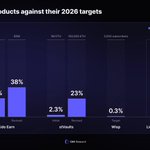
◻️ Lido Earn, which includes its ETH and stablecoin yield vaults, generates about $1.6M in fee-based ARR, against a target of $8M by the end of 2026, since revised down to $5M. Meanwhile, the leverage loops in its vaults also bring the DAO roughly $1M per year in staking fees (calculated from current figures).
◻️ stVaults, the tailored staking offering for institutions, hold 18,781 ETH, against an initial target of one million ETH, since revised down to 100,000.
◻️ According to the latest available data, published in August, @usewisp_io, the confidential AI assistant launched by Lido, had around ten paying subscribers against 3,000 expected.
In the first half of 2026, Earn and the "New Bets" category, where Wisp is accounted for, cost the DAO about $2.2M for $0.23M in net revenue.
Against this backdrop, Lido recently unveiled "Lido Lend", a product consistent with its core business, but one that may be arriving at the wrong time.
We break it all down in our latest article on the topic (link in comments) 👇

3
6
454
🟣 Hedge funds are betting on a bitcoin:native rally again, while other institutional investors remain cautious. That is what our new analysis of the CFTC's COT report shows.
Put simply, the report tracks how the main institutional players are positioned on CME Bitcoin futures, which gives a clearer picture of where they stand on the market.
In the latest data, as of November 10, hedge funds have significantly increased their longs. As a result, their short exposure has dropped to its lowest level since January 2023.
Not everyone is following, though. Asset managers, for example, are increasingly less inclined to bet on a rise, while US spot Bitcoin ETFs recorded $1.06B in net outflows over the period.
Our full analysis is in the comments 👇


🟣 Nvidia, Walmart, the Fed and LayerZero: what to watch this week
Tonight, @nvidia will report its earnings for the first time since its founding without Jensen Huang at the helm.
An event to watch just as closely as those related to the Fed, which, for its part, could clarify this week the size of its next rate hike.
On the equities side, two earnings reports to watch:
◻️ Nvidia ($NVDA)
$NVDA reports its earnings tonight, less than a week after the resignation of Jensen Huang, co-founder and CEO since 1993.
He left following revelations about several extramarital affairs, including one with a woman suspected of spying for China. Colette Kress, until now the chief financial officer, is serving as interim CEO.
The stock has lost nearly 13% in one week and is trading about 27% below its October 6 record.
Nvidia expects $108 billion in revenue, plus or minus 2%, while the consensus expects slightly more, around $109 billion, with earnings per share of $2.47.
Investors will focus above all on the guidance for the next quarter, and on what Colette Kress will say to prove that Jensen Huang’s departure changes nothing in customer orders or in the timeline for the new chips.
◻️ Walmart ($WMT)
$WMT reports Thursday before the open. The consensus expects earnings per share of $0.64, on revenue of about $186.5 billion.
This quarter is unusual, as @Walmart used nearly $2.9 billion in tariff refunds to lower prices on more than 11,000 products.
The market reacted poorly to this strategy in August, with the stock falling 10% in a single session, before a sharp rebound.
As Walmart is the largest supermarket chain in the United States, these results will also show how American households are doing ahead of the holiday season.
On the Fed side, the context has changed a lot since the October meeting.
At the time, only two members had voted for a rate hike.
Since then, the U.S. economy added 165,000 jobs in October, compared with about 60,000 expected, and prices rose 0.4% over the month, more than forecast.
The market now puts the probability of a hike in December at about 85%.
Several events this week will provide more clarity on what the Fed intends to do:
◻️ October retail sales, this afternoon, after a 0.8% increase in September, well above the 0.3% expected.
◻️ The FOMC minutes, Wednesday, which will detail the discussions from the October meeting.
◻️ Christopher Waller’s speeches, Tuesday and Friday. He recently raised the possibility of a 50 basis point hike.
◻️ Lisa Cook’s remarks on Friday, one of the two members who voted for a hike in October.
On the crypto side, one unlock has caught our attention:
◻️ LayerZero (ethereum:0x6985884c4392d348587b19cb9eaaf157f13271cd)
About 23.6 million ethereum:0x6985884c4392d348587b19cb9eaaf157f13271cd, or $33.5 million, will be unlocked on Thursday, representing nearly 3.48% of the circulating supply. These tokens go to core contributors and strategic partners.
This unlock comes eleven days before the launch of the Zero and ATLAS mainnet, scheduled for November 30.
All of this week’s earnings, unlocks and macro reports can be found on our calendar 👇

4
5
493

🚨 Trader hit by a hack of over $10M on Lighter
This morning, two accounts belonging to a trader on @Lighter_xyz were targeted in an attack worth around $15.5 million.
To keep losses from growing, the platform paused trading and withdrawals, as well as the creation of new pools, until the situation returns to normal.
According to the team, Lighter’s code is not at fault and no smart contract was hacked. The attacker reportedly just got hold of a trader’s API key.
Several on-chain analysts believe the victim is Abraxas Capital, a London-based fund that is very active on @HyperliquidX, but neither the fund nor Lighter has confirmed this so far.
Under normal circumstances, this key alone would not have been enough to steal funds.
On Lighter, an API key is mainly used to run trading bots, and it can only withdraw funds to the account owner’s wallet.
The attacker got around this limit by using public pools, which allow a trader to manage other users’ USDC. It took them about ten minutes to move the victim’s funds off the platform.
As things stand, here is the tally:
◻️ $10.39M has left Lighter. It was converted into ETH via CoW Swap, then partly dispersed, notably to buy wrapped XMR on Hyperliquid.
◻️ $5.09M from a second account is still locked, because the withdrawal freeze kicked in before the request was executed.
◻️ Users of existing pools, including LLP, are not affected.
To recover the $5.09M that is still locked, Lighter plans an emergency update to its contracts.
However, the team has not yet said whether this update will also close the public pools loophole that made the attack possible.
We explain in detail how the attacker went about it, and how Lighter plans to recover the locked funds, in our full analysis on the Alpha Feed 👇

We are actively investigating a security incident that appears to involve a single compromised external party.
As a precaution, we have temporarily suspended all withdrawals and pool creation while we investigate the circumstances and assess the full impact.
1
6
500

OAK Research retweeted
🟣 Derive has bought back 12 million DRV since January, nearly 2 million of which came from the increase in its buybacks
Every week, the Derive DAO uses part of the protocol’s fees to buy back ethereum:0xb1d1eae60eea9525032a6dcb4c1ce336a1de71be on the market. Since the start of the year, more than 12 million tokens have been bought back this way.
Until the end of April, 25% of the fees generated by the protocol were allocated to token buybacks. DIP 313 raised this share to 35%, then DIP 324 brought it to 50% in mid-October.
If the buyback program had remained at 25% until today, the DAO would have bought back only about 10.23 million ethereum:0xb1d1eae60eea9525032a6dcb4c1ce336a1de71be.
But thanks to the two proposals adopted by governance, the buyback volume has increased significantly:
◻️ The increase from 25 to 35%, in place since the end of April, has made it possible to buy back an additional 1.62 million ethereum:0xb1d1eae60eea9525032a6dcb4c1ce336a1de71be.
◻️ The increase from 35 to 50% has already added 0.25 million, even though it has only been in effect for five weeks.
The two increases have therefore made it possible to buy back 1.87 million more tokens, or about 15% of the total bought back since January.
And this result was achieved even as ethereum:0xb1d1eae60eea9525032a6dcb4c1ce336a1de71be has become increasingly expensive. The average buyback price went from about $0.05 at the start of 2026 to more than $0.30 since September.
With the same budget, the DAO would therefore buy back six times fewer tokens today than at the start of the year.
The main goal of these increases is to return more of the value created by @DeriveXYZ to ethereum:0xb1d1eae60eea9525032a6dcb4c1ce336a1de71be holders.
Rather than keeping a larger share of the fees in the treasury, the DAO is choosing to dedicate a growing share of them to buying back the token.
The more activity the platform generates, the more market demand for ethereum:0xb1d1eae60eea9525032a6dcb4c1ce336a1de71be increases, and the token thus reflects the protocol’s growth more and more directly.

OAK Research retweeted

How are vaults changing how platforms access stablecoin yield?
Petter Ikekhua, GTM Lead at Railnet (@railnet_org), and Igor Igamberdiev (@FrankResearcher), Lead at Armitage, covered vault design, sign-off and institutional capital at Stable Summit IV’s fireside, “Stablecoin Yield Through a Single Integration”.
Moderated by Artem Sinyakin (@Artem_Oak), CEO of OAK Research (@OAK_Res).
🟣 Derive has bought back 12 million DRV since January, nearly 2 million of which came from the increase in its buybacks
Every week, the Derive DAO uses part of the protocol’s fees to buy back ethereum:0xb1d1eae60eea9525032a6dcb4c1ce336a1de71be on the market. Since the start of the year, more than 12 million tokens have been bought back this way.
Until the end of April, 25% of the fees generated by the protocol were allocated to token buybacks. DIP 313 raised this share to 35%, then DIP 324 brought it to 50% in mid-October.
If the buyback program had remained at 25% until today, the DAO would have bought back only about 10.23 million ethereum:0xb1d1eae60eea9525032a6dcb4c1ce336a1de71be.
But thanks to the two proposals adopted by governance, the buyback volume has increased significantly:
◻️ The increase from 25 to 35%, in place since the end of April, has made it possible to buy back an additional 1.62 million ethereum:0xb1d1eae60eea9525032a6dcb4c1ce336a1de71be.
◻️ The increase from 35 to 50% has already added 0.25 million, even though it has only been in effect for five weeks.
The two increases have therefore made it possible to buy back 1.87 million more tokens, or about 15% of the total bought back since January.
And this result was achieved even as ethereum:0xb1d1eae60eea9525032a6dcb4c1ce336a1de71be has become increasingly expensive. The average buyback price went from about $0.05 at the start of 2026 to more than $0.30 since September.
With the same budget, the DAO would therefore buy back six times fewer tokens today than at the start of the year.
The main goal of these increases is to return more of the value created by @DeriveXYZ to ethereum:0xb1d1eae60eea9525032a6dcb4c1ce336a1de71be holders.
Rather than keeping a larger share of the fees in the treasury, the DAO is choosing to dedicate a growing share of them to buying back the token.
The more activity the platform generates, the more market demand for ethereum:0xb1d1eae60eea9525032a6dcb4c1ce336a1de71be increases, and the token thus reflects the protocol’s growth more and more directly.