

Building @SeiNetwork. Sei Giga, coming soon.
Joined November 2022
- Tweets245
- Following8
- Followers8.2K
- Likes75




Pinned Tweet
V2 of the Sei Giga Whitepaper is live.
Sei Labs can now confirm that Giga will have substantially better performance and an improved featureset over what was initially described.
Giga will have:
- Sub-250ms finality
- Pre-execution privacy
- Protocol-level MEV resistance.
Here's what's new and why it matters:
Finality: sub-250ms, down from 400ms.
Autobahn's pipelined two-phase BFT is designed to reach consensus in 1.5 round trips versus Tendermint's 3.
In the design, ordering finality is decoupled from state attestation: every trade will settle at consensus speed, while execution happens asynchronously so heavy computation never delays block production.
State commitments will use lattice hash divergence digests over write logs, eliminating Merkle tree computation from the hot path.
The biggest addition in this new version is Sedna.
On single-leader chains, the block producer controls ordering. On multi-proposer chains, any proposer that sees your full transaction can duplicate it and race you in the merge order. The whitepaper identifies three MCP-specific MEV channels.
Sedna is designed to address all of them. Senders would encode transactions into rateless fragments distributed across proposer lanes, and no proposer would see the full payload until the finalization threshold is crossed.
Pre-execution privacy without encrypted mempools, threshold decryption or adding latency to the critical path.
Under Giga, transaction ordering will be fully deterministic.
The tip priority merge rule orders lanes by descending maximum tip, preserves intra-lane position, and deduplicates by hash. The output is a pure function of the committed cut.
Every correct executor will derive the same ordered transaction sequence from the same finalized data.
Storage and execution were also substantially upgraded in v2.
Storage: flat LSM-based key-value store will replace Merkle Patricia Tries. Tiered hot/warm/cold architecture. Divergence commitments over write logs introduced.
Execution: Block-STM parallel execution with optimistic concurrency control. Pipelined parsing, address recovery, and signature verification.
The paper also clearly defines:
- Production Sedna with PIVOT-K incentive layer
- Autobahn consensus upgrades
Forthcoming research:
- Full transaction fee mechanism
- Full-scale PQC alternatives beyond ML-DSA
- Giga tokenomics

Introducing SIP-7: Decrease risk for SEI stakers by reducing pacific-1 unbonding time from 21 days to 7 days.
This SIP is now open for community discussion: github.com/sei-protocol/sips…

ALT Sei Labs card on a dark wireframe background. sei-protocol/sips/sip-7. Proposal: reduce SEI unbonding from 21 days to 7 days.
SIP-6, the proposal to upgrade Sei's consensus protocol to Autobahn, is live for voting.
If successful, SIP-6 will be the most significant change on the way to Sei Giga.
Sei will become the first MCP EVM chain.
seistream.app/proposals/129

ALT Sei Labs card on a black background with a wireframe visualizer. Text: sei-protocol/sips. SIP-6 is up for a vote. Proposal: upgrade Sei to Autobahn consensus.
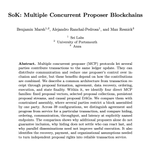
Introducing the first Systematization of Knowledge for Multiple Concurrent Proposer blockchains.
Sei Labs researchers @muurshb and @alranpe collaborated with @MaxResnick of @anza_xyz to compare 39 MCP configurations.
Full paper here: ia.cr/2026/2684

ALT First page of the paper SoK: Multiple Concurrent Proposer Blockchains by Benjamin Marsh, Alejandro Ranchal-Pedrosa and Max Resnick (Sei Labs, University of Portsmouth, Anza), showing the title, authors and abstract.
Sei Labs retweeted

Very pleased to announce we're hosting the 1st MCP workshop to be co-located with FC next February. Submissions open soon and will close on November 24th so make sure to submit your MCP papers or talks.
You can read more at ifca.ai/fc27/mcp/
Sei Labs is proud to be hosting the first ever academic workshop on Multiple Concurrent Proposer blockchains, alongside @anza_xyz, @Mysten_Labs and @category_xyz.
Submissions open soon: fc27.ifca.ai/mcp/cfp.html

Sei Labs retweeted

Can't miss it:
Key players in the industry have gotten together to answer critical questions on MCP by creating the first workshop on Multiple Concurrent Proposers is happening at Financial Cryptography 2027, Barbados, Feb 12.
MCP lets many validators propose at once instead of one leader per block: fair market access and censorship resistance.
Submit talks or papers by Nov 24 AoE!
fc27.ifca.ai/mcp/cfp.html

The proposal for SIP-6, upgrading Sei's consensus protocol to Autobahn, is live.
If successful this will be the most significant change on the way to Sei Giga, and make Sei the first multi-proposer EVM chain.
See the discussion here: github.com/sei-protocol/sips…

Scaling Sei's storage to handle 200K TPS is extremely challenging.
Every 24 hours Giga could create as much state as Ethereum has in its entire history.
To keep up, Sei is splitting Giga's storage in two. @alrevuelta explains how.
seilabs.io/research/scaling-…

Last week @SeiNetwork completed its biggest migration since 2024.
~712 million EVM keys moved from MemIAVL to FlatKV without affecting chain performance.
Today Sei nodes run on >30GB less memory, and snapshot rewrite time has decreased from 4 to 9 hours to ~10 minutes.

This migration was part of Sei Giga's Eidos Upgrade.
Learn more about how Eidos is increasing Sei's storage capacity to reach Giga levels of throughput here:
blog.sei.io/the-eidos-upgrad…


A Sei Labs researcher has a found a critical safety issue in a major new consensus protocol.

I found a critical safety issue in one major new consensus protocol in the blockchain sector.
The protocol had been formally verified, HOWEVER the formally verified protocol is not the same as the pseudocode.
This appears to be the same scenario that OpenAI has run into with Navier-Stokes.
If this had gotten into production it could have triggered a catastrophic failure, since only a small portion of stake could have broken safety.
The protocol in question is Fast Tendermint. It lets a single Byzantine validator (out of 5f+1) make honest validators decide different values. With 2 validators, equivocation is not even required.
Paper with two fixes and proofs: github.com/ranchalp/fast-ten…
Disclaimer: The authors also specified they consider the formally verified protocol the source of truth.

Sei v6.7 is live on mainnet.
Proposal #125 passed and validators have upgraded pacific-1 to v6.7.
v6.7 installs the governance switch for the next Eidos step: moving EVM state from memIAVL to FlatKV. The migration itself will follow separately, after the upgrade.
It also streamlines the codebase, removing 184K lines of legacy code across 305 merged PRs from 17 contributors.
Top highlights:
- SIP-3: IBC, CosmWasm IBC, capability and feegrant are removed, leaving a much smaller Cosmos surface around Sei's EVM.
- Faster EVM execution: contract bytecode is cached in memory across calls, and BLOCKHASH is read from a 256-block ring in state.
- Resilient public infrastructure: RPC, WebSocket and query endpoints now enforce per-client limits and bounded work, so one heavy caller can't degrade service for everyone else.
- Hardened core: tighter validation throughout the protocol, backed by AI-assisted security review.
- Simpler node operations: built-in seed peers, so a fresh node joins the network with no peer config.
Release notes: github.com/sei-protocol/sei-…

The proposal to upgrade Sei to v6.7. is now live.
v6.7 sets up the future migration of EVM state from memIAVL to FlatKV.
It also continues SIP-3 by removing IBC core, IBC transfer, and other legacy CosmWasm elements from the chain.
Vote here: seistream.app/proposals/125


Sei Labs retweeted

This is a frontier breakthrough in consensus.
Hermes is an upcoming consensus protocol which will eventually go live on Sei Giga.
It just delivered 68ms finality in our test environment.


Performance was achieved across 51 replicas in 4 European regions at a stable rate of 100 000 TPS.
Note that the numbers quoted indicate lab conditions only. Production numbers will vary.
Read the full post here:
seilabs.io/research/hermes-f…
