
Law student. Coloradan. Former worker pay & power researcher @BrookingsMetro.
Boston, MA
Joined June 2020
- Tweets95
- Following292
- Followers220
- Likes1.2K




In our latest piece, @MollyKinder @kathrynsbach & I find that #inflation has erased at least half of the average wage gains for workers at 13 leading fast food & retail companies since the start of the pandemic brook.gs/3dynQPI
⬇️Costco increased starting wages...again.
This post is from an account that no longer exists. Learn more
3
Women and people of color are concentrated in the types of gig work jobs that offer the lowest pay, @xavbriggs writes in a new @FastCompany op-ed. COVID-19’s fallout revealed how archaic our definitions of work, workers, and worker protection are. https://nitter.gq/t.co/FbLittumgT
2
Headlines about wage increases (sometimes) don't capture the behind-the-scenes changes that negatively impact worker #takehomepay.
See @MollyKinder's math below.
This post is from an account that no longer exists. Learn more
7
A piece full of good examples by @TerriGerstein about the impact & societal consequences of jobs with low pay, long hours, bad treatment, or no #workervoice.
nytimes.com/2021/09/06/opini…
1
Timely piece by @_cromer043 & @andreperryedu: Black neighborhoods and low-wage, #EssentialWorkers will bear the brunt of the coming eviction crisis, and the crisis won’t be solved if we don’t address why residents have difficulty paying rent to begin with. brook.gs/2V7ZUx5

3
Great thread by @MollyKinder on how state & local govts should design their premium pay (#hazardpay) programs using ARP funding.
Programs should: (a) cover a broad range of #EssentialWorkers, and (b) not necessarily include large retail chains that have earned windfall profits
This post is from an account that no longer exists. Learn more
1
Treasury guidance on #ARP provides recipient govts flexibility to apply #premiumpay prospectively—using the funds to provide incentives to workers to fill in-person occupations w/ many vacancies, such as in health care, care work, retail, & restaurants.
brook.gs/3vYe8wY
1
1
State & local officials can also apply premium pay (#hazardpay) retrospectively for work performed at any time since the start of COVID-19—recognizing that many #EssentialWorkers have yet to be adequately compensated for work they previously performed. @berubea1 @EliByerlyDuke
1
Data from @indeed find that job postings in nearly all sectors are above the pre-pandemic baseline.
Low-remote sectors saw the biggest increase in job postings: manufacturing (+71%), loading & stocking (+69%), construction (+60%), and pharmacy (+57%).
hiringlab.org/2021/05/11/job…

Postings are up most in low-remote sectors -- in-person jobs that sustained the pandemic economy as well as in-person sectors that shut down and reopened.
hiringlab.org/2021/05/11/job…
3/

My research at @BrookingsInst and interviews with #essentialworkers over the past year have shown that unions make workplaces safer, more equitable, and give workers a voice.
That's why I support #BrookingsUnited
@BrookingsUnion

@Kroger, the largest US supermarket chain, aims to double its digital sales by 2023. It will open its first of 10 fully automated distribution warehouses this spring.
Another example of how traditional retail jobs are changing b/c of covid & to compete with Amazon and Walmart.

Kroger is betting that cavernous automated warehouses are the solution to meet growing demand for online grocery orders in the race against Amazon, Walmart.
cnn.com/2021/04/14/business/…
The care economy is the "invisible scaffolding" that allows American workers to actually get the job done.
My two @BrookingsMetro mentors, @MollyKinder & @MarthaHRoss, with a great piece in the New York Times.
nyti.ms/3mTp2kF

8
State & local governments can now take the lead in implementing new #hazardpay programs by leveraging the tremendous flexibility of the ARP’s $350 billion in state and local aid. @MollyKinder explains 4 design principles that policymakers can consider. brook.gs/3a5uETJ
⬇️Great thread from @MollyKinder showcasing the voices of #EssentialWorkers a year into the pandemic & summarizing our recent work (including a collaboration with @andreperryedu and @_cromer043)
This post is from an account that no longer exists. Learn more
My thoughts are with my home state of Colorado, the Boulder community, and the victims & their loved ones. So sad to see another Colorado community grapple with this grief.
2
Great thread from my colleague, @MollyKinder. She provides context to Walmart's announcement that it's raising wages for ~¼ of its frontline associates.
“A company’s wage floor matters”
@Walmart, the largest private employer in the country, STILL has a starting wage of $11/hr.
This post is from an account that no longer exists. Learn more
5
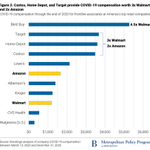
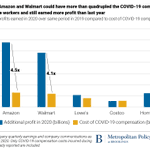
In our latest #hazardpay analysis at @BrookingsMetro, @MollyKinder and I find that Amazon & Walmart could have *quadrupled* the COVID-19 compensation given to their #frontlineworkers through their last Q and STILL earned more profit than last year.
1/


In our new @BrookingsMetro piece, @MollyKinder, @JuliaTDu, and I take a look at the state of hazard pay today.
While the hazards of #COVID19 are growing worse as we enter a 3rd peak, few frontline essential workers are receiving any hazard pay at all. 1/
brook.gs/37QJ35D
1
3
While large retail companies initially offered #hazardpay, most ended it months ago. We found that that #essentialworkers at the top 20 companies have been without hazard pay for an average of 126 days. 2/

1