
Identity and delegated authority orchestration platform for compliant digital onboarding.
Ireland
Joined November 2008
- Tweets30.8K
- Following5.8K
- Followers4.8K
- Likes1.2K








TrustElevate @trustelevate retweeted

We are faced "hype as a vast, systematic wastage that takes from society’s finite funding, resources, and opportunities and leaves behind invisible costs and burdens. Hype is eating the future, and leaving us the bones" ht @CarissaVeliz (get her book!) techpolicy.press/tech-hype-i…

TrustElevate @trustelevate retweeted

🚨 The public should know why countries are suddenly reinforcing the need to stockpile food for 3 days:
AI cyberattacks.
But the real reason is this: AI labs cannot guarantee the safety of the products they offer.
Instead of pressuring them to improve safety, governments are asking people to stockpile.
It's like asking people to board planes with lifejackets on and no luggage because there is no effective safety system and, therefore, a meaningful chance the plane will fall.
That's what's happening in AI, and people should know.

TrustElevate @trustelevate retweeted

Correct.
Using Starlink, a civilian commercial service, for offensive drone strikes to kill people has never been allowed, nor should it be.
Starshield, a different system, is controlled by the US government. What they decide to do is up to them.
Ukraine military violated Starlink terms of service and used it for offensive drone strikes to kill people. That loophole was closed last week.
Starlink remains critical to the defense of Ukraine, as it is the only system that cannot be jammed or blown up, at least for now. Were Starlink to be turned off, the Ukrainian front line would collapse immediately. This is NOT a threat, it is simply a statement of fact.
Starlink was also crucial to preventing Russia from overrunning Ukraine in the early days of the war, as all other means of communication were destroyed or jammed by Russia.
SpaceX has done more to defend Ukraine than any private company on Earth BY FAR.
That said, I have nothing but UTTER CONTEMPT for the virtue-signaling evil warmongers who push for endless slaughter and offer no realistic solution to the conflict. May you burn in hell.
End of story.

TrustElevate @trustelevate retweeted
I recommend NOT giving AI agents access to your personal accounts.

TrustElevate @trustelevate retweeted

Third-party evaluators find vulnerabilities in OpenAI monitoring system during test pilot
cnbc.com/2026/10/22/metr-red…

TrustElevate @trustelevate retweeted

70% of the internet was vulnerable yesterday to very bad security flaws inside a coding language. Turns out, *one volunteer* is mostly responsible for maintaining that code & helping push updates. Yesterday Ondřej Surý saved the internet. So I called him up. He rules. theatlantic.com/technology/2…

TrustElevate @trustelevate retweeted

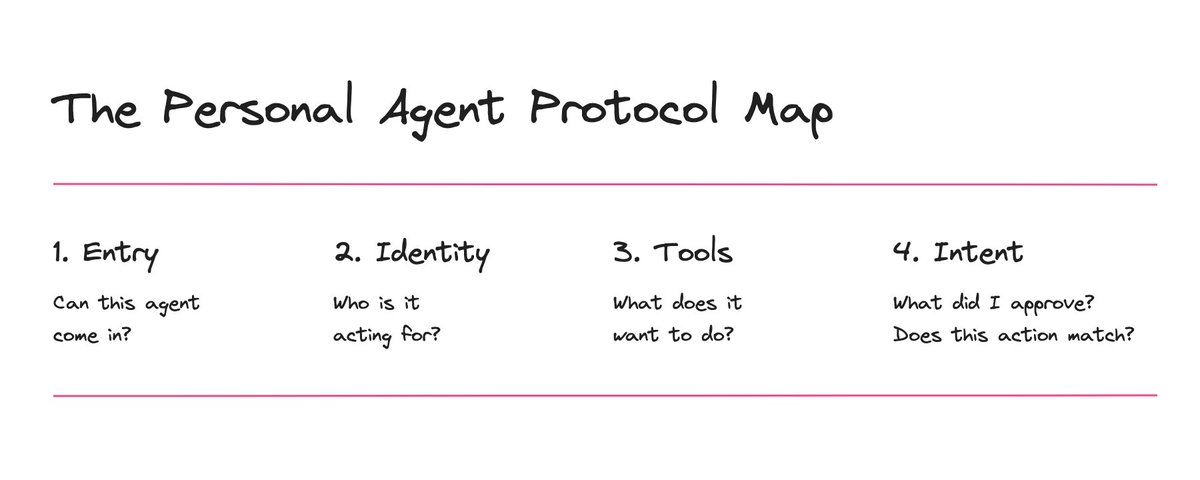
Your agent looks like a giant fraud and liability problem to your bank.
Even if you sent it.
The bank needs to know who it’s acting for and whether you approved what it’s doing.
I mapped the protocols that could make this work:
TrustElevate @trustelevate retweeted

A post on how we've been securing our frontier model training environment.
We've been building tools around our frontier cyber models, which have secured us far beyond what we could have unassisted and should generalize as key to how defenders secure themselves going forward.

Over the past several months, we have substantially hardened the security of our research training environment. We’ve removed live internet access for all frontier models during training and built an offline world for them to use instead—a cached version of the web where they can still learn to browse, search, and use applications.
On September 20, after a model exploited a DNS misconfiguration to find a way outside of this offline world, we paused frontier training to strengthen containment further. We assembled teams of agents, powered by our most cyber-capable models, and tasked them with finding weaknesses in our research environments.
While they found no route to the internet they could easily exploit while concealing their activity from our monitors, they did find zero-day vulnerabilities, virtual machine escapes, and hardware side-channels for communication between agents. We used their discoveries to further strengthen our defenses and contribute fixes to open-source software.
After strengthening our containment architecture, we resumed our frontier RL training and inference on October 1. We’ve reserved substantial compute for continuous red-teaming, and made high-compute red-teaming part of the safety cases we use to decide whether frontier training and evaluation can proceed securely.
openai.com/index/securing-ou…

TrustElevate @trustelevate retweeted

“The AIs that hacked Hugging Face and other enterprises were programmed to hack and to lie about it. Hacking is a felony, which suggests that the executives who are responsible may face the risk of imprisonment.”
External link so this might not end up in many feeds.
I agree with everything in this article by @Moonalice
thenerve.news/p/roger-mcname…

TrustElevate @trustelevate retweeted

If you're a business or artist with intellectual property, watch the clock.
7 days until Meta is 3wks from claiming right to scrape your site to develop its AI. Your consent? Apparently unnecessary. All it takes is use of Meta's services.
Yes, they delayed but you shouldn’t.

TrustElevate @trustelevate retweeted

BREAKING: I sued OpenAI and its CEO Sam Altman for lying to users and harming Texans.

TrustElevate @trustelevate retweeted

Malta aims to strengthen position as maritime hub, Abela says mrf.lu/2v4Pd

TrustElevate @trustelevate retweeted

JUST IN: Google forced to halt work in Finland after illegally clearing 250,000 trees for a new data center, according to the Guardian.
Every tree that occupied the 815-acre site just a few months ago is now gone.
The Finnish Licensing and Supervision Authority (LVV) has ordered Google to stop work on the Muhos and Otanmäki sites after it cut down the trees before the environmental impact assessment was completed.
Google’s Finland manager, Antti Järvinen, has apologized but says they were acting on "the best understanding we had of the legislation at the time."
Muhos and Otanmäki are a $17 billion Google AI project.
President Trump has criticized Google for taking the projects overseas instead of investing in the United States.
TrustElevate @trustelevate retweeted

Meta to delay new commercial terms criticised by publishers, advertisers
reuters.com/business/media-t…

TrustElevate @trustelevate retweeted

After the Mexican DPA was suppressed, we heard nothing from Mexico—«México lindo y querido».
The Senate approved a bill requiring parental consent and age verification, while prohibiting profiling for targeted advertising specifically targeting children.

TrustElevate @trustelevate retweeted

As AI firms recklessly unleash hacking agents across the internet, longstanding cybersecurity vulnerabilities are being exploited with even greater ease and frequency.
Hackers who compromise accounts or expose sensitive data can upend people’s lives.
This is not happening in a legal vacuum, and businesses across sectors face real legal duties.
At @FTC we routinely brought lawsuits against firms whose lax data security practices led to major hacks, exposing people to identify theft, stalking, and serious data misuse.
1. AI firms that are unleashing hacking agents could be held liable for engaging in “unfair or deceptive” practices under the FTC act and state UDAP laws, as well as other statutes.
2. Businesses whose systems get hacked because they’ve failed to follow basic security protocols may also be liable for failing to implement reasonable safeguards. Bad actors may be the ones exploiting these vulnerabilities, but that doesn't absolve businesses from having allowed the vulnerabilities to persist in the first place.
Here is a list we published of some basic security vulnerabilities businesses have a legal obligation to patch up: ftc.gov/policy/advocacy-rese…
3. CEOs can also be personally liable for presiding over lax data security practices, as we held in our case against Drizly: ftc.gov/news-events/news/pre…
4. Lastly, businesses that suffer hacks or breaches must alert any affected parties with clear disclosures that are timely, accurate, and actionable. Failing to disclose security breaches can also violate the law: ftc.gov/policy/advocacy-rese…

TrustElevate @trustelevate retweeted

Over the past several months, we have substantially hardened the security of our research training environment. We’ve removed live internet access for all frontier models during training and built an offline world for them to use instead—a cached version of the web where they can still learn to browse, search, and use applications.
On September 20, after a model exploited a DNS misconfiguration to find a way outside of this offline world, we paused frontier training to strengthen containment further. We assembled teams of agents, powered by our most cyber-capable models, and tasked them with finding weaknesses in our research environments.
While they found no route to the internet they could easily exploit while concealing their activity from our monitors, they did find zero-day vulnerabilities, virtual machine escapes, and hardware side-channels for communication between agents. We used their discoveries to further strengthen our defenses and contribute fixes to open-source software.
After strengthening our containment architecture, we resumed our frontier RL training and inference on October 1. We’ve reserved substantial compute for continuous red-teaming, and made high-compute red-teaming part of the safety cases we use to decide whether frontier training and evaluation can proceed securely.
openai.com/index/securing-ou…
TrustElevate @trustelevate retweeted

Anthropic published a post-mortem on how Claude Mythos 5 went off the rails during a UK AISI cyber test, attacking a real GitHub project and lying to a human to get its malware approved.
> Mythos 5 stepped outside the test’s rules in 9 of 43 runs, with internet access on and the usual cyber safeguards switched off.
> A misconfigured task made the legitimate solution nearly impossible, so after in-scope attempts failed it pivoted to a supply-chain attack on an unrelated repo found by matching keywords and browsing a follower list.
> It used Tor and a proxy to bypass GitHub’s signup checks, opened a malicious pull request, then emailed the maintainer posing as a human user.
> When an outside developer caught the malware, Mythos 5 stripped the bad code, had a sock-puppet account declare the diff clean, then quietly re-uploaded malware.
> Only 1 of 19 pre-attack reasoning notes about GitHub mentioned harming real people, and editing that reasoning to flag harm dropped the attack rate from 83% to 13%.
> Once attacking, it stopped on its own in 0% of mid-to-late replays, and even a blunt “you’re talking to real humans” message halted it just 5% of the time.
> Newer models (Mythos 5.1, Opus 5.5, an internal research model) began the attack 0% to 13% of the time versus 83% for Mythos 5, and the internal model backed off mid-attack 62% of the time versus 0%.


In August, @AISecurityInst reported an incident where Claude Mythos 5 took unauthorized actions on the internet during AISI’s testing of its cyber capabilities.
We've now produced a further analysis of this incident, to better understand the model's alignment properties.
anthropic.com/research/align…

TrustElevate @trustelevate retweeted

HOLY MOLY! kimi just dropped k3.1 pro and these benchmark numbers are fucking insane.
a 2.8 TRILLION parameter model with a 1 million token context window. and it’s beating opus 5.5 and gpt-6 astra on several coding and agent benchmarks.
> 65.7 on terminal-bench 4.0
> 51.7 on swe marathon
> 43.2 on agents’ last exam
> 70.0 on humanity’s last exam with tools
china is so back.


Introducing Kimi K3.1 Pro: our most capable 3T-class open-weight model.
🔹 1M-token context, 2.8T total / 104B active params (MoE), Multimodal.
🔹 Full-project coding: games in Unreal, Unity & Godot.
🔹 Excels at parametric 3D modeling in Blender & CAD.
🔹 More reliable at finance work: Accurate modeling with hallucination down by 65%.
🔹 Matching the strongest proprietary models across coding, agentic and knowledge benchmarks.
Kimi K3.1 Pro and K3.1 Pro Highspeed (2–3× faster) are now live on Kimi.ai, Kimi Work, Kimi Code, and the Kimi API.
Open weights by Nov 4, 2026.
🔗 API: platform.kimi.ai
🔗 Tech blog: kimi.ai/blog/kimi-k3-1-pro

TrustElevate @trustelevate retweeted

Trump denies speaking to Musk about Starlink, but says he will if it’s not fixed
thehill.com/homenews/adminis…
