

Product Developer Human Biology, Medicine & Health Technology Host of The Active Site podcast
Joined October 2014
- Tweets3.4K
- Following76
- Followers34.3K
- Likes413



People whose diets were above the lowest niacin intake had about 20% less dementia over ten years, and eating more niacin than that added nothing.
Niacin, or vitamin B3, helps make NAD, a molecule every brain cell uses to produce energy, and a severe shortage can cause dementia on its own. The question has been whether ordinary differences in diet matter. In a Chicago study of 815 adults aged 65 and older, people in most of the higher niacin groups had about a 70% lower risk of developing Alzheimer's disease over four years than people with the lowest intake, and among 3,718 people tracked for cognitive change, more niacin from food went with slower decline.
The new study, in Nutrition Journal, followed 207,043 UK Biobank adults for a median of about 10.5 years, during which 2,403 developed dementia. Niacin from food, including what the body makes from the amino acid tryptophan, was estimated from one or more 24-hour diet surveys and scaled to each person's calorie intake. The analysis accounted for age, education, smoking, exercise, overall diet quality, other B vitamins, and B vitamin supplements.
1. Compared with the lowest fifth for niacin, every other group had a lower risk of dementia, by 18%, 25%, 21%, and 21% from the second fifth to the top fifth.
2. Risk fell with each added milligram only up to about 18 mg per 1,000 calories, by about 5.5% per milligram, and then leveled off. Even the lowest group was already eating more than twice Europe's reference intake.
3. Memory and processing speed scores were best in the middle range, and the lower risk of Alzheimer's disease in particular was seen only in people with high genetic risk.
Taken together, niacin looks like a floor to clear rather than a dose to push. The lowest niacin diets were likely low in protein and overall food quality, and the simple way to stay out of that group is to eat regular protein foods such as fish, poultry, eggs, dairy, beans, and peanuts, along with whole grains and mushrooms. Nothing here supports taking niacin pills for the brain, and high-dose niacin can cause side effects.
This was an observational study, so it shows a link and not proof that niacin prevents dementia. Diet was measured with only a few 24-hour surveys, and niacin intake tracks closely with protein and diet quality, which the adjustments may not fully separate. The earlier numbers above come from a separate study.
References
Luo C et al., Nutrition Journal, 2026
Morris MC et al., Journal of Neurology, Neurosurgery and Psychiatry, 2004

Sources:
Luo et al., Nutr J 2026: doi.org/10.1186/s12937-026-0…
Morris et al., J Neurol Neurosurg Psychiatry 2004: doi.org/10.1136/jnnp.2003.02…
doi.org/10.1186/s12937-026-0…

184
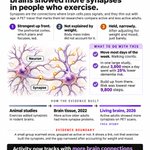
For the first time, scans of living brains showed more synapses, the connections between brain cells, in people who exercise.
Exercise has solid human evidence for brain health. In a randomized trial of 120 older adults, a year of aerobic exercise training grew the hippocampus, the brain's memory center, by 2%, which reversed about one to two years of age-related shrinkage and went along with better memory. In 78,430 UK adults who wore activity trackers, about 9,800 steps a day went with roughly half the risk of dementia over seven years, and even about 3,800 steps a day went with 25% lower risk.
What has been missing is a direct look at the brain's wiring. Synapses thin out with age and with depression, and the evidence that exercise protects them has come almost entirely from animals and from brains studied after death. In the new study, in Biological Psychiatry: Cognitive Neuroscience and Neuroimaging, Yale researchers used a PET scan with a tracer that binds to synapses to measure synapse density in the living brains of 51 adults, 61% of them women, and compared people who were physically active with people who were insufficiently active.
1. Physically active people had higher synapse density across the brain's mood and memory circuits than less active people.
2. The clearest links were in the prefrontal cortex, the part of the brain that handles planning, focus, and self-control.
3. Body weight did not explain the difference, and the pattern was still present, though borderline, after accounting for both weight and depression symptoms.
Taken together, this is the first evidence from living people that physical activity goes along with more of the connections the brain runs on, which fits with the trials showing that exercise can grow memory regions. It adds one more reason to move most days of the week, and walking counts.
This was a small study that scanned each person once, so it shows a link and not proof that exercise builds synapses. Active people may differ in other ways, and the result became borderline after adjusting for weight and depression. The earlier numbers above come from separate studies.
References
Moisieienko K et al., Biological Psychiatry: Cognitive Neuroscience and Neuroimaging, 2026
Erickson KI et al., Proceedings of the National Academy of Sciences, 2011
Del Pozo Cruz B et al., JAMA Neurology, 2022

Sources:
Moisieienko et al., Biol Psychiatry Cogn Neurosci Neuroimaging 2026: doi.org/10.1016/j.bpsc.2026.…
Erickson et al., PNAS 2011: doi.org/10.1073/pnas.1015950…
Del Pozo Cruz et al., JAMA Neurol 2022: doi.org/10.1001/jamaneurol.2…
doi.org/10.1016/j.bpsc.2026.…
1
329
About 45 minutes a day of tracked activity went with half the coronary calcium in adults near 80.
Movement has long been tied to living longer. A pooled analysis of 15 studies with 47,471 adults found that people in the top quarter for daily steps, at about 10,900 a day, had 53% lower risk of dying during follow-up than people in the bottom quarter, at about 3,550 steps, and for adults over 60 the benefit leveled off around 6,000 to 8,000 steps a day. The link with calcium in the heart's arteries has been less clear. In a study of 284 male athletes, those with the highest lifelong exercise volume were more likely to have coronary calcium, at 68%, but their plaques were more often fully calcified and less often the mixed type, at 48% compared with 69% in the least active men.
The new study, in JACC: Advances, looked at 1,429 adults from the long-running ARIC study, with a median age of 78. Each person wore a chest-patch heart monitor with a built-in motion sensor that recorded their moderate-to-vigorous activity, filled out a questionnaire about their activity over the past year, and had a heart CT scan to measure coronary artery calcium, a direct marker of plaque.
1. Measured activity tracked closely with calcium. The modeled calcium score was 197 in people who recorded no moderate-to-vigorous activity and fell to 94, about 52% lower, at about 45 minutes a day.
2. More was not always better. Beyond about 45 minutes a day, the calcium score crept slightly back up, giving a J-shaped curve.
3. The questionnaire showed no link with calcium at all, and what people reported matched what the monitor recorded only weakly, with a correlation of 0.40.
Taken together, about 45 minutes a day of brisk walking or similar activity looks like a reasonable target, even late in life, and a watch, phone, or other wearable gives a far more honest count than memory does. People who want to know where they stand should measure their activity for a week or two rather than guess.
This was a single snapshot with one CT scan per person, so it shows a link and not proof that activity lowered calcium. The curve is a statistical fit, these were mostly adults in their late 70s, and the slight rise at higher amounts does not mean that more activity is harmful. The earlier numbers above come from separate studies.
References
Sun D et al., JACC: Advances, 2026
Paluch AE et al., The Lancet Public Health, 2022
Aengevaeren VL et al., Circulation, 2017

Sources:
Sun et al., JACC Adv 2026: doi.org/10.1016/j.jacadv.202…
Paluch et al., Lancet Public Health 2022: doi.org/10.1016/S2468-2667(2…
Aengevaeren et al., Circulation 2017: doi.org/10.1161/CIRCULATIONA…
3
409
Watching TV went with worse memory in older adults, but using a computer went with better thinking.
TV has been under suspicion for a while. In the English Longitudinal Study of Ageing, 3,662 adults over 50 who watched more than 3.5 hours of TV a day showed a steady, dose-dependent decline in verbal memory over the next six years. A UK Biobank study of 146,651 adults aged 60 and older, followed for about 12 years, found that more time watching TV went with about 24% higher risk of dementia, while more time on a computer went with about 15% lower risk, and both links held no matter how physically active people were.
The new study, in npj Digital Medicine, pulled together four large aging studies from the United States, England, and Europe, with people averaging between 69 and 76 years old. The researchers compared hours of TV with hours of computer use against memory and thinking test scores, after accounting for age, education, health, depression, and other factors. They then used genetic data to check whether the pattern held for people whose genes nudge them toward more TV or more computer time.
1. In all four studies, each extra daily hour of TV went with lower overall thinking scores, mostly in memory. Between 40% and nearly half of participants watched four or more hours a day.
2. Computer use went with higher scores, especially in processing speed and delayed recall, and the gains were clearest at light to moderate use, with the best results at about two to three hours a day in three of the four studies.
3. The genetic analysis pointed in the same direction. Genetically predicted TV time went with poorer thinking and a smaller insula, a brain region involved in attention and self-control, while genetically predicted computer time went with better thinking.
Taken together, the kind of screen time seems to matter more than the screen itself. Sitting and passively watching is linked to worse memory, while time spent doing something that makes the brain work is linked to better thinking. Trading some daily TV for reading, writing, puzzles, video calls, or learning something new is an easy swap to make.
These were observational studies, so they show links and not proof that TV harms the brain, and the effect of any single hour was small. The surveys counted hours on a computer but not what people did on it, smartphones were not measured, and people with better thinking may simply choose to use computers more. The earlier numbers above come from separate studies.
References
Zhong Z et al., npj Digital Medicine, 2026
Fancourt D, Steptoe A, Scientific Reports, 2019
Raichlen DA et al., Proceedings of the National Academy of Sciences, 2022

Sources:
Zhong et al., NPJ Digit Med 2026: doi.org/10.1038/s41746-026-0…
Fancourt & Steptoe, Sci Rep 2019: doi.org/10.1038/s41598-019-3…
Raichlen et al., PNAS 2022: doi.org/10.1073/pnas.2206931…

3
340
A high-fiber diet cut the nanoplastics left in the body a day later from 39% to 6%.
We already swallow plastic. In a small study of eight healthy adults from Europe and Asia, every stool sample contained microplastics, with a median of 20 particles per 10 grams. Fiber, meanwhile, has strong human evidence for other reasons. A Lancet analysis of 185 prospective studies and 58 clinical trials found that in the observational studies, people who ate the most fiber had a 15% to 30% lower risk of early death, heart disease, stroke, type 2 diabetes, and colorectal cancer than people who ate the least, and the risk reduction was greatest at about 25 to 29 grams a day.
The new study, in Nature Communications, asked whether fiber changes what happens to nanoplastics after they are swallowed. Researchers fed male mice nanoplastics tagged with a fluorescent dye and tracked them with imaging while the animals ate diets containing 5%, 15%, or 50% purified cellulose fiber. The 5% diet is the standard rodent diet. They followed single doses for 24 hours and daily doses for 28 days.
1. Twenty-four hours after a single dose, 39% of the plastic was still in the body on the standard diet, compared with 17% on the 15% fiber diet and 6% on the 50% fiber diet. Within the first six hours, 71% had already left on the highest fiber diet, compared with about 3% on the standard diet.
2. After 28 days of daily doses, plastic buildup in the gut on the highest fiber diet was about a sixth of that on the standard diet, and less reached organs such as the liver. On the standard diet the finger-like villi in the gut wasted away and the seals between cells broke down. The 15% fiber diet kept the lining intact, and the 50% diet caused only mild changes.
3. The mechanism looks physical. In lab simulations of digestion, digested cellulose had about 10 times more surface area than before digestion and held the particles on it, so they could pass out in stool instead of being absorbed.
Taken together, fiber appears to act as a physical trap that carries plastic out of the body, which could be one more benefit of a nutrient most people already need more of. Aiming for 25 to 30 grams a day from beans, lentils, whole grains, vegetables, fruit, nuts, and seeds is worth doing for your heart, blood sugar, and gut whether or not it turns out to help with plastics. Do not try to copy the 50% fiber diet from this study or reach for large doses of fiber supplements.
This study used small groups of male mice only. The 50% fiber diet is far beyond any human diet, the fiber was purified cellulose rather than whole foods, and the authors say neither fiber level should be read as a recommendation for people. The human numbers above come from earlier, separate studies.
References
1. Yu Z et al., Nature Communications, 2026
2. Schwabl P et al., Annals of Internal Medicine, 2019
3. Reynolds A et al., The Lancet, 2019

Sources:
Yu et al., Nat Commun 2026: doi.org/10.1038/s41467-026-7…
Schwabl et al., Ann Intern Med 2019: doi.org/10.7326/M19-0618
Reynolds et al., Lancet 2019: doi.org/10.1016/S0140-6736(1…

2
480
Six kinds of exercise, from walking to yoga, each eased fatigue during cancer treatment.
A new network meta-analysis pooled 166 randomized trials with 14,076 patients and compared types and weekly amounts of exercise for cancer-related fatigue. During treatment, aerobic exercise, strength training, the two combined, yoga, walking, and traditional Chinese exercise such as tai chi and qigong all reduced fatigue. After treatment ended, aerobic exercise, combined training, yoga, and Pilates helped. The doses were moderate. The largest modeled benefit during treatment came from yoga at an estimated 3 hours a week, and after treatment from Pilates at an estimated 1 hour 45 minutes a week.
Cancer fatigue is driven by treatment effects on muscle, sleep, inflammation, and fitness, and regular movement works on several of those at once rather than just one.
Earlier evidence agrees. A meta-analysis of 113 trials with 11,525 people found that exercise and psychological therapy both reduced cancer-related fatigue during and after treatment, while medications did not. An international roundtable of exercise and cancer experts concluded that every survivor should avoid inactivity, and that aerobic exercise, strength training, or both can improve fatigue, anxiety, depression, physical function, and quality of life. For fatigue, they concluded that moderate aerobic exercise three times a week for at least 12 weeks reduces it both during and after treatment, that sessions longer than 30 minutes may help more, and that combined aerobic and strength training two to three times a week may also work.
What this means for you: almost any kind of movement can help, so the best program is the one you will keep doing. If you are in treatment, start with what feels doable, even 10 minutes of walking or a gentle yoga class, and build toward a few hours a week. Spread it across the week, and let your care team know what you are doing, especially if you have low blood counts, bone involvement, or recent surgery.
The certainty of the evidence ranged from very low to moderate, and the best-dose figures come from a statistical model with wide margins rather than from trials that compared doses directly.
References
1. Huang H, et al. Support Care Cancer. 2026;34(12):1262.
2. Mustian KM, et al. JAMA Oncol. 2017;3(7):961-968.
3. Campbell KL, et al. Med Sci Sports Exerc. 2019;51(11):2375-2390.

Sources:
Huang et al., Support Care Cancer 2026: doi.org/10.1007/s00520-026-1…
Mustian et al., JAMA Oncol 2017: doi.org/10.1001/jamaoncol.20…
Campbell et al., Med Sci Sports Exerc 2019: doi.org/10.1249/MSS.00000000…

1
436
8 g of citrulline malate added 10.7 reps across eight sets of hack squats to failure.
Citrulline is converted in the body to arginine and then to nitric oxide, a signal that widens blood vessels and may help working muscle. In 2010, Perez-Guisado and Jakeman gave 41 trained men 8 grams of citrulline malate an hour before a 16-set chest workout. From the third tested set onward they completed more bench-press reps at 80% of their max, with the last set reaching about 53% more reps than on placebo, and muscle soreness was about 40% lower at 24 and 48 hours. In 2015, Wax and colleagues tested the same 8 gram dose in 12 advanced lifters before five sets each of leg press, hack squat, and leg extension at 60% of their max. Total reps were higher on citrulline malate for all three lifts, including 38.3 versus 31.7 on the hack squat. A 2026 review of 30 randomized trials in 644 people found only a small overall performance benefit, equal to citrulline malate beating placebo about 55 times in 100, just above a coin toss.
A new double-blind crossover trial from the same research group tested a single hypertrophy-style session. Fifteen trained men took 8 grams of citrulline malate or a placebo one hour before eight sets of hack squats at 67% of their max, taken to failure with 90 seconds of rest, then swapped drinks a week later.
1. Total repetitions rose by 10.7 on citrulline malate, with the true gain most likely falling between 1.4 and 20 reps.
2. Muscle soreness was lower at both 24 and 48 hours, while ratings of perceived effort and blood lactate did not differ between drinks.
3. In this trial, citrulline malate beat placebo about 67 times in 100, a clearer session-level edge than the 55 in 100 average across those 30 earlier trials.
Taken together, an 8 gram dose taken about an hour before high-volume sets to failure can add reps without making the work feel harder, which matters most when the goal is more quality work in a single session.
This was 15 trained men and one workout on each drink. It does not show whether the extra reps add up to more muscle or strength over weeks of training, and the likely gain in this study ranged widely from just over 1 rep to as many as 20.
References
Wax B et al., Journal of Strength and Conditioning Research, 2026
Perez-Guisado J et al., Journal of Strength and Conditioning Research, 2010
Wax B et al., Journal of Strength and Conditioning Research, 2015
Wang X et al., Nutrients, 2026

Sources:
Wax et al., J Strength Cond Res 2026: doi.org/10.1519/JSC.00000000…
Perez-Guisado et al., J Strength Cond Res 2010: doi.org/10.1519/JSC.0b013e31…
Wax et al., J Strength Cond Res 2015: doi.org/10.1519/JSC.00000000…
Wang et al., Nutrients 2026: doi.org/10.3390/nu1812188112…

1
405
Each healthy habit adults added in midlife was tied to an 18% lower risk of later depression.
Researchers followed 18,678 UK adults, average age 57, who had no history of depression or anxiety. Everyone was scored on seven habits twice, about four years apart: not smoking, light or no drinking, a healthy diet, a healthy weight, at least 150 active minutes a week, a healthy sleep pattern built around 7 to 8 hours a night, and 3 hours of TV a day or less. They were then followed for close to ten more years. Each habit gained between the two visits was tied to an 18% lower risk of later depression and a 7% lower risk of anxiety, whatever score a person started with. Compared with people whose habits held steady, gaining two or more habits was tied to a 32% lower risk of depression, and losing even one habit went the other way, with a 41% higher risk. People who stayed at three or fewer healthy habits had nearly three times the risk of people who kept six or seven. Those who started at three or fewer and then improved cut that excess to about twice the risk, and those who started at four or five and then improved ended up with about the same risk as people who kept six or seven.
This fits a much larger body of work. A meta-analysis of 49 prospective studies in about 267,000 people found that the most active people were 17% less likely to develop depression than the least active, in young people, adults, and older adults alike. A genetic study that helps separate cause from effect found that people inclined to move more, measured with activity trackers, had a lower risk of major depression, while depression itself did not appear to drive lower activity. And a review of 26 studies found that people who quit smoking saw their depression, anxiety, and stress fall compared with people who kept smoking.
These habits likely work through shared systems. Regular activity and steady sleep help regulate stress hormones, inflammation, and energy, and routines around alcohol, food, and evening screens tend to protect sleep in turn.
What this means for you: you do not need to overhaul your life at once. Pick the one habit that is easiest for you to change and make it stick, whether that is a daily walk that adds up to 150 minutes a week, a regular bedtime, an evening without the TV on, or a few fewer drinks. In this study, the direction habits moved mattered, not only where people started, so one change in your fifties or sixties still appeared to count. Guarding the habits you already have matters too, since losing ground was tied to a clear rise in risk.
This was an observational study, so it shows a link rather than proof that the habits caused the difference. Habits were self-reported at two time points, and low mood can wear down habits before a diagnosis is ever recorded, which could make the link look stronger than it is.
References
1. Zhu C, Lian Z. Int J Behav Nutr Phys Act. 2026;23(1):111.
2. Schuch FB, et al. Am J Psychiatry. 2018;175(7):631-648.
3. Choi KW, et al. JAMA Psychiatry. 2019;76(4):399-408.
4. Taylor G, et al. BMJ. 2014;348:g1151.

Sources:
Zhu & Lian, Int J Behav Nutr Phys Act 2026: doi.org/10.1186/s12966-026-0…
Schuch et al., Am J Psychiatry 2018: doi.org/10.1176/appi.ajp.201…
Choi et al., JAMA Psychiatry 2019: doi.org/10.1001/jamapsychiat…
Taylor et al., BMJ 2014: doi.org/10.1136/bmj.g1151

1
404
Drinking hibiscus tea instead of coffee kept the top blood pressure number 4.2 points lower across a three-hour sit, and part of that gap is likely coffee pushing pressure up rather than the tea pulling it down.
In a randomized crossover trial, 24 young adults, about half of them with overweight or obesity, drank hibiscus tea on one day and coffee on another, then sat without a break for three hours while blood pressure and heart rhythm were tracked. On the hibiscus day, systolic pressure was 4.2 mmHg lower, diastolic 3.3 mmHg lower and mean arterial pressure 3.6 mmHg lower. A heart rhythm marker of resting, or vagal, activity was also higher.
Hibiscus has lowered blood pressure in longer trials too. In adults with mildly raised blood pressure, three cups of hibiscus tea a day for six weeks lowered systolic pressure 7.2 mmHg, against 1.3 mmHg with a placebo drink.
Hibiscus calyces are rich in anthocyanins and other polyphenols that help blood vessels release nitric oxide and may act as a mild ACE inhibitor and diuretic, which together relax arteries.
The comparison here was coffee, not water. A review of caffeine studies found that 200 to 300 mg raised systolic pressure about 8 mmHg for at least three hours, so part of this gap is likely coffee pushing pressure up rather than hibiscus pulling it down. Each drink was tested once, in young adults, so it says little about long-term pressure or about people with hypertension.
References
1. Almalki H, et al. Eur J Nutr. 2026;65(8):297.
2. McKay DL, et al. J Nutr. 2010;140(2):298-303.
3. Mesas AE, et al. Am J Clin Nutr. 2011;94(4):1113-1126.

Sources:
Almalki et al., Eur J Nutr 2026: doi.org/10.1007/s00394-026-0…
McKay et al., J Nutr 2010: doi.org/10.3945/jn.109.11509…
Mesas et al., Am J Clin Nutr 2011: doi.org/10.3945/ajcn.111.016…

436
Omega-3 at 2 grams a day lowered the top daytime blood pressure number by 6.5 points more than a placebo, in adults who were already on blood pressure medication.
In a 12-week double-blind pilot trial in Argentina, 100 adults on stable treatment for high blood pressure and high cholesterol took omega-3 ethyl ester capsules or matching placebo capsules on top of their usual drugs. Pressure was tracked over 24 hours. Compared with placebo, daytime systolic pressure fell 6.5 mmHg, night-time diastolic pressure fell 5.6 mmHg, and central systolic pressure, the pressure the heart itself works against, fell 6.7 mmHg. Two blood markers linked to inflammation, the neutrophil-to-lymphocyte ratio and ferritin, also fell.
Larger pooled analyses point the same way. A dose-response review of 71 trials found the biggest drops at 2 to 3 g a day of EPA and DHA, and a review of 70 trials found systolic pressure about 4.5 mmHg lower in people with untreated high blood pressure.
A possible mechanism is in the artery wall. EPA and DHA are built into the membranes of the cells lining blood vessels, where they help produce nitric oxide and calmer inflammatory signals, which lets arteries relax and stiffen less.
This was an exploratory pilot that measured many outcomes without correcting for multiple testing, so some of these results may be chance. The 2 g refers to the capsule dose, not pure EPA and DHA. The authors call for a larger, preregistered trial before anyone treats this as settled.
References
1. Kotliar C, et al. Nutrients. 2026;18(21):3717.
2. Zhang X, et al. J Am Heart Assoc. 2022;11(11):e025071.
3. Miller PE, et al. Am J Hypertens. 2014;27(7):885-896.

Sources:
Kotliar et al., Nutrients 2026: doi.org/10.3390/nu18213717
Zhang et al., J Am Heart Assoc 2022: doi.org/10.1161/JAHA.121.025…
Miller et al., Am J Hypertens 2014: doi.org/10.1093/ajh/hpu024
