

granular thoughts and right of first refusal
Joined November 2022
- Tweets346
- Following68
- Followers14
- Likes76




I could be very wrong and very controversial but privates markets weren’t built for the everyday Joe. Just a thought
1
18
Krishang retweeted

opus 5 is a VERY interesting release for a few reasons
1. it showed that the general benchmarks we use today are almost completely useless now
opus 5 is nowhere near fable in practical use, not even close. anyone who’s used it meaningfully can tell this very quickly after a few tasks. yet opus beats fable on many benchmarks
i now trust domain specific benchmarks built with private datasets a lot more than the popular ones. perhaps the future is everyone running their own evals because the public ones are really not telling us much
2. it seems with the 5 series, anthropic is trying a new way of training models
previously, the same generation of sonnet and opus were often released at the same time or sonnet comes out before opus, which indicates sonnet and opus were trained by separate pipelines in parallel
with the 5 series, it was very clear that they trained mythos first, and then distilled it into sonnet and opus. it seems this approach has a big influence on the models
seeing sonnet 5 being a flop and opus 5 getting pretty mixed reviews already, i’m not sure this is working out
3. “how pleasant is it to work with the model” used to be a strength in claude, but now it’s not. honestly, grok is my favorite right now on the “pleasant” dimension. kimi is not bad either
it feels like both anthropic and openai are giving RLHF less care, in favor of scalable RL that’s machine verifiable
this almost looks like AI is directing humans to build a world that’s more friendly for machines rather than humans, and most humans don’t even realize they are being manipulated to help with that
almost every new generation of frontier models now talk more jargons, need more steering to do what you want, and are just less fun to work with
if this continues, AI will start to speak their own language that looks like English but average humans can’t understand. they will choose to do things that their human user never asked for. are we already failing at alignment?
Imagine the boost to dark store planning with this.

🌟 Get true reachability calculations with the Isochrones API.
This API calculates the area you can reach from an origin point within a set amount of time — but unlike a radius, it accounts for actual road network travel times ➡️ goo.gle/3RnkOp2

ALT Multiple overlapping shapes with irregular borders imposed onto a map.
34
Krishang retweeted

🌟 Get true reachability calculations with the Isochrones API.
This API calculates the area you can reach from an origin point within a set amount of time — but unlike a radius, it accounts for actual road network travel times ➡️ goo.gle/3RnkOp2
ALT Multiple overlapping shapes with irregular borders imposed onto a map.
Krishang retweeted

Finally, sudo make me a sandwich is reality.

In the pre-AI world, china was the king of manufacturing and industrial production (still is).
Now, china is the king of token production.
First they nailed physical output, now they’re nailing software output (almost 2x of US). USP? cheapest available option in the world.
1
19
It’s been a minute and here’s where my head’s at right now.
Context was the loudest outcry through the most of last year.
It largely seems to have been fixed today with the use of 1M context windows and sub-agents that have their own context limits.
Nested agents for the win? Interesting times for sure.
41
The Big Picture
I am learning it the hard way that systems that run deep, that have multiple layers and huge codebases, cannot be 'vibe coded'. It needs deep understanding of how a particular system works and how it gels in with the rest of your project's architecture. This 'understanding' needs some real time and effort to attain, something that claude alone cannot help you with.
50
The fifth grader is me was amazed when you could sync multiple Bluetooth speakers on a field trip with your classmates.
Never thought that there’d be a day when you could morph multiple laptops into one big machine and run high end compute on it. Wow indeed! Need to test this out asap!

Introducing Pods
Hyperspace Pods lets a small group of people - a family, a startup, a few friends, to pool their laptops and desktops into one AI cluster. Everyone installs the CLI, someone creates a pod, shares an invite link, and the machines form a mesh. Models like Qwen 3.5 32B or GLM-5 Turbo that need more memory than any single laptop has get automatically sharded across the group's devices - layers split proportionally, inference pipelined through the ring. From the outside it looks like one OpenAI-compatible API endpoint with a pk_* key that drops straight into your AI tools and products. No configuration beyond pasting the key and changing the base URL.
A team of five paying for cloud AI burns $500–2,000 a month on API calls. The same team's existing machines can serve Qwen 3.5 (competitive on SWE-bench) and GLM-5 Turbo (#1 on BrowseComp for tool-calling and web research) for free - the hardware is already on their desks. When a query genuinely needs a frontier model nobody has locally, the pod falls back to cloud at wholesale rates from a shared treasury. But for the daily work - code reviews, refactors, research, drafting - local models handle it and nobody gets billed. And when it is idle, you can rent out your pod on the compute marketplace, with fine-grained permissions for access management.
There's no central server involved in inference. Prompts go from your machine to your pod members' machines and back: all of this enabled by the fully peer-to-peer Hyperspace network. Pod state - who's a member, which API keys are valid, how much treasury is left - is replicated across members with consensus, so the whole thing works on a local network. Members behind home routers don't need port forwarding either. The practical setup for most pods is three models covering different jobs: Qwen 3.5 32B for code and reasoning, GLM-5 Turbo for browsing and research, Gemma 4 for fast lightweight tasks. All running on hardware you already own.
Pods ship today in Hyperspace v5.19. Model sharding, API keys, treasury, and Raft coordinator are all live.
What Makes This Different - No middleman. Your prompts travel from your IDE to your pod members' hardware and back. There is no server in between reading your data.
- No vendor lock-in. Pod membership, API keys, and treasury are replicated across your own machines using Raft consensus. If the internet goes down, your local network keeps working. There is no database in someone else's cloud that your pod depends on.
- Automatic sharding. You don't configure layer ranges or calculate VRAM budgets. Tell the pod which model you want. It figures out how to split it across whatever hardware is online.
- Real NAT traversal. Your friend behind a home router with a dynamic IP? Works. No VPN, no Tailscale, no port forwarding. The nodes handle it.
- Free when local. This is the part that matters most. Cloud AI bills scale with usage. Pod inference on local hardware scales with nothing. The marginal cost of your 10,000th prompt is the electricity your laptop was already using.
Coming soon:
- Pod federation: pods form alliances with other pods.
- Marketplace: pods with spare capacity can sell inference to other pods.
Readers added context they thought people might want to know
Hyperspace Pods is not yet available for installation or use, as there are no mentions of it, model sharding, or related features in the official documentation, website, or CLI repository. hyper.space github.com/hyperspaceai/a… github.com/hyperspaceai/a…
181
What’s the most cracked tool(s) for terminal?
Something that improves your workflow by 10X or just some for some of terminal’s weird list of quirks. (besides tmux).
1
66
Tough times often let the water seep through the cracks. I can't even imagine a % of your pay taking a plunge because some company launched a single plugin.


1
171
Will more than three quartiles of software be commoditized in the near future?
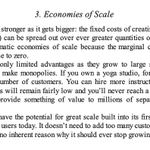
Almost all of Twitter seems to be arguing that when the costs of producing are drastically low, there will be so much competition that it drives software to be a commodity. Regardless of the cost to produce, the top quartile of software companies will still continue to dominate, primarily because of taste, long-term vision, and the deep understanding of edge cases.
Although my prediction is that economies of scale will no longer be one of the primary advantages of being a software company.
Credits: An excerpt from zero to one by Peter Thiel.

44
Is there any new methodology wherein indie-writers [like me] who try to piece together information from multiple corners to create net new observations/articles can get better recognition for articles?
At least for Premium users?
A reworked perk like Reply Boost but for articles, only for high quality content, not paraphrased horse**. At least some form of recognition besides monetary in the early stages.

For this creator payout cycle, we’re experimenting with new tools to identify original authors of content and allocating a portion of revenue to them.
Over the last few months, we've seen incredible work from original creators on X. Nick Shirley uncovered billions of dollars of fraud in hospice care. Charles Curran parodied global events with studio-quality videos. Will Manidis earned acclaim for his insightful articles on technology and AI.
Reposts & commentary will always be a core pillar of X, but our Revenue Sharing program should incentivize original, high-quality content that brings new value to the Timeline. This means rewarding the effort it takes to produce something, not just the poster who helped it travel furthest.
This is how we build a richer Timeline and how X continues to be the most valuable platform in the world. The Revenue Sharing program will continue to evolve to encourage creators to post their best content to X.
1
65
