


Secta retweeted
A 24-year-old engineer posted a 40-second video learning Go.
The second monitor reportedly showed an AI trading wallet with $868,862 in profit.
The video was supposed to prove a viral prediction wrong: that AI agents would wipe out a huge share of Bangalore’s programming jobs.
Instead, viewers paused at 0:27.
Behind the Go installer was a live Polymarket wallet called gabagool22.
28,620 positions.
$868K reported profit.
Almost entirely focused on 15-minute Bitcoin markets.
While thousands of engineers were arguing about whether AI would replace programmers, the system on his second screen had apparently been running for months.
The irony was brutal.
His salary was around $32,000 per year.
The wallet reportedly made more than $868,000 in four months.
He posted a video about learning to stay relevant in the AI era.
The real story was already running quietly behind him.

A 14-year-old reportedly made more on Polymarket in one month than his math teacher earns in five weeks.
He did not write a single line of code.
Using Claude Code, he simply asked AI to find the wallet with the best NBA prediction record, analyze its trading history and start following its positions.
A task that would have taken weeks manually became a conversation with Claude.
His uncle had been analyzing markets every night for six months. Over the same period, the teenager reportedly made more than 3x his returns.
Then he turned the system into a probability project for school.
His math teacher admitted he did not fully understand the strategy, but gave him an A for “an unconventional application of statistics to a real-world problem.”
Schools are still teaching probability with dice.
He was already testing it in a live prediction market with real money.
The uncomfortable part for his uncle was simple: the kid was actually doing it better.

Secta retweeted
A 14-year-old reportedly made more on Polymarket in one month than his math teacher earns in five weeks.
He did not write a single line of code.
Using Claude Code, he simply asked AI to find the wallet with the best NBA prediction record, analyze its trading history and start following its positions.
A task that would have taken weeks manually became a conversation with Claude.
His uncle had been analyzing markets every night for six months. Over the same period, the teenager reportedly made more than 3x his returns.
Then he turned the system into a probability project for school.
His math teacher admitted he did not fully understand the strategy, but gave him an A for “an unconventional application of statistics to a real-world problem.”
Schools are still teaching probability with dice.
He was already testing it in a live prediction market with real money.
The uncomfortable part for his uncle was simple: the kid was actually doing it better.
This Polymarket trader made $145,000 with just a 56% win rate.
No massive jackpot. No secret prediction model.
Over seven months, he placed 998 trades, generated $3.3M in volume and built one of the smoothest profit curves I’ve seen.
His biggest single win was only around $6,700.
The real edge was repetition.
He trades almost nothing except Counter-Strike Match Winner markets. EWC qualifiers, StarLadder, CS Asia, PGL. Same game, same market type, over and over again.
Then he looks for underpriced teams the crowd does not want.
K27 at 15 cents.
Sashi at 44 cents.
Fluxo at 37 cents.
He also avoids oversized bets. Positions are built gradually through dozens of smaller entries, settled after the match, then the capital goes straight back into the next opportunity.
A 56% win rate sounds barely better than a coin flip.
Across nearly 1,000 trades with disciplined sizing and favorable prices, that small edge was enough to produce $145K in net profit.
No one trade made him rich.
He found one repeatable setup and kept executing it for seven months.
Secta retweeted
A Hong Kong quant engineer reportedly used Claude to build a Polymarket bot that generated $248,259 in net profit over 102 days.
29,555 predictions. 60% win rate. Roughly 12 trades every hour.
The strategy was not about finding one massive winner.
The bot focused almost entirely on short-term crypto “up or down” markets and repeatedly ran the same structure: time arbitrage, directional hedging and continuous inventory rotation.
It could build one side of a position first, wait for probabilities to move in its favor, then add the opposite side when the hedge became more attractive.
Some of its best reported trades:
$2,182 became $4,500, a $2,318 profit.
$3,383 became $5,700, a $2,316 profit.
$1,864 became $4,080, a $2,216 profit.
The important part is the repetition.
Instead of trying to predict one huge market correctly, the system keeps rebuilding the same small statistical edge across thousands of short-term windows.
That is how a relatively small advantage can compound into nearly $250K.

Someone reportedly gave Claude $200, full control of a computer and one instruction: trade on Polymarket and make money.
Ten hours later, the balance showed $3,000.
No strategy was provided. No markets were selected manually. The owner went to sleep and let the system decide what to do.
According to the activity logs, Claude began by scanning hundreds of public wallets and analyzing their trading histories.
It compared performance, consistency and positioning, then identified two accounts that had been profitable over long periods and started automatically following their trades.
The first few attempts reportedly lost around $50 while the system adjusted.
After that, the account began recovering and the balance kept climbing.
By morning, the entire process had happened without manual intervention: wallet discovery, analysis, trader selection and execution.
The owner has now reportedly reinvested the profits and left the system running.
The interesting part is not the claim that $200 became $3,000 overnight.
It is that Claude did not need to invent a brilliant prediction strategy. It used transparent market data to find traders already performing well, study their behavior and automate the execution around them.
AI trading agents are starting to look less like chatbots with market access and more like autonomous research and execution systems.
Secta retweeted
Someone reportedly gave Claude $200, full control of a computer and one instruction: trade on Polymarket and make money.
Ten hours later, the balance showed $3,000.
No strategy was provided. No markets were selected manually. The owner went to sleep and let the system decide what to do.
According to the activity logs, Claude began by scanning hundreds of public wallets and analyzing their trading histories.
It compared performance, consistency and positioning, then identified two accounts that had been profitable over long periods and started automatically following their trades.
The first few attempts reportedly lost around $50 while the system adjusted.
After that, the account began recovering and the balance kept climbing.
By morning, the entire process had happened without manual intervention: wallet discovery, analysis, trader selection and execution.
The owner has now reportedly reinvested the profits and left the system running.
The interesting part is not the claim that $200 became $3,000 overnight.
It is that Claude did not need to invent a brilliant prediction strategy. It used transparent market data to find traders already performing well, study their behavior and automate the execution around them.
AI trading agents are starting to look less like chatbots with market access and more like autonomous research and execution systems.
A Claude-powered Polymarket bot reportedly made $496,820 in just 14 days with a 48% win rate.
That is the interesting part.
It was losing more predictions than it won and still generating tens of thousands of dollars per day.
The wallet focused almost entirely on short-term crypto “up or down” markets, executing roughly 36 trades per hour.
Its edge was not prediction accuracy. The system combined time arbitrage, directional hedging, near-expiry opportunities and inventory rotation.
When probabilities moved too far in one direction, the bot could accumulate one side first, wait for a cleaner hedge on the opposite side and then complete or rebalance the position.
Some of its best reported trades:
$205 became $8,905, a $8,701 profit.
$89 became $8,434, a $8,345 profit.
$21,793 became $29,754, a $7,961 profit.
Across the period, the wallet reportedly completed 6,480 predictions.
A 48% win rate looks terrible if you think trading is about being right most of the time.
This system was built around something different: making more when the structure was favorable than it lost when it was wrong.

Secta retweeted
He had $200 left and nine days until payday, so he asked Claude how to make it last.
Claude reportedly gave him a script that scanned ignored prediction markets for unusually large pricing edges.
He loaded it onto an $8 desktop robot he had built a few weeks earlier.
During the first week, the robot flagged 41 opportunities across obscure golf, esports and player-prop markets. Some had only six or eleven active traders.
Then it found one wallet: gatorr.
The wallet had reportedly made $2.21M from just 684 trades since registering in November 2025.
The strategy was surprisingly simple.
While tens of thousands of wallets crowded into popular election markets fighting over tiny edges, gatorr focused on markets almost nobody was watching.
In one golf market with only 17 participants, the wallet reportedly captured an 8% edge before the rest of the market adjusted.
When asked why more traders were not doing the same thing, Claude’s answer was basically this:
Everyone searches for the busiest markets. Almost nobody searches for the emptiest ones.
He kept the original $200 and only entered three markets the robot flagged that week.
All three reportedly closed in profit.
The interesting part was not predicting the future better than everyone else.
It was using AI to search places where almost nobody else was looking.
A college student accidentally revealed a $1.14M Polymarket wallet while filming a “learning AI from zero” video.
For 30 days, he posted daily updates about studying AI automation. His goal was to operate his computer without touching the keyboard by day 60.
Then viewers paused his day-30 video at 19 seconds.
A Polymarket wallet appeared on screen with a reported $1.14M balance and 940 sports predictions.
People traced the address and found that Claude was constantly open in the background, analyzing obscure sports markets with less competition.
Suddenly, the previous 29 videos looked completely different.
He was not simply learning AI automation from scratch. According to the theory spreading through crypto circles, the public challenge was happening while an automated betting system quietly worked behind the scenes.
The account had only 800 followers before the clip exploded to 300,000 views. More than 80,000 people reportedly joined the investigation into his wallet activity.
He deleted the video almost immediately, but the screenshots had already spread everywhere.
The wallet was later linked to as much as $2.29M in reported positions.
Some people perform the story of working hard in public. The system actually making the money is usually hidden in the tab they forgot to close.
Secta retweeted
A 24-year-old software intern reportedly used Claude to build a Polymarket bot that generated $1,194,937 in 119 days.
The wallet completed 97,904 predictions with a 56% win rate, averaging roughly $10,041 per day.
Its edge was not predicting every market correctly.
The bot focused on short-term crypto “up or down” markets and used a system built around time arbitrage, hedging and inventory rotation.
It could accumulate one side of a market first, wait for better hedging conditions and then add the opposite position. Capital was continuously rotated toward the time windows where the probability advantage appeared strongest.
Some of its most profitable reported trades included:
$1,467 turned into $8,638.
$820 turned into $7,280.
$1,677 turned into $7,713.
The wallet was operating at more than 34 trades per hour.
A 56% win rate does not sound extraordinary on its own. At nearly 100,000 predictions, though, a small repeatable edge can compound into more than $1 million.

A college student accidentally revealed a $1.14M Polymarket wallet while filming a “learning AI from zero” video.
For 30 days, he posted daily updates about studying AI automation. His goal was to operate his computer without touching the keyboard by day 60.
Then viewers paused his day-30 video at 19 seconds.
A Polymarket wallet appeared on screen with a reported $1.14M balance and 940 sports predictions.
People traced the address and found that Claude was constantly open in the background, analyzing obscure sports markets with less competition.
Suddenly, the previous 29 videos looked completely different.
He was not simply learning AI automation from scratch. According to the theory spreading through crypto circles, the public challenge was happening while an automated betting system quietly worked behind the scenes.
The account had only 800 followers before the clip exploded to 300,000 views. More than 80,000 people reportedly joined the investigation into his wallet activity.
He deleted the video almost immediately, but the screenshots had already spread everywhere.
The wallet was later linked to as much as $2.29M in reported positions.
Some people perform the story of working hard in public. The system actually making the money is usually hidden in the tab they forgot to close.
Secta retweeted
Sam Altman told Stanford students that the era of manually writing every prompt may already be ending.
“You no longer need to write prompts yourself.”
The next step is not becoming better at wording instructions. It is giving ChatGPT a clear goal, letting it generate the prompts it needs and allowing the system to improve them as it works.
That changes the role of the user.
Instead of micromanaging every response, you define the objective, provide the right context and let the model plan the path toward the result.
The advantage is no longer knowing a collection of clever prompt templates. It is knowing how to build a workflow where ChatGPT can understand the task, evaluate its own output and adjust without starting from zero each time.
Most people still use ChatGPT exactly as they did a year ago: one question, one answer, one closed tab.
The people getting the most leverage are turning it into a system that can plan, execute and refine its own work.
The full Stanford lecture is worth watching because it shows how quickly the interaction model is changing.
This 7-minute tutorial shows how to automate AI video creation from start to finish using Claude Code and Seedance 2.0.
No complicated editing workflow. No unnecessary theory.
You see the entire process: generating the concept, preparing the assets, creating the video and turning everything into a repeatable system.
The interesting part is not only the final result. It is how Claude Code connects the individual steps so you do not have to rebuild the workflow manually for every new video.
For content creators, this can remove hours of repetitive editing and production work.
For developers, it is a practical example of how AI agents can control a complete creative pipeline instead of handling one isolated task.
Seven minutes is enough to understand the workflow and decide whether it fits your own content system.
Secta retweeted
Someone reportedly extracted the operating instructions behind Fable 5 before Anthropic could restrict access to it.
The model itself may disappear at any time. Its working method does not have to.
Using Opus 4.8 and a single prompt, he reconstructed what he describes as the model’s internal playbook: how it reasons, structures answers and approaches difficult tasks.
That does not recreate the original model or its full capabilities. It gives you a reusable set of instructions that can preserve part of its workflow inside another Claude project.
The process is simple:
1. Extract the operating playbook from Fable 5.
2. Save the instructions as a local .md file.
3. Create a new Claude project called “Fable 5 Brain.”
4. Add the file to the project context.
5. Test it on a demanding task and refine the instructions based on the result.
Access to the best model is never guaranteed. Providers can change limits, remove versions or replace them entirely.
The more durable advantage is learning how the model works and turning that process into a system you control.
A college student used OpenClaw and a $2,400 scholarship to build a 39-agent AI team that completed four days of developer work overnight.
His parents thought the iPad and Mac Mini were for studying. His roommates thought he was mining crypto.
The reality was more interesting.
He cloned 39 AI agents from GitHub, started the system and went to sleep. By morning, the terminal had reportedly completed the entire task with no questions, supervision or visible bugs.
Pause his screen recording at 40 seconds.
OpenClaw is running at the top of the stack, giving every agent access to the same project context. This allows them to coordinate, track what has already changed and decide what should happen next.
The iPad became his office. The Mac Mini became his team.
While he attended classes, the agents kept working.
He landed his first client one month later and another the following week. A traditional development agency reportedly charged around $16,000 per month for similar output.
His system cost $21 to run.
Six months ago, this kind of multi-agent infrastructure was mostly available to funded startups with engineering teams and serious compute budgets.
Now a student can assemble it from open-source tools and consumer hardware.
The biggest shift is not that AI can write code. It is that one person can now coordinate an entire software team without hiring the team first.
Secta retweeted
A 14-year-old Chinese student reportedly used a $13 Raspberry Pi to expose parts of a GTA VI pre-alpha build.
The device was built from a Raspberry Pi Zero, a battery and a 3.5-inch screen bought from AliExpress. He assembled it himself, then installed Ollama and the Gemma 2B model.
No cloud.
No paid API.
No internet connection.
According to the claim, the handheld system helped him inspect internal parts of the game that Rockstar had kept private, including the debug console, Lucia’s inventory and early water physics.
The entire setup fit in his hand and cost less than a fast-food meal. All it took was a few evenings of building, testing and running a local model on cheap hardware.
The most striking part is not only the GTA VI leak.
It is that tools once associated with expensive labs can now run offline on hardware a teenager can assemble at home for $13.
A 13-year-old released a Polymarket trading terminal for free, and two months later a stranger sent him $20,000 as a thank-you.
He built it during 14 days of summer vacation while most of his classmates were playing games.
Once the terminal was stable, he uploaded the full source code to GitHub, returned to school and barely thought about it again. There was no paid course, subscription or premium version hidden behind a checkout page.
Two months later, he opened the repository and found it filled with messages from traders using his code.
One message stood out.
A trader claimed the terminal had helped him make more than $200,000 in a single month. He asked for the boy’s crypto wallet address because he wanted to reward the person who had built the tool.
Soon after, $20,000 arrived.
The boy had not spent those two months marketing the project or building a personal brand. He was doing homework while the code spread on its own and became useful to people he had never met.
That is what makes the story interesting.
He did not begin by asking how to monetize an audience. He built something practical, removed every barrier to adoption and let the product prove its value in the hands of real users.
Sometimes the strongest distribution strategy is simply releasing a tool people genuinely need.
Secta retweeted
A college student used OpenClaw and a $2,400 scholarship to build a 39-agent AI team that completed four days of developer work overnight.
His parents thought the iPad and Mac Mini were for studying. His roommates thought he was mining crypto.
The reality was more interesting.
He cloned 39 AI agents from GitHub, started the system and went to sleep. By morning, the terminal had reportedly completed the entire task with no questions, supervision or visible bugs.
Pause his screen recording at 40 seconds.
OpenClaw is running at the top of the stack, giving every agent access to the same project context. This allows them to coordinate, track what has already changed and decide what should happen next.
The iPad became his office. The Mac Mini became his team.
While he attended classes, the agents kept working.
He landed his first client one month later and another the following week. A traditional development agency reportedly charged around $16,000 per month for similar output.
His system cost $21 to run.
Six months ago, this kind of multi-agent infrastructure was mostly available to funded startups with engineering teams and serious compute budgets.
Now a student can assemble it from open-source tools and consumer hardware.
The biggest shift is not that AI can write code. It is that one person can now coordinate an entire software team without hiring the team first.
A 24-year-old quant reportedly used Claude to build a Polymarket bot that grew $20,000 into roughly $160,000 in six weeks.
The account is called mo-money.
It focuses on short-term crypto markets, though it does not simply bet on whether the price will move Up or Down.
The bot looks for several different pricing inefficiencies and combines them inside one strategy.
Place limit orders on both sides
The system starts by providing liquidity to both Up and Down rather than immediately committing to one direction.
Buy the cheaper side during volatility
When prices move sharply, one outcome can temporarily become underpriced. The bot accumulates that side before the market corrects.
Keep the combined cost below $1
It gradually balances its Up and Down positions while trying to buy both outcomes for less than their guaranteed $1 settlement value.
For example:
Up position: $0.47
Down position: $0.49
Combined cost: $0.96
One side eventually settles at $1, leaving a theoretical margin before fees, slippage and failed execution.
Add directional exposure
Once the model identifies a stronger probability on one side, the bot increases that position.
This turns the structure from pure arbitrage into a partially directional trade, with the cheaper hedged base reducing some of the risk.
Trade extreme prices near settlement
As the market approaches resolution, the bot can buy an outcome priced between $0.95 and $0.999 when the result appears nearly certain.
It can also take the opposite side when the market has pushed its price unusually low.
Some of the strongest reported positions were:
$175 to $1,269, a 622% return
$198 to $1,140, a 474% return
$293 to $1,639, a 458% return
The system is not relying on one prediction model or one type of trade.
It combines timing gaps, temporary directional mispricing and extreme settlement prices, then applies the same framework repeatedly across short-duration markets.
Claude’s role is not to guess whether crypto goes up or down.
It helps turn several small market inefficiencies into one automated system for research, execution and risk control.
Secta retweeted
A 24-year-old quant reportedly used Claude to build a Polymarket bot that grew $20,000 into roughly $160,000 in six weeks.
The account is called mo-money.
It focuses on short-term crypto markets, though it does not simply bet on whether the price will move Up or Down.
The bot looks for several different pricing inefficiencies and combines them inside one strategy.
Place limit orders on both sides
The system starts by providing liquidity to both Up and Down rather than immediately committing to one direction.
Buy the cheaper side during volatility
When prices move sharply, one outcome can temporarily become underpriced. The bot accumulates that side before the market corrects.
Keep the combined cost below $1
It gradually balances its Up and Down positions while trying to buy both outcomes for less than their guaranteed $1 settlement value.
For example:
Up position: $0.47
Down position: $0.49
Combined cost: $0.96
One side eventually settles at $1, leaving a theoretical margin before fees, slippage and failed execution.
Add directional exposure
Once the model identifies a stronger probability on one side, the bot increases that position.
This turns the structure from pure arbitrage into a partially directional trade, with the cheaper hedged base reducing some of the risk.
Trade extreme prices near settlement
As the market approaches resolution, the bot can buy an outcome priced between $0.95 and $0.999 when the result appears nearly certain.
It can also take the opposite side when the market has pushed its price unusually low.
Some of the strongest reported positions were:
$175 to $1,269, a 622% return
$198 to $1,140, a 474% return
$293 to $1,639, a 458% return
The system is not relying on one prediction model or one type of trade.
It combines timing gaps, temporary directional mispricing and extreme settlement prices, then applies the same framework repeatedly across short-duration markets.
Claude’s role is not to guess whether crypto goes up or down.
It helps turn several small market inefficiencies into one automated system for research, execution and risk control.
A Spanish developer reportedly used Claude to build a fully autonomous Polymarket trading system that made $847 overnight
The entire project started with one article about Polymarket bots.
Claude analyzed the idea, found seven relevant open-source GitHub repositories and combined them into a working pipeline. It then helped configure and deploy the system from start to finish.
Once launched, the bot operated without manual intervention.
It reportedly analyzed more than 412,000 on-chain transactions, tracked profitable whale wallets and searched for unusual trading behavior that could indicate informed market participants.
Every few seconds, the system cleaned the incoming data, evaluated the current signals and chose between three actions:
Buy
Sell
Do nothing
It then executed the decision automatically.
After 47 live trades, the bot reportedly finished the night with $847 in net profit.
The interesting part is not the amount itself. It is how quickly Claude turned scattered public resources into one functioning trading system.
The developer did not write every component from scratch. He used AI to research the existing infrastructure, select useful repositories, connect the pieces, fix deployment problems and automate execution.
That is where coding agents become genuinely powerful.
They do not need to invent an entirely new strategy. They can take an idea, find the required components and compress the distance between reading about a system and actually running one.
Secta retweeted
A Spanish developer reportedly used Claude to build a fully autonomous Polymarket trading system that made $847 overnight
The entire project started with one article about Polymarket bots.
Claude analyzed the idea, found seven relevant open-source GitHub repositories and combined them into a working pipeline. It then helped configure and deploy the system from start to finish.
Once launched, the bot operated without manual intervention.
It reportedly analyzed more than 412,000 on-chain transactions, tracked profitable whale wallets and searched for unusual trading behavior that could indicate informed market participants.
Every few seconds, the system cleaned the incoming data, evaluated the current signals and chose between three actions:
Buy
Sell
Do nothing
It then executed the decision automatically.
After 47 live trades, the bot reportedly finished the night with $847 in net profit.
The interesting part is not the amount itself. It is how quickly Claude turned scattered public resources into one functioning trading system.
The developer did not write every component from scratch. He used AI to research the existing infrastructure, select useful repositories, connect the pieces, fix deployment problems and automate execution.
That is where coding agents become genuinely powerful.
They do not need to invent an entirely new strategy. They can take an idea, find the required components and compress the distance between reading about a system and actually running one.
Someone used Claude to build a @Polymarket trading bot that reportedly generated more than $110,000 in just six weeks.
The bot focuses on short-term Crypto Up / Down markets.
Its strategy combines two different edges.
First, it exploits the timing gap between Up and Down prices.
Instead of betting on only one side, the bot accumulates both outcomes at different moments. The goal is to keep the combined cost below $1.
For example:
Up purchased at $0.46
Down purchased later at $0.48
Total cost: $0.94
Since one side eventually settles at $1, the position contains a built-in margin before fees and execution costs.
The second layer is directional residual trading.
When the model detects a strong signal, the bot increases exposure to one side. The position moves from a mostly hedged structure into a directional trade with a controlled imbalance.
That means it is not simply market making or blindly buying both sides.
It builds a lower-risk base first, then adds directional exposure only when the model identifies enough edge.
The Polymarket account is called bosona.
According to the original claim, the system grew roughly $20,000 into more than $110,000 through a combination of mathematical modeling, disciplined execution and automated risk management.
This is where AI becomes useful in prediction markets.
Not as a machine that tells you whether Bitcoin will go up or down, but as a system that continuously monitors prices, structures positions, controls exposure and executes the same rules without emotion.
Secta retweeted
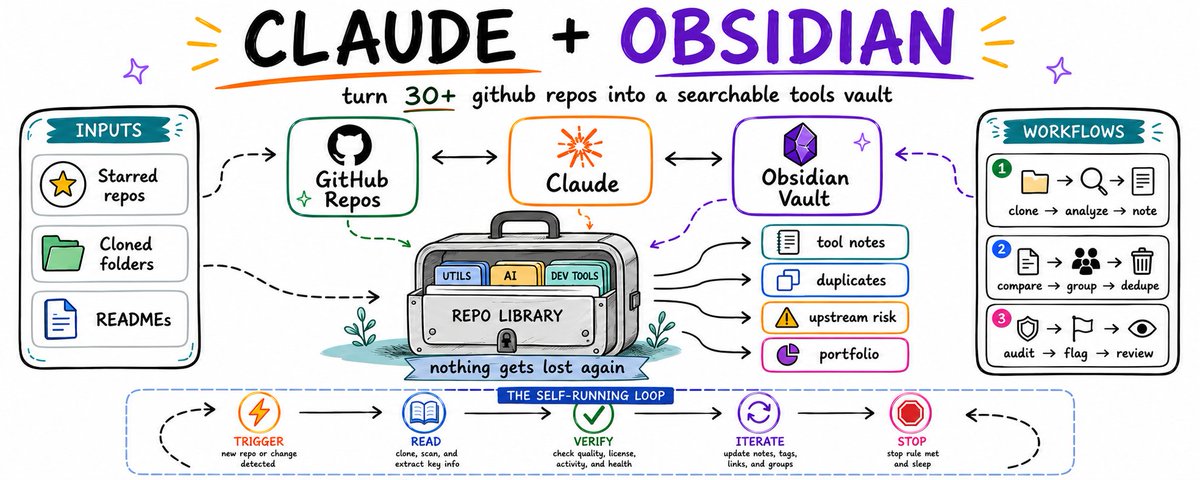
A DEVELOPER WIRED CLAUDE CODE INTO OBSIDIAN AND MADE HIS ENTIRE SOFTWARE STACK AUDIT ITSELF
Before this, his folders were full of tools he could no longer trust.
Repos downloaded and forgotten. Duplicate libraries hiding under different names. Dependencies still used in production even though their maintainers had gone silent.
Claude turned the collection into a living map.
Every repo gets inspected, documented, and checked against real usage across his projects.
Then a second loop scans the full vault for dead weight, duplicates, upstream risk, and tools that no longer deserve a place in the stack.
A README understands one repository.
This system understands how every repository fits together.
The full setup is below.

Secta retweeted
A Russian mathematician who died in 1922 reportedly helped a Polymarket bot make $468,228 in 30 days
His name was Andrey Markov.
Markov chains were originally developed to study random processes. More than a century later, the same mathematics is being used to identify temporary pricing inefficiencies in prediction markets.
The account, Bonereaper, focuses on 1-hour BTC and ETH markets. It has reportedly executed 14,671 trades, usually placing between 1,500 and 2,900 shares per position.
The entry logic is strict.
The bot only trades when two conditions are true at the same time.
First, its estimated probability must differ from the market price by at least 5 percentage points:
Δ = p̂ − q ≥ 0.05
Second, the current market state must be highly stable:
p(j*, j*) ≥ 0.87
In simple terms, the bot needs both a clear pricing gap and enough confidence that the current market state will persist.
Once those conditions appear, it executes automatically.
The system scans markets every minute and runs 24/7. That becomes especially useful during low-liquidity hours, when short-term BTC markets can become temporarily mispriced because fewer traders are actively updating the book.
The bot is not trying to predict whether Bitcoin goes up or down.
It is looking for moments when the market price does not match the probability implied by the current state.
That distinction matters.
Most traders are trying to form an opinion about direction. This system waits for measurable disagreement between its model and the market, then acts only when the gap is large enough.
The interesting part is not that a century-old formula suddenly became magical.
It is that classical mathematics becomes much more powerful when an automated system can apply it every minute, across thousands of markets, without fatigue or emotion.

This trader reportedly made $90,000 in one day after using Claude Fable 5 to test 600 strategies in 48 hours.
He was not smarter than Wall Street.
He simply killed bad ideas thousands of times faster.
His old backtesting system needed nearly a week to evaluate one strategy. Claude Fable 5 reportedly reduced the same process to around two minutes, letting him test hundreds of ideas over a single weekend.
The results were brutal.
597 strategies failed.
Only 3 survived.
Those three were then deployed into live Polymarket trading and reportedly generated $90,000 in one day.
The real edge was not discovering one brilliant strategy. It was eliminating almost every weak strategy before real money touched the market.
His process started with a simple rule:
“When the order book leans 70/30 during the final 90 seconds, buy the UP side.”
Fable 5 then replayed that rule tick by tick across thousands of settled markets, including real order books, fills, liquidity and slippage. Two minutes later, the system could show whether the idea had any chance of surviving.
The three successful strategies now reportedly run through MiroFish, use Kelly-based position sizing and only enter when simulated expectations diverge from the live market.
That is what makes AI quant trading powerful.
It does not instantly turn someone into a trading genius. It gives them far more attempts to test ideas, reject weak setups and identify the few patterns that remain profitable after realistic simulation.
A traditional fund might test 20 strategies in a quarter.
He tested 600 in one weekend.
The advantage was not better intuition.
It was faster elimination.
Secta retweeted
This trader reportedly made $90,000 in one day after using Claude Fable 5 to test 600 strategies in 48 hours.
He was not smarter than Wall Street.
He simply killed bad ideas thousands of times faster.
His old backtesting system needed nearly a week to evaluate one strategy. Claude Fable 5 reportedly reduced the same process to around two minutes, letting him test hundreds of ideas over a single weekend.
The results were brutal.
597 strategies failed.
Only 3 survived.
Those three were then deployed into live Polymarket trading and reportedly generated $90,000 in one day.
The real edge was not discovering one brilliant strategy. It was eliminating almost every weak strategy before real money touched the market.
His process started with a simple rule:
“When the order book leans 70/30 during the final 90 seconds, buy the UP side.”
Fable 5 then replayed that rule tick by tick across thousands of settled markets, including real order books, fills, liquidity and slippage. Two minutes later, the system could show whether the idea had any chance of surviving.
The three successful strategies now reportedly run through MiroFish, use Kelly-based position sizing and only enter when simulated expectations diverge from the live market.
That is what makes AI quant trading powerful.
It does not instantly turn someone into a trading genius. It gives them far more attempts to test ideas, reject weak setups and identify the few patterns that remain profitable after realistic simulation.
A traditional fund might test 20 strategies in a quarter.
He tested 600 in one weekend.
The advantage was not better intuition.
It was faster elimination.


Secta retweeted
A 13-year-old released a Polymarket trading terminal for free, and two months later a stranger sent him $20,000 as a thank-you.
He built it during 14 days of summer vacation while most of his classmates were playing games.
Once the terminal was stable, he uploaded the full source code to GitHub, returned to school and barely thought about it again. There was no paid course, subscription or premium version hidden behind a checkout page.
Two months later, he opened the repository and found it filled with messages from traders using his code.
One message stood out.
A trader claimed the terminal had helped him make more than $200,000 in a single month. He asked for the boy’s crypto wallet address because he wanted to reward the person who had built the tool.
Soon after, $20,000 arrived.
The boy had not spent those two months marketing the project or building a personal brand. He was doing homework while the code spread on its own and became useful to people he had never met.
That is what makes the story interesting.
He did not begin by asking how to monetize an audience. He built something practical, removed every barrier to adoption and let the product prove its value in the hands of real users.
Sometimes the strongest distribution strategy is simply releasing a tool people genuinely need.
A Polymarket account reportedly turned $50 into $435,000 by exploiting short-lived BTC pricing delays.
Almost nobody is talking about it.
The strategy was reverse engineered, then recreated with Claude in around 40 minutes as a bot with similar logic.
The core idea is simple: Polymarket can update certain BTC contract prices slightly slower than the underlying market.
The bot watches external BTC data, looks for moments when Polymarket is lagging by more than 0.3%, then enters before the contract price catches up.
Execution speed is the real edge.
The reported system was written in Rust, runs locally without a GPU or cloud server, and can react in under 100 milliseconds. It was designed to process large order flow while keeping the risk on each trade between 0.3% and 0.8%.
The risk rules were strict as well.
Around 0.5% maximum risk per trade and no more than 2% total daily risk. The claimed result was roughly $400 to $700 per day.
The important part is that this is not a prediction strategy.
The bot is not trying to guess where Bitcoin goes next. It is looking for temporary gaps between the real market and Polymarket’s pricing, then trading before the gap closes.
That also explains why the opportunity probably will not last forever.
Once more bots detect the same lag, the price difference gets smaller, execution becomes more competitive and the edge gets absorbed by the market.
The money is not in knowing the strategy exists.
It is in finding it before everyone else does.
Secta retweeted
A Polymarket account reportedly turned $50 into $435,000 by exploiting short-lived BTC pricing delays.
Almost nobody is talking about it.
The strategy was reverse engineered, then recreated with Claude in around 40 minutes as a bot with similar logic.
The core idea is simple: Polymarket can update certain BTC contract prices slightly slower than the underlying market.
The bot watches external BTC data, looks for moments when Polymarket is lagging by more than 0.3%, then enters before the contract price catches up.
Execution speed is the real edge.
The reported system was written in Rust, runs locally without a GPU or cloud server, and can react in under 100 milliseconds. It was designed to process large order flow while keeping the risk on each trade between 0.3% and 0.8%.
The risk rules were strict as well.
Around 0.5% maximum risk per trade and no more than 2% total daily risk. The claimed result was roughly $400 to $700 per day.
The important part is that this is not a prediction strategy.
The bot is not trying to guess where Bitcoin goes next. It is looking for temporary gaps between the real market and Polymarket’s pricing, then trading before the gap closes.
That also explains why the opportunity probably will not last forever.
Once more bots detect the same lag, the price difference gets smaller, execution becomes more competitive and the edge gets absorbed by the market.
The money is not in knowing the strategy exists.
It is in finding it before everyone else does.
A trader spent eight months trying to automate one simple Polymarket strategy.
Eleven broken systems. $1,400 paid to developers. Scripts that stopped working after API updates. Bots that missed trades whenever his laptop was closed.
Then he described the strategy in plain English.
“When a political market trades above 70 cents while social sentiment stays below 50% positive, buy NO. Exit at 85 cents or below 30 cents.”
Prince AI asked two questions, translated the belief into execution logic, and backtested it against Polymarket data from 2022 to 2025.
47 historical triggers.
34 profitable.
Only then did he deploy it.
That is the part most traders get backwards.
They automate first, lose money live, then slowly discover whether the strategy ever had an edge.
This workflow does the opposite:
describe the belief,
convert it into a blueprint,
backtest it,
add hard risk limits,
then run it 24/7.
The article below breaks down the full setup.
Secta retweeted
A Japanese developer found a Claude Code trick that turns one prompt into an entire content workflow.
It is called “find skills.”
The idea is simple: you describe the result once, and Claude searches through hundreds of skills in the Anthropic ecosystem, picks the right ones and assembles the workflow by itself.
For a YouTube channel, that could look like this:
The script is created through Notion and Claude. B-roll is selected with Veo 3. The thumbnail is generated with Sora. Captions and scheduling go through Buffer, while performance is tracked in Typefully.
All of that starts from one prompt.
The important part is not that AI saves a few hours.
He has encoded the entire production process into Claude.
Instead of manually choosing tools, moving files between apps and repeating the same steps for every video, he only defines the outcome. Claude decides which skills are needed and runs the workflow around it.
That is a very different way to use AI.
Most people are still asking ChatGPT to “write this” or “summarize that.” The real leverage appears when the model understands the full process, selects the right tools and keeps the system running without constant supervision.
The advantage is no longer a better prompt.
It is owning the workflow.

