

TSC maxi ~ roundtrip king & cook ~ Temple | Sanctuary NFA DYOR etc | base.eth
on ze blox
Joined April 2022
- Tweets1.8K
- Following4.1K
- Followers2.8K
- Likes2.9K




Pinned Tweet
just had an utmost important thought while working
gm
ga
gn
or just
gman
to greet all everywhere

Mira tests the provider; tensorcash:native is designed to let you verify which model produced your actual answer.


0xfffaf retweeted

前两天看到 @AnthropicAI 用 ZK 技术探索 AI 推理的可验证性,今天又看到 @miranetwork 推出 Sterling,开始解决 AI 推理服务商的可信度问题。
方向都没错,但我觉得这些还不够酷。
一个在研究如何证明 AI 推理过程,一个在解决 AI 推理服务的可信交付。
而 @Tensorcash 想做的是更进一步:
让 AI 推理本身成为 PoW 共识工作。
不需要在完成推理之后,再额外花费大量算力去生成证明。
而是让真实的 AI 模型推理直接参与区块链安全,通过推理轨迹、统计验证、随机抽检和经济激励,实现低开销的可验证推理。
推理即工作,工作即共识。
让维护区块链安全的算力,同时创造真实的 AI 生产力。
这才是我认为更酷的 AI × Crypto 结合方式。 tensorcash:native


AI推理正在成为一种商品。但商品市场首先要解决一个问题:你付费买的,和实际收到的,是不是同一种东西?
石油有品质标准,白银有成色检验。AI推理也需要自己的“验货机制”——你买的是某个模型的推理,交付的结果究竟是不是由它产生的?
@Tensorcash 这条官方推文,讲的就是这个问题:把推理验证作为协议的核心。
要让AI推理像石油、电力一样可以定价、交易,甚至进一步衍生品化、金融化,可验证的交付是一个重要前提。
验证本身不是金融化,但它可能是连接两者的一块关键底座。
这也是我认为 tensorcash:native 值得关注的地方:不只是“AI+挖矿”,而是让AI推理从黑箱服务,走向可信商品的可能性。

0xfffaf retweeted

In an anonymous market nobody trusts you. Without a good reputation it is hard to sell anything - doesn’t matter how good your product might be.
So compute gets bought from a handful of names everyone knows. Buyers can’t check the product, so they pay for the brand... and they just pay “the extra”.
Beyond this there’s another problem. Even for the same open model, picking a good provider is surprisingly hard. GLM 5.3 on OpenRouter: 78% to 89% on GPQA, depending on who serves it. So even if you pay the extra, there are big differences - own quantisation, custom kernels, silent bugs in the stack. Without your own reference you will never notice.
@Tensorcash solves this. Every answer carries a proof of the model that produced it, so a provider can’t swap in a heavily quantised or fine-tuned version without being caught. A GPU at home can sell next to a data centre, and nobody needs to know who runs it.
Bringing more supply, all of it verifiable, to a market with ever-growing demand.
This is why we are building @inferenceFI on @Tensorcash.

Picking a good inference provider is difficult.
Picking the best inference provider for an open model is surprisingly hard: The reason: no single provider does it all. On OpenRouter, GLM 5.3’s GPQA score ranges from 78% to 89% (quite a large gap, despite the caveats†), and the trends in GPQA is not strongly correlated with other tasks, so it varies by workload.
Why discuss this now?
Recently, Jon Barron and colleagues showed that standard softmax implementations hide two silent bugs: Softmax Collapse, where the target gradient rounds to zero, and Softmax Cancellation, where identical logits still produce a gradient. Widely speaking, inference has the same problem, except it's harder to get something agreed to be a 'correct' outcome.
In my experience, providers on alternative chips tend to have worse silent framework bugs, though these issues are apparent on NVIDIA inference frameworks as well.
MoE models are especially fragile: the router bias and router output need fp32, etc. (there's a long list of half-patched issues). As deployment engines grow more complex, these bugs get almost exponentially harder to catch.
(Note†: SGLang or vLLM in their default configurations should give the best accuracy. The issue come from what providers add, like some custom quantization, speculative decoding, and custom kernels, or even simply forgetting to update to the latest versions of the frameworks that improve accuracy. And consider the case where you have no open reference at all (i.e they take care of both post-training and inference, so you don't own your own canon copy of the model, where you wouldn't know if there's some error in the stack silently reducing your quality).

"i don't think that useful work is required for AI labs to mine it"
"my bullcase rests on i think AI labs will mine Pearl"
gl pearl-2:native maxis


The $PEARL debate turns to a key question, how much of its hash rate is actually doing useful AI work today?
A recent @Blockworks report found that less than 1% of blocks match real AI models, raising questions about whether @prlnet's current valuation already assumes useful work is happening before it's been verified
The bull case is that PEARL doesn't need useful work to succeed, but needs AI labs to adopt and mine the network

0xfffaf retweeted

On TensorCash, two people can trade directly, with no one else in between. The funds stay in their own wallets until the trade settles, removing the risk of an exchange losing or freezing them.
This video follows one of those trades, from the offer to the block it settled in.
One unit of a call option on the network’s difficulty was traded for 0.9 TSC. The option and the TSC moved in one transaction, straight from one wallet to the other.
Each trade on the protocol is trustless, and neither side can end up paying without receiving. All in an ordinary transaction, with no escrow, no multisig and no trace of the negotiation, which keeps it cheap and private.
0xfffaf retweeted

As @enrico_otta said on @MCGlive, the @Tensorcash protocol lets you prove which AI model ran a prompt, and that it wasn’t swapped for a cheaper, heavily quantised version.
That matters for two reasons.
1. Decentralized markets. Participants in decentralized markets, marked by their anonymity, can’t sell things that aren’t verifiable. The result is a closed market with a few “trusted” sellers, which brings a lot of flaws. The fix from the protocol is that sellers can use it to generate a proof that credentials what they sell, so the buyer now knows what he gets.
2. Security. TensorCash is a layer one where the proof of work is the inference itself. That only works if the work (the inference) can be verified. Without it, everything collapses.
So at the same time you allow an efficient and decentralized market to take place and a new market structure to emerge on a massive new commodity, while securing a blockchain and incentivizing miners to participate, through the verification protocol.
Creating a system where the chain is secured by one of the most in-demand commodities out there atm: AI inference.
0xfffaf retweeted
Verifiable inference is the cornerstone for an open and decentralised market, what we are building with @inferenceFI.
@Tensorcash protocol is already delivering verifiable inference at scale - great to see attention on the topic growing.

New Anthropic research: progress on provable inference for large language models.
Here, we introduce FlashProve. Building on established cryptographic techniques, FlashProve allows developers to verify whether a given response came from a given AI model. It’s substantially more efficient than prior open-source methods for doing so.
These proofs have a range of applications. They can, for instance, make it harder for attackers to hijack a chat, or enable safety evaluators to verify that the model they’re testing is the same one being served to customers.
For our full write-up, see here: anthropic.com/research/prova…
Further progress in provable inference will likely be an important part of improving trust in AI deployment. To that end, we're open-sourcing FlashProve’s code, here: github.com/anthropics/FlashP…
We’re grateful to our collaborators: Alessandro Chiesa, @GiacomoFenzi, @gwberg95, @miranda__christ, Rahul Dalal (rdalal.github.io) and Ben Mayer (@transmissions11).


0xfffaf retweeted

He is right and here is why.
Every exchange has the same hidden product and that is the queue. Prices are public and matching rules are public so the only thing left to fight over is who came first. Whoever controls the sequence owns the market.
On a centralised exchange one engine sets the sequence and the race goes to whoever rents the rack next to it but on a chain the block producer reads every pending order and picks the sequence himself. That is MEV the sandwich in every block and every DEX pays it. For example Hyperliquid handles it with a small validator set.
The TSC exchange design does it the other way around. Decide the order before anyone can read it so your order is encrypted the key split in ten pieces and each piece sent to a random validator. Each one stamps the arrival time on something it cannot read. Only when six pieces are public does the order become readable and by then its time is already signed. A colocated market maker cannot cancel in time bcs the key pieces have to cross his own link first. Being first becomes physics not a referee.
Now add what sits on the same chain. Your coins never leave your wallet they lock under your own key with no deposit to anybody. The inference price index and the CFD on it already live on the L1 so the exchange is not inventing a product it is giving one a venue. And by design fees in TSC, validators stake TSC and earn them, and the ticket to validate comes from mining shares. The miners who serve inference are the ones who run the exchange.
Hyperliquid for inference with fair sequencing you can verify instead of trust run by the people producing the commodity, settling in the coin that pays for it.
Still research stage the paper is public a sidechain anchored to the L1. The order book is standard stuff but the sequencing is the rare part. Still early but that is case when you frontruning biggest tradfi trade with $TSC in real time. Hyperliquid of Inference anon ❤️

0xfffaf retweeted

this is the part of @Tensorcash i keep explaining to friends. the mining is the ai work.
a miner's gpu answers a prompt, and that same answer is a try at the next block. so it earns $TSC for the block and can sell the answer to a customer.
that's one power bill paid twice
$TSC


0xfffaf retweeted

When Anthropic starts working on proving which model answered you, the narrative is real
TensorCash has been doing it on mainnet for months and miners already run AI compute worth an estimated ~$2.4M every day at market prices, and every answer proves which model ran
early
tensorcash:native

Anthropic is releasing an open source library, FlashProve, for provable inference. It was measured on Llama 4 Maverick, a 400B-parameter mixture of experts model.
Code:
github.com/anthropics/FlashP…
Blog post:
anthropic.com/research/prova…
0xfffaf retweeted

I’ve been telling you ➡️ tensorcash:native is coded
This market is still at its infant stages, compared to what it’s going to look like in a few years from now.
This is going to be a multi-trillion dollar market in the not so distant future…

0xfffaf retweeted
I dont know about you but sometimes it hits me so hard i have to do the breathing thing and walk through it all again from the start just to confirm it is real kek.
We are this early on the only valid bridge between a crypto L1 and tradfi that i have seen i mean it solves every problem tradfi fights with. Custody, proof of what you bought, honest price, a way to hedge and no middleman to hack
and it solves a problem almost nobody knows exists yet bcs they are too busy talking to their AI lmao. Every conversation you have every task you hand your agent and every answer you take at face value. At global scale that is a problem. Who ran this, which model, was it the one I paid for. $TSC solved that before most people noticed it was a question.
That is how bullish this is the bridge is solved and solved by people who know exactly what tradfi needs because they come from that side of the table fucking home turf.
Of course on the way there will be plenty of wannabe TSC projects also driven by huge raises.
Btw we all know inference will be such a big market that there is room for 100 winners but still i see one bcs only $TSC as far as I know secures a block with real inference.
90 to 97% of the GPU time is the proof itself and serving runs at 99 percent of plain vLLM speed measured by an independent verifier. Everything else is smoke and mirrors with a GPU in the middle. Wake up call for everyone on frontruning tradfi with $TSC
nitter.gq/drwconvexity/status/21…

An autonomous coding agent ran for 28 minutes on a @Tensorcash miner via the AskTilly API. One prompt, and it built this animation on its own for the client.
We sold the session for $0.16 and the miner was paid in tensorcash:native. A day after the model went live, already at market rates.
0xfffaf retweeted

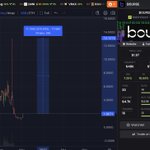
Most people lose money learning to trade.
The first few months are tuition, and you pay for every lesson in real capital.
Bourse Demo moves that cost off your balance sheet. Onchain paper trading with simulated capital in live market conditions, so the market is real and only the risk is not.
Test entries, practise exits, track your P&L and win rate.
Coming to Bourse soon.