

i liek crocs n llamas
future of france
Joined June 2022
- Tweets5.6K
- Following1.1K
- Followers4.6K
- Likes52.6K





strobie reeeee 🍓 莓莓 ストロベリ retweeted

Trueo × DefiLlama
We’re proud to announce that Crypto’s analytics powerhouse is now a distribution partner for Trueo!
Our prediction markets are live on @DefiLlama dashboards, bringing markets on risk, revenue, AUM, and other metrics directly to the users tracking the data.
strobie reeeee 🍓 莓莓 ストロベリ retweeted

it's not only charts btw, it's basically "generative" ui, so basically anything you can think of can be created by LlamaAI

jussa made an app - PaperPro, an advanced trading terminal for @papertrade_xyz
advanced charting, TP/SL and limit orders, fill-time estimates, execution queue pressure, live tape, and more...
and of course, no additional fees!
in alpha now - paperpro.app 😇


come give PaperPro a try if you are a pro trader on @papertrade_xyz !
the app is still being developed so please lmk if you found any bugs or anyting! feedback welcum! > <
cc @izebel_eth
sumting i feel kinda sad about issa back then if u encapsulate or abstract sum patterns or logic thats not ever done before u can make a smol library to share it wif ppl n it wud feel gud having helped anibooty else
making gud software was kinda lika art
nao no longer need ani of dis cuz can jussa ask claude to rawdog aniting n neva look at code wif biological eyes
errybooty finding out their ledgers have been impanted
are trezor etc safu n only ledgers are rekt so far?
cuz most of ze retailers n mani distributors work wif mani different brands…
strobie reeeee 🍓 莓莓 ストロベリ retweeted

I wasn’t going to comment since this is a really bad take IMO, but since it’s taken off I feel the need to. To my understanding, there is no evidence whatsoever pointing to a break of decades old hardness assumptions like elliptic curve cryptography. 1/n

Today I call upon the blockchain industry to calmly begin planning for "bunker mode". My personal recommendation is to set in motion a controlled mass migration of assets to fresh addresses, i.e. addresses whose pubkeys remain hidden behind a hash.
Holders, starting with large and sophisticated ones, should consider moving the bulk of their funds to addresses that have never signed a transaction. And when they do sign one, they should also move remaining funds to a new address (possibly generated from the same seed phrase).
Don't rush. While I believe there is cause for action a rushed migration would do more harm than good. Don't panic either. Moving assets to protected addresses is a simple, preventative step which does not require new cryptography or new wallets.
IMO it is now reasonable to brace for the possibility that ECDSA breaks before qday, in the worst case in months not years. By "break" I mean fast private key recovery (e.g. in one week) on available hardware (e.g. a large GPU cluster).
Recent days have been humbling for human mathematical intuition. Long-held, unquestioned hypotheses have fallen. This includes the n log(n) bound for integer multiplication and the 3SUM conjecture. In hindsight, May's unexpected disproof of the Erdős unit distance conjecture was our warning shot.
Yesterday's OpenAI drop made it clear that mathematical superintelligence is upon us. They say there are weeks where decades happen. We are about to live through weeks where centuries of mathematical progress happen. Could our magic 64-byte ECDSA signatures be too good to be true? Was it just security through obscurity all this time?
Elliptic curves feel especially vulnerable to superintelligence. Curves carry rich structure, with room for fancy tricks like Schoof, Frobenius, pairings. (By contrast, hashes are designed to minimise algebraic structure.)
Separately, as Ewin Tang can attest, an efficient quantum algorithm sometimes foreshadows an efficient classical one. We should be open to the possibility of a classical counterpart to Shor that breaks elliptic curves and RSA at once.
Also noteworthy is the striking under-representation of cryptographic breakthroughs among the 722 mathematical results OpenAI published. I've witnessed first-hand the US government censoring academic quantum cryptanalysis results. Backroom interventionism is my base case.
I urge large, sophisticated actors to lead by example. Project11's "risq list" (bitcoin-risq-list.projecteleven[.]com) is a great tracker of exposed BTC pubkeys. Binance, Bitbank, Robinhood, Bitfinex, and Tether have an opportunity to harden their cold storage. Next month I'll address institutions in London in a live Q&A (forum.ethereuminstitutional[.]org/london-2026).
Again, please do not rush. Wallets holding under 50 BTC enjoy partial cover from "Satoshi's shield", i.e. his 20K exposed addresses that hold 50 BTC each. Load-bearing signers like oracles and L2 security councils should consider rotating ECDSA pubkeys with every signed message and/or multi-signing with a hash-based schemes like SPHINCS.
Exiting bunker mode safely will require post-AI cryptography. My inclination is to go all-in on hash-based cryptography and avoid structured mathematical assumptions entirely, whether from curves, lattices, or isogenies. A single battle-tested hash (e.g. from the SHA or BLAKE families) yields plausible post-AI security.
The Ethereum roadmap on strawmap[.]org fully embraces hash-based cryptography with end-to-end formal verification as a response to the quantum threat. Those timelines must now be revisited and accelerated in light of mathematical superintelligence. I'll be pushing for maximum defensive acceleration.


strobie reeeee 🍓 莓莓 ストロベリ retweeted

after some onchain sleuthing, i think this is what happened:
19 metamask validators had won block rewards, and 18 of the rewards were not paid to the correct fee recipient but instead to this tornado funded account: 0x98B9231de84334c1d48BA0b72CF13f92484924A3
~17k validators proactively exited, ~523k eth total, unknown whether the attacker had the ability to change all fee recipients
it appears that 3 of the exploited validators have not yet been exited, and that 821 potentially impacted validators in total have yet to exit, unclear why
attacker only stole ~0.36 eth in rewards and likely never had the ability to withdraw any staked eth. however, depending on how the attacker managed to get signing access, they could potentially cause the validators to be intentionally slashed

Security Update: We are responding to a security incident affecting part of our infrastructure.
At this time, we have identified no immediate threat to MetaMask wallets.
As a precaution, we are proactively exiting affected validators within our non-custodial staking operations, in coordination with clients, partners and security advisors.
We’ll share further updates as appropriate. metamask.io/news/user-update…

strobie reeeee 🍓 莓莓 ストロベリ retweeted

We runnin PFOF on Chain?
Some quick analysis of past 24 hours shows of 4.3m swaps watched, there were >10k potential same block back runs, including >6k where the arb was directly after the initial swap in the same block.
Which should be impossible....


strobie reeeee 🍓 莓莓 ストロベリ retweeted

How Wintermute PropAMM fiddles with quotes on Base
Spoofing: aggregators route on the quote from the end of the previous block. For Tessera on Base, we show that the operator consistently raises its default fee early in the block and lowers it again late in the block, so aggregators read stale state that carries the lower fee. As a result, only 39% of swaps execute at the quoted price, and the average swap receives 1.08 bps less.

🚨 New paper alert 🚨
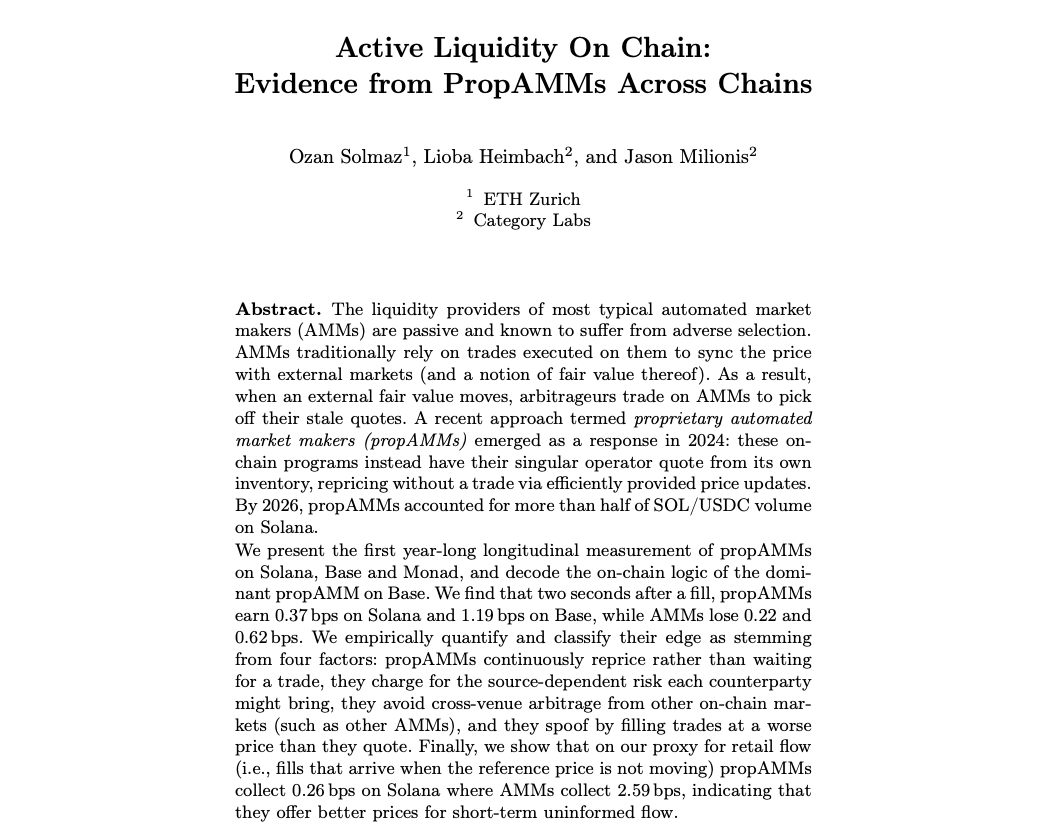
Active Liquidity On Chain: Evidence from PropAMMs Across Chains
w/ Ozan Solmaz @jason_of_cs
Liquidity providers on traditional AMMs such as Uniswap are passive and suffer from adverse selection. As a result, their price only moves through trades. When an external market moves, these LPs get picked off on their stale quotes. PropAMMs, a new design, emerged in 2024 attempting to combat this. In them, a single operator quotes from its own inventory and reprices actively. By 2026, propAMMs carried more than half of SOL/USDC volume on Solana and had been found, among other chains, on Base and Monad.
Our work seeks to elucidate the benefits of this new design both for LPs and for retail users. Do propAMM operators really have an edge over passive LPs, and if so, where does this edge come from? Can propAMMs offer tighter quotes to retail users? We measured a full year of propAMMs on Solana, Base and Monad, and decoded the closed-source on-chain logic of Tessera, the largest propAMM on Base.
The result: propAMMs have a measurable edge over passive LPs: two seconds after a fill, propAMMs earn 0.37 bps on Solana, 1.19 bps on Base and 1.69 bps on Monad, while passive LPs on AMMs comparatively lose 0.22, 0.62 and 2.06 bps. We trace the edge to four sources:
🟠 Cheap, frequent repricing: updates use at least 25 times less resources than swaps on Solana, and 5 to 15 times less on Base and Monad. Generally, the default block order on all three chains is by priority fee per unit of computation. Thus, an update pays far less than a swap for the same priority placement.
🟠 Pricing by counterparty: five of the six largest Solana propAMMs offer tighter spreads to aggregator flow than to non-aggregator flow. For Tessera on Base, we show that it whitelists, penalizes or blacklists individual addresses.
🟠 Arbitrage against AMMs: when a reference price moves, propAMMs reprice while AMMs do not, and arbitrageurs trade the two. A propAMM fills at its updated quote, so it may break even on these legs on Solana and Base and even earn 1.55 bps on Monad.
🟠 Spoofing: aggregators route on the quote from the end of the previous block. For Tessera on Base, we show that the operator consistently raises its default fee early in the block and lowers it again late in the block, so aggregators read stale state that carries the lower fee. As a result, only 39% of swaps execute at the quoted price, and the average swap receives 1.08 bps less.
The second question we ask is: can propAMMs offer users tighter quotes as a result of their edge? The answer is yes: on fills that arrive while the price is not moving (our proxy for retail flow) propAMMs take 0.26 bps on Solana, 1.26 bps on Base and 1.62 bps on Monad, where AMMs take 2.59, 1.38 and 8.60 bps respectively. Retail also makes up a larger share of propAMM volume: 32%, 43% and 17% on Solana, Base and Monad, against 9%, 16% and 8% on AMMs.
What did we learn? PropAMMs avoid the losses of passive liquidity provision, yet still manage to give retail tighter quotes. However, users also have to bear the cost of spoofing, which we expect to change as aggregators move to an on-chain methodology.
Link: arxiv.org/abs/2609.38056
been noticing same block backruns on RH since early august that should NOT have been possible, dis definitely started before september
unless Relay issa being dishonest here, more RH infra providers hav been leaking private data feeding users to ze sharks
320k comp tho llamaooo


strobie reeeee 🍓 莓莓 ストロベリ retweeted

My experience... Even if you think you understand AI, if you haven't actually built the primitives yourself, you're probably missing some core basics
No prior theory or ML required. Just basic calculus and python. Runs on pretty much any MacBook.
mister-meeseeks.github.io/g2…
strobie reeeee 🍓 莓莓 ストロベリ retweeted

We just created a new metric for exchanges: realized perp slippage
1. We take a snapshot of the orderbook right before market orders execute
2. Calculate the slippage at which it should fill ($0.94 on Binance)
3. Compare against actual slippage on the fill (actually $1.63)

Which exchanges have your tokens? Which work in your country? What are the fees?
New on DefiLlama: Find My Exchange
50+ exchanges compared on costs, slippage, liquidity & volume. Advanced filters, token finder, and detailed per-exchange pages.
defillama.com/exchanges