

Brief glimpses into fights, and fighters, of the 20th century; the great, the near great, the very good, the journeymen, the opponents and much more.
Joined April 2025
- Tweets12.1K
- Following320
- Followers733
- Likes11.7K

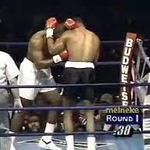



Michael Bentt TKO's WBO (Don't get me started with the alphabet nonsense) Heavyweight Champion Tommy Morrison in the 1st round, on October 29, 1993, at the Convention Center in Tulsa, Oklahoma.
From boxrec:
Betting Underdog Michael Bennt dropped Tommy Morrison three times en route to scoring a 1st round TKO. Morrison was set to fight Lennox Lewis in December of 1993 and the fight with Bentt was supposed to be a tune up for him. Morrison started off strong, trapping Bentt in the ropes and knocking him off balance with a well placed flurry, but was caught off guard with a sudden straight to chin. Morrison was shaken by the blow and kneeled after a barrage of fast punches to the head. This loss derailed Morrison's fight with Lennox Lewis, though the match did end up occurring over 2 years later. Michael Bentt's purse was $135,000.
Born in England but raised in New York, Bentt won the New York Golden Gloves Heavyweight Open Championship in 1984, 1985, 1986, and 1988.
Michael Bentt had lost to Ray Mercer at the 1988 Olympic trials by a 5-0 decision. Bentt lost to Mercer again at the box-offs by a 3-2 decision. He won the right to fight on the Jamaican Olympic boxing team but refused when he was told that he would have to give up his U. S. citizenship.
Bentt was trained by former (WBA) Light Heavyweight Champion Eddie Mustafa Muhammad.
Bentt would be KO'd in the 7th round by Herbie Hide, in his first defense, and spend four days in a coma. Thankfully, Bentt retired after recovery having spent several weeks in the hospital. He would never fight again obviously, finishing his career at 11-2-0 (6 KO wins).Bentt was KO'd in his first (by Jerry Jones) and final fights.
After retiring from boxing, Bentt became an actor. He portrayed Sonny Liston in the movie Ali, starring Will Smith. He has many other credits on his acting resume, including Collateral, starring Tom Cruise and Jamie Foxx, and Million Dollar Baby, which won the Academy Award for "Best Motion Picture" in 2005.

Undefeated (26-0) Riddick Bowe and Elijah Tillery have a fight, and a riot, on October 29, 1991, in their meeting for the vacant WBC Continental Americas heavyweight Title at the Convention Center in Washington, D.C.
Aired on USA's Tuesday Night Fights, Tillery was hurt midway through Round 1 by a right hand. A left hook then sent Tillery down at 2:52 of the opening round.
He was up at the count of six and received a mandatory eight-count. Although it appeared that the round should have been over after the standing eight-count, the two fighters were allowed to continue for another 10-15 seconds. After the referee called an end to the round, in retaliation to a jab after the bell by Bowe, Tillery kicked Bowe three times.
As the melee ensued, Tillery was pulled backwards over the ropes and onto the floor by Bowe's manager Rock Newman.
Tillery was disqualified for "a flagrant kick."
The pair would rematch, in December, with Bowe scoring a 4th round TKO.


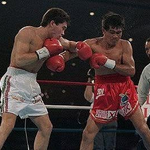
WBA Lightweight Champion (left, his 2nd defense) Julio Cesar Chavez wins an 11-round Technical Decision over WBC Lightweight Champion Jose Luis Ramirez (his 3rd defense), on October 29, 1988, in Las Vegas.
Chavez comes in 61-0 while Ramirez, in his second reign as WBC Champion, entered at 101-6-0.
The NY Times fight report read:
While Chavez never scored a knockdown, he buckled Ramirez's knees in the fourth round with a right hand that sent Ramirez reeling backward in a half-squat that nearly put him on the canvas. But Ramirez righted himself and gamely fought back, as he did all night.
Chavez's hand speed was superior to that of the 29-year-old Ramirez, who entered the bout as the W.B.C. lightweight champion, and left as the victim of a somewhat controversial ending.
As Ramirez moved forward in the 11th round of the scheduled 12-round bout, he and Chavez butted heads. Blood spilled from a gash on Ramirez's scalp, close to the middle of his forehead. The referee, Richard Steele, temporarily halted the bout so that the ringside physician, Flip Homansky, could examine the cut. Homansky took a look and would not let Ramirez continue.
By the rules, Steele was obliged to penalize Chavez, as the uninjured fighter, a point in the scoring, and the bout went to the judges' scoring of the first 10 rounds for the verdict. Even with Steele's deduction, all three judges had Chavez ahead.
Afterward, there was the reflex protest of Ramirez that the butt was intentional and that he figured he was winning the fight anyway. Just as predictable was Chavez's verbal counterpunch.
"When he comes in," Chavez said of Ramirez, "he lowers his head too much."

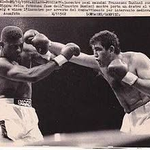
Francesco Damiani (right, 21-0 coming in) beats Tyrell Biggs by 5th round TKO, on October 29, 1988, in Milan, Italy, in a rematch of the 1984 Olympic Super Heavyweight final where Biggs had won a 4-1 decision.
It was the second of three straight KO losses for Biggs (to Tyson, Damiani and then Gary Mason) after starting his pro career with 15 straight victories.

Thomas Hearns KO's Juan Domingo Roldan in the 4th round on October 29, 1987, at the Las Vegas Hilton, for the vacant WBC Middleweight Championship.
The WBC Middleweight Title became vacant with the retirement of Sugar Ray Leonard on May 27, 1987 after his decision win over Marvelous Marvin Hagler.
Hearns knocked Roldan down twice in the first round and once in the second. Early in the fourth, Roldan had wobbled Hearns with a left hook. Later in that round, Hearns put Roldan down for the count with a right cross to the chin.
Hearns became the first boxer to win world titles in four weight divisions, albeit only two of the traditional eight (and none of them an undisputed title).

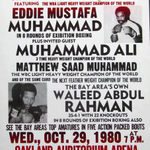
On October 29, 1980 at the Oakland Auditorium Arena in Oakland, California professional exhibitions and appearances were conducted on a local amateur boxing show. Exhibitions were conducted by World (WBA) Light Heavyweight Champion Eddie Mustafa Muhammad and World (WBC) Light Heavyweight Champion Matthew Saad Muhammad with an appearance by former three-time World Heavyweight Champion Muhammad Ali.

In a NABF Light Heavyweight Title bout on October 29, 1971, undefeated (32-0) Mike Quarry wins a 5th-round Technical Decision over defending titlist Jimmy Dupree at the Anaheim (CA) Covention Center.
The Pittsburgh Press reported:
"Undefeated Mike Quarry was awarded a technical decision last night over North American light-heavyweight champion Jimmy Dupree when their bout was halted at 2:08 of the fifth round due to an unintentional butt by Dupree which opened a deep cut over Quarry's eye. Quarry was ahead on points at the time the fight was stopped and under California regulations he was awarded the decision because he was unable to continue."
(The title did not change hands)


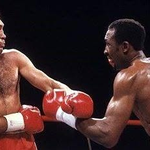
Undefeated George Foreman (left, 31-0) stops Luis Faustino Pires in 4 rounds, on October 29, 1971, at Madison Square Garden.
Referee Johnny LoBianco stopped the fight between the 4th and 5th rounds.

Henry Hank ducks under an Eddie Cotton left hand, on October 29, 1963, during their 15-round battle for the State of Michigan's version of the Light Heavyweight Championship. Cotton would win a UD.
Eddie Cotton, 56-24-2 (33 KO's), was a light heavyweight contender from the late 1950s until his retirement in the late 1960s. He was known as a good defensive fighter, although not very exciting. He was also prone to getting cut in fights.
Cotton twice unsuccessfully challenged for the World Light Heavyweight Title; losing to Harold Johnson for the National Boxing Association Title, and losing what many felt was a controversial decision in 1966 to Jose Torres for the World Title.
He should not be confused with the referee of the same name.
Hank, 62-30-4 with 40 KO's, never fought for a world title, but he fought six former or future world champions beating two of them.
He had wins against Joey Giardello (1961) and Jimmy Ellis (1962) and losses to Virgil Akins (1954), Giardello (1962), Dick Tiger (1962), Harold Johnson (1963), and Bob Foster (twice, 1964 and 1965).
Hank's second fight against Joey Giardello was named the 1962 Fight of the Year by The Ring.
The Ring magazine ranked Hank as one of the top 10 middleweight contenders from 1959 to 1961 and as one the top 10 light heavyweight contenders in 1962 and 1963.
Hank's loss to Bob Foster by a ninth-round TKO in 1964 was his only stoppage loss in his 96 professional bouts.
As in many cases with old-time fighters, the record is deceiving as Hank, clearly past his prime, lost 17 of his last 30 bouts in a career that lasted from 1953-72.

Eddie Cotton digs a right to Henry Hank's midsection in the 3rd round, on October 29,1963, during his 15-round UD win for the State of Michigan's version of the Light Heavyweight Title.

Henry Hank weighs in for his fight with Eddie Cotton, on October 29, 1963, for the State of Michigan version of the Light Heavyweight Title, at the IMA Auditorium in Flint, Michigan.

Super Lightweight Paul Armstead wins a 10-round unanimous decision over Joey Reynolds on October 29, 1962 at San Jose (CA) Civic Auditorium.

Southpaw Katsutoshi Aoki (right) wins a 12-round decision, and the Oriental and Pacific Boxing Federation's Bantamweight Championship in Tokyo, Japan, on October 29, 1962, over Kenji Yonekura.
Aoki would continue his winning ways and earn a shot at Eder Jofre's Bantamweight World Title in 1963 and lose by a 3rd round KO.
Aoki would go 48-14-4 with 25 KO's as a pro, and his record is deceiving, he lost ten of his final twelve fights.
And you're not going to ever read about fine boxers like Aoki anywhere else but 20thCB:IM&M.

Guilio Rinaldi (left) wins a 10-round decision over Archie Moore, on October 29, 1960, in Rome.
The win would get Rinaldi, who'd fought for Italy as a middleweight in the 1956 Olympic Games, a shot at Moore's Light Heavyweight Championship in June of 1961 (Moore would win a 15-round UD in that fight).

1960 Olympic Gold Medalist at Light Heavyweight, Cassius Clay, makes his pro debut on October 29, 1960, against Tunney Hunsaker at Freedom Hall in Louisville, Kentucky.
The future Muhammad Ali, who'll soon be the most recognizable figure in the sport's history, wins a 6-round UD over Hunsaker.
Tunney Hunsaker was named after former World Heavyweight Champion Gene Tunney. He started boxing while he was in the U.S. Air Force and won a Golden Gloves title while stationed at Lackland Air Force Base in Texas.
Besides Ali, Hunsaker fought such notable boxers as Ernie Terrell, Tom McNeeley, and Alejandro Lavorante.
In his final fight, he was knocked out by Joe "Shotgun" Sheldon in ten rounds on April 6, 1962. He was in a coma for nine days and required two brain operations.
Hunsaker's pro record was 19-15-1.
Hunsaker was also a Sunday School teacher and a police officer. He became the police chief of Fayetteville, West Virginia at the age of 27 and held the job for 38 years. He was the youngest police chief in the history of West Virginia. Hunsaker was inducted into the Law Enforcement Hall of Fame and had a bridge named after him.
From the Louisville Courier-Journal of October 30, 1960:
Olympic light heavyweight champion Cassius Clay of Louisville finished his first professional fight streaked in blood -- that of his battered opponent -- Tunney Hunsaker.
18-year-old Clay, turning in a classy, confident performance against a heavier and slower opponent last night at Freedom Hall, won every round of the six from the 30-year-old police chief from Fayetteville, W. Va.
At the final bell, Clay, appearing almost as fresh as when he started, was splattered with blood from Hunsaker's nose and a cut over the West Virginian's eye. The eye was swollen almost shut after the fight.
Clay, who put behind him a brilliant amateur record, weighed 186 pounds, his heaviest ever, for the fight. Hunsaker came in at 192.
The dancing, fast-moving Clay bloodied Hunsaker's nose in the third round with a flood of blows and it was the fourth that he opened the cut over his eye.
Although Clay was the master throughout, neither fighter ever had the other in trouble and gave the crowd of 6,180 little to cheer about. Proceeds from the fight went to the Kosair Crippled Children's Hospital.
Judge Sid Baer ruled 30-24 in Clay's favor, judge Walter Beck had it 30-23, and referee Paul Matchuny saw it the widest of all -- 30-19. The Courier-Journal card showed 30-24.
Clay said after the fight he didn't get tired at all going six rounds for the first time. "I'm ready to go 10 rounds anytime," he said. "The extra weight slowed me down just a little bit, not enough to hurt."
Hunsaker had praise for Clay in his dressing room as he nursed his bruised eye.
"He's awfully good for an 18-tear-old and as fast as a middleweight," he said. Hunsaker said he thought he won the first and last rounds and said Clay never hurt him at any time.
Clay received $2,000 for his first pro fight, while Hunsaker got $300.
Hunsaker showed little in the way of an offensive against the lean, 6-foot-3 Clay. Twice he slipped forward to the canvas while throwing punches off balance.
He did a good job of keeping his opponent from landing any real damaging blows but Clay's constant hammering finally took its toll.
Clay was unmarked except for the blood splotches on his arms and his natty white Olympic trunks. However, he slightly bruised a knuckle on his right hand.
After last night's fight, in which he was handled by George King, Clay will be taken over by a group of 10 Louisville businessmen, with whom he signed an $18,000 contract last week. They will hire a manager and trainer for him.

youtu.be/PrAAFR01XYU
The AP reports on Virgil Akins 14th-round TK of Tony DeMarco at Boston Garden on October 29, 1957:
"Virgil Akins, 29, St. Louis, floored former welterweight titlist Tony DeMarco three times in the 14th round for a knockout tonight in a war of attrition. The fight, billed in Massachusetts as a welterweight title match, though not recognized by the NBA or the NYSAC as a championship contest, was one of the most savage and exciting the Boston Garden ever had known. Akins spent the early rounds sending out left jabs and hooks to score against the hard-hitting DeMarco and picking off Tony's blows with a slip of the shoulder and dart of the glove. Akins, down himself in the 12th round, polished off the 25 year old DeMarco with a smashing two-handed flurry at 1:17 of the 14th - the 6th time in the bout DeMarco had been on the canvas."
----------------------------------------------------------
Akins KO of Tony DeMarco in Boston, Massachusetts, in fourteen rounds billed in Massachusetts as a welterweight title match. His impressive knockout of top-ranking DeMarco elevated him to the top of the division by Ring magazine and the NBA and in prime position along with Issac Logart, Gil Turner, Vince Martinez, Gaspar Ortega, and George Barnes to compete in the welterweight elimination tournament to crown a successor to Carmen Basilio, who vacated the title when he beat Sugar Ray Robinson for the middleweight title.
----------------------------------------------------------
An excerpt from IBRO's 'Virgil Akins: His Long Journey to the World Welterweight Title' by Dan Cuoco:
Dan Daniel of Ring magazine wrote, “Akins has proved himself eminently able to rise to an occasion. He came into the competition as an underdog. Gil Turner had beaten him. This after Virgil’s eight-round knockout of Sugar Hart and on top of a defeat by Franz Szuzina. Once entered in the welter eliminations, Akins stopped fooling around. He made Tony DeMarco retire from the ring with two knockouts in Boston.”
The first Akins-DeMarco fight took place on October 29, 1957, and was among the most savage and exciting fights ever held in the Boston Garden. In a war of attrition, Virgil floored DeMarco three times in the 14th round for a knockout. Virgil spent the early rounds sending out left jabs and hooks to score against the hard-hitting DeMarco and picking off Tony’s blows with a slip of the shoulder and dart of the glove. Virgil was dropped in the 12th round before finishing DeMarco with a smashing two-handed flurry at 1:17 of the 14th – the 6th time in the bout DeMarco had been on the canvas. After the fight, the NBA and the NSAC said that they did not regard the meeting as a championship bout but only as an elimination in the tournament, which would ultimately name a successor to Carmen Basilio.
Akins and DeMarco met in a rematch on January 21, 1958, again at the Boston Garden, once more for the Massachusetts version of the welterweight championship. Virgil scored a twelfth-round technical knockout in another brutal match. He finished the bout with a jarring right uppercut forcing referee Eddie Bradley to stop the fight. DeMarco had been down once in the eighth round and twice in the eleventh but didn’t know how to quit until Bradley made the decision for him before an overflow crowd of some 15,000 screaming fans.
With top-rated DeMarco out of the way, the final six vying for the vacant title were Virgil Akins, Isaac Logart, Vince Martinez, Gil Turner, Gaspar Ortega, and George Barnes. Isaac Logart advanced when he defeated Gasper Ortega in twelve rounds on December 6, 1957. Six days earlier, Vince Martinez also advanced with a twelve-round majority decision over Gil Turner. With three fighters left in the tournament due to George Barnes’ withdrawal, Julius Helfand, chairman of the state commission, and the championship committee arranged a draw to determine the next pairing. Nat Fleischer, publisher of The Ring, drew out the names, first Akins and then Logart, so Martinez automatically got the bye.
On March 21, 1958, Virgil stopped the shifty Issac Logart in the sixth round of their welterweight tournament semi-final at Madison Square Garden. The end came with surprising suddenness. Logart had dazzled Virgil with his flashing hand speed and clever maneuvering. In the first, second, fourth, and fifth rounds, Logart landed significantly more punches than Virgil. Until the sixth, Virgil’s best round was the third, when he came on strong in the last two minutes. He scored with some right hands for the first five rounds, but none landed flush. Virgil finally caught up with Logart early in the sixth round and staggered him with two right hands to the jaw, followed by a right to the body and a push that dropped him. Logart arose groggily at three and was given the mandatory eight count. Virgil belted away at Logart with both hands. A right sent Logart sagging into a sitting position on the ropes. Although he didn’t hit the floor, referee Harry Kessler ruled it a knockdown and gave him another eight count. Virgil roared in for the knockout. He smashed Ike to the ropes with both hands. With a cut over his right eye and a bloody mouth, he was headed to the canvas when Kessler stopped the fight. This was their rubber match. They had met twice before in 1955. Virgil won the first by split decision, and Logan evened the score, winning a unanimous decision in the return bout.
Virgil hardly got a chance to enjoy his victory. Right after the bout, the New York District attorney subpoenaed both fighters and their managers as part of a continuing investigation into the influence of underworld figures on boxing in New York. Despite the odds favoring Logart, a lot of “smart money” had been placed on Virgil just before fight time. In the end, a Grand Jury cleared all parties of any wrongdoing.
On June 6, 1958, Virgil met Vince Martinez in Virgil’s hometown of St Louis, MO, for the vacant world welterweight championship. Virgil, moving fast out of his corner, didn’t waste any time. Just thirty seconds into the opening bell, the entire pattern of the fight was set. Virgil moved in and landed a left to the side of Vince’s head, a solid left hook to the body, followed by a right crossing over Martinez’s left. Down went Vince. Caught cold, Vince never was in the fight after the first knockdown. Before the round had ended, he had been down four more times.
The second round saw Martinez remain off the canvas for only three minutes of the fight. Although he was completely on the defensive with a cut under his right eye and nose bleeding profusely, he appeared to be gaining strength. He made good use of his left jabs with one flurry of combinations more like the Martinez the fans had expected to see
But Vince’s short rally didn’t last long. Twice more in the third and twice more in the fourth session, Martinez was slugged to the canvas by Virgil’s booming right before the referee raised his hand in triumph at 52 seconds of that fateful fourth with Martinez on the deck, drained of all ability to fight. Kessler explained later that he could have counted to thirty over Martinez without him getting up.
The casual onlooker must have found it difficult to understand how a cautious, clever, experienced boxer like Vince Martinez could have been demolished in such a hurry by his hard-hitting but slower-moving opponent. Virgil explained after the fight that he had exploited a weakness he spotted in Martinez’s style in watching four of Martinez’s televised fights. Martinez telegraphed his vaunted left hook. He made a peculiar movement of his head and dropped his left hand too low before striking with it.
Philadelphia Boxing Historian Chuck Hasson shared his observations with me. “Of course, anybody can be caught cold – but I remember after Akins kayoed Isaac Logart in the welterweight tourney semi-final, he was asked his thoughts on the upcoming Martinez match, and Virgil said he would kayo Vince because Vince had a habit of double jabbing, dropping his hands and leaning back, real pretty like, and when Vince does that he has to throw two straight right hands the first probably missing but the second will be on the money. Obviously, Vince wasn’t listening because 30 seconds after the fight started, the scenario played out just as the prognosticator Akins had called it. I think Akins was one of the most dangerous welters in history from 1955 to 1958 (check his record).”
After winning the title, Virgil took his wife to Mexico. When he returned, he discussed prospective challengers with Eddie Yawitz. They both hoped that recently dethroned middleweight champion Carmen Basilio would reenter the welterweight division because he would give them their biggest payday. Moreover, they didn’t fear Carmen because they were sure Virgil hit harder than anyone in the division. This confidence made Virgil announce that if Basilio wasn’t available, he didn’t care who he fought.

Vince Martinez (right) and Carmen Fiore battle, on October 29, 1954, with Martinez scoring a 7th round TKO at Madison Square Garden.
Vince Martinez, 69-8-0, would get one title shot, losing by 4th round KO to Virgil Akins for the vacant Welterweight Championship in 1958.
----------------------------------------------------------
From The New York Times:
Martinez Halts Fiore in 7th Here To Extend Winning Streak to 11; Paterson Welterweight Beats Foe Second Time as Referee Stops Contest With Brooklyn Man Helpless on Ropes
Vince Martinez, the sharp- punching welterweight from Paterson who is fighting his way to a championship bout, stopped Carmine Fiore of Brooklyn in the seventh round of their scheduled ten-round contest in Madison Square Garden last night. The end came after 2 minutes 32 seconds of the round. Fiore was helpless on the ropes in his own corner when Referee Harry Kessler called a halt. The loser. was cut over both eyes and another good punch would have finished him.
A terrific right cross to the chin, landed by Martnez as Fiore! retreated into a corner, was the blow that started Fiore on the way to defeat. That punch made Fiore's knees buckle and he tried to cover against the barrage of lefts and rights that followed. But he was too dazed to block all the punches.
Straight Right Cuts Brow
A straight right cut Fiore's left brow. Two slashing lefts and the right brow was opened. Now Fiore was both dazed and blinded. He fought his way out of the corner and that was courageous, but not the best thing to do. For as he moved into the center of the ring he was wide open. All his defenses were gone. A left hook to the jaw, a right to the chin and he fell onto the ropes, all done.
Fiore is one of the hardest hitters in the welterweight division, especially with his left. He is a forcing, aggressive fighter, but he is no boxer. Martinez is a superior boxer. He fights in the classic style and when he lands a punch it is sharply landed, and it jars and hurts. From the beginning until that first right landed in the seventh, Martinez was the master. He met the bull-like rushes of Fiore as deftly and as gracefully as a matador, side-stepping and punching, moving in for the jab. Fiore, after being hit, would clinch and push his rival into the ropes. There Martinez would tie him up, move out and jab the left into his face. And the bull that was Fiore, stung and infuriated, would move in again, taking more and more punches, mostly that lancing left. When the seventh round started Fiore was, as always, the one to move in. His attack now was furious and it was desperate. But Martinez could not be drawn into that sort of fighting. He jabbed and he jabbed and then the right, and that was all of it.
The two judges, Arthur Susskind and Jack Gordon, gave Martinez the first six rounds on points. The referee voted one round to the loser, the fourth.
Martinez has now won eleven fights in a row. He and Fiore met once before, in January of last year. Martinez. didn't win that one so easily, but he won. Now the Paterson fighter is looking for bigger game. He believes he can go on to a title fight with Johnny Saxton, Last night Martinez scaled 148 pounds against Fiore's 147.
In a four-rounder following the main bout Tommy Jones, 156, of Newark, outpointed Lou Perry, 161, Brooklyn.
Copeland and Lightburn Win
Two eight-rounders, both full of action, preceded the main hout. In the first one, Auburn Copeland, 129, of Flint, Mich., out-boxed Frankie Sodano, 129¾, of Philadelphia, a rugged, hard puncher. Copeland, hurt several times and staggering, rallied to take the decision. In the other eight-rounder, which served as the semi-final, Ludwig Lightburn, 136%, of British Honduras, took the de- cision over George Justine, 141, Philadelphia. The British Honduras boxer, making his first appearance in the Garden, had too much skill, especially with his left, for the willing but open- chinned Justine. Ronnie D'Alboro, 130½, of Brooklyn, outpointed Tony Decola, 131, East Side, in a four- rounder that opened the show.

A retired Sugar Ray Robinson rehearses his stage act with the chorus girls, at the French Casino in New York, on October 29, 1952.
This was four months after Robinson's failed attempt at Joey Maxim's Light heavyweight Title.
Sugar Ray would not return to the ring until January of 1955.

Sandy Saddler hands Featherweight Champions Willie Pep the second loss of his 137-fight career (Pep was 134-1-1 to this point) on October 29, 1948 at Madison Square Garden, scoring a 4th-round KO.
Pep was dropped twice in the 3rd and then once in the 4th for the count.
----------------------------------------------------------
From The New York Times:
Saddler Wins World Featherweight Title by Knocking Out Pep in 4th Round; VETERAN FLOORED 3 TIMES AT GARDEN Saddler Pins First Knockout on Pep, 1-3 Choice, in 2:38 of Fourth Before 14,685 LEFT TO JAW LIFTS TITLE Down Twice for 9 in Third, Willie Suffers Only Second Defeat in 137 Pro Bouts
Sandy Saddler became the featherweight champion of the world last night by knocking out Willie Pep of Hartford, Conn., in four rounds. In one of the biggest ring upsets of the year, the spindly Negro from Harlem stretched the defending titleholder on the canvas for the full count with a left hook to the jaw after the round had gone 2 minutes 38 seconds. Just before the fighters entered the ring Pep became a 1-to-3 choice to retain the crown that he won clearly in June, 1946, but Saddler confounded the pricemakers by doing a workmanlike boxing job on Willie in the first two rounds. He floored Pep twice for counts of nine in the third before putting the crusher on the favored one in the fourth. In going down to defeat, the 26- year-old Pep definitley lacked the quality from which he took his 'ring name. The veteran of ten years of amateur and professional battling had little spring in his legs, no sharpness to his punching and an inability to get away from a tantalizing, and at the same time punishing, left to the face that Saddler constantly threw at him. Veteran Fights Cautiously In addition, the defending champion fought what for him was a cautious battle. Accustomed, in the past, to carrying the action to his rivals with the sound of the bell, Willie was all caution in his joust with the 22-year-old Saddler. It was the latter who did all the forcing, who advanced toward his foe without reck and who seemed every bit superior even in the first two rounds. A fairly good puncher with either hand, Pep reached his challenger once or twice with a solid left or right to the chin in those sessions, but Saddler showed no ill effects from them and went about carving up Willie with sharp lefts to the face and short rights to the body and head. A crowd of 14,685 paid a total of $55,751 to sit in on Saddler's surprising success. The new champion was probably the least surprised person in the whole place at the end. He knew, as did most of those in attendance, that the fight was surrounded by "fix" rumors in which he was supposed to win, but the manner in which he disposed of Willie made it clear no collusion was necessary, that he had enough guns at his disposal to take care of Pep on his own. The battle simply proved that Willie, didn't have enough to hold off the eager young Negro. Veteran Has Weight Edge Saddler weighed 124 pounds, as against 125½ for his victim. When they went out for the first round, the impression arose that the more compactly built Pep would have no trouble with his rangy rival, but Saddler quickly dispelled that belief by stepping into Willie and driving both hands to the body. Returning a left and right to the head, Pep sought to carry the fight to close quarters. Saddler wrestled the champion, though, and twisted him around so that both were looking in the same direction before Referee Ruby Goldstein could untangle them. After the separation the challenger reached Willie with several left hooks to the body. In the second round Pep shot a straight right to the head, but Saddler moved forward to jab his left to the face repeatedly. The Harlem boxer again wrestled Willie out of position and received a solid right to the head after Goldstein had parted them. Saddler continued to wade into Pep in the third, absorbing Willie's punches and sending a steady two- handed attack on his own account. Midway through the round Saddler let fly a straight left to the face and the punch carried so much force that it spilled Pep for a count of nine. Bell Saves Pep in Third On arising. Pep walked into a left hook and a right to the jaw, and went down again, once more taking nine. The bell ended the round before Saddler could resume his attack. The challenger sprang at Pep in the fourth, belaboring him with rights to the jaw as Willie made. only feeble returns. Suddenly, in a neutral corner, Saddler released a smashing left hook to the jaw and down went Willie for the full count. The defeat was only the second and the first knockout suffered by Pep in 137 professional fights, of which he won 134. He was out- pointed once by ex-lightweight king Sammy Angott and was held to a draw once by Jimmy McAllister. The fight was the ninety-fourth of Saddler's pro career and his sixty-fourth knockout victory. A native of Boston, he moved to Harlem as a child. He has been boxing in the paid ranks for four years. In his dressing room the new champion said he felt he would win after sampling what Pep dealt him in the first round. The Hartford fighter offered no alibi, except to say that the over-confidence of his handlers might have affected him. Touching on the "fix" angle, Chairman Eddie Eagan of the State Athletic Commission told the fighters at the noon weighing that rumors of that nature attached themselves to every fight. He added: “I am holding you responsible to uphold the good name of boxing. There are rumors of a 'fix' before every fight, but we don't pay any attention to them. You are two honest athletes fighting in a great class for a great championship. You will represent boxing tonight." On leaving commission headquarters, Pep said to reporters: "Don't worry about me. I'll be in there to win.' " Saddler said nothing. He just won. ' After the bout, Chairman Eagan declared the fight was a "good scrap." "Both boys did their utmost," he added. C. P. Powell, another member of the commission, said, "it was a good, hard-hitting fight." In the semi-final, Jackie Weber, Pawtucket, R. I., outpunched Johnny La Russo, of the Bronx. Weber weighed 135 and La Russo 135½. Harry La Sane, 131, Houston, Tex., defeated Bobby Bell, 124, Youngstown, Ohio, and Nunzio Carlo, 134, Philadelphia, beat Eduardo Carrasco, 132½, Peru, in six- rounders. In the four-round opener, Tommy Collins, 125%, Boston, out- pointed Lorenzo Safora, 127, Cuba.

