

Seoul dev by day, builder after dark. A practitioner's field notes on AI at work, mostly the parts nobody demos. https://nitter.gq/t.co/vpy4ZOFtNd · https://nitter.gq/t.co/ybI4vYM7Tg
Seoul, Republic of Korea
Joined March 2010
- Tweets1.3K
- Following703
- Followers751
- Likes3.4K


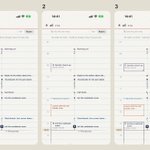
The foot of my todo list had two lines: "3 done, put away · show" and "1 put off to later days · show". With a long list, those two extra lines started to feel like clutter. They were the same height as a row, with a check and an hourglass where the bullets go, so they read like two more todos.
So now there's one blank line, then a single line with no marks.
I also renamed "put off". It was also counting the next instance of a repeating todo and events a few days out, things I never put off myself. It says "ahead" now.

1
2
65


Work's gotten a lot harder over the past few months, to the point where I can't trust the tickets and docs that come my way.
AI was supposed to make this easier. So why is it harder? People used to write every line themselves and put their name behind it. No matter how good they were, if they said they'd checked something, you could at least trust that they had. Now it all reads smooth (but a little off), and you can't tell by looking where the unchecked parts are buried. They blindside me and eat up my time and energy.
I used to give people the benefit of the doubt and build from there, pushing back or pointing out what they'd missed. That's what let me work async and answer on my own time. Now, weirdly, talking in person is the best shot I've got at a straight answer. Instead of moving things forward, I'm spending all my energy paying the verification tax.
Should I stop paying it too? Is it time to turn my brain off and coast? I go back and forth on this every day.
1
1
75
I thought 'effort' and 'thinking level' had replaced 'temperature', but they hadn't.
Gemini 2.5 Flash shuts down on December 1, so I was moving a service to 3.6. The release notes said 'temperature', 'top_p' and 'top_k' are now ignored and will trigger a 400 error in future models. Our code was sending 'temperature', but it was set to 1.0, the default, so removing it changed nothing. I still wanted to know why it was going away.
Reasoning models think before they answer, so swapping a sampling setting for a "how long to think" setting made sense.
Then I checked. Both settings predate the removal. Anthropic dropped 'temperature' too, and its migration guide says requests that lowered it for more consistent output lose that effect. Then it adds: "No other setting replaces it."
The only reason I found written down was Google's. Their Gemini 3 docs say the model's reasoning is optimized for the default of 1.0, and going lower can cause looping. For consistency, Google suggests writing explicit rules into the system instruction.
1
125


AI is overrated. So are we.
Agents can do the work, but people still answer for it. For anything to get decided, we have to understand it together.
Some agenda items keep coming back meeting after meeting, still undecided. I think it’s because we don’t understand them well enough. We’ve gotten used to agents that always have an answer and never have to answer for it. Then when it’s time to put our name on a decision, we realize how little we actually know.
6
101

In the week view, each day's square only fits a few finished todos.
What if they were sorted by how long each one took that day, instead of the order I finished them in? Then whatever ate my day would stay visible when the square overflows.

2
3
120
Building a Mac version of my to-do app.
Day / Week / Month are on ⌥⌘1, 2, 3, since ⌘1–9 already switch categories. Holding two modifiers for something you do all day feels wrong.
How would you map them?

3
2
129
The design system is part of our product repo, so designers can edit components and push changes directly. It's nice not having handoffs or ticket queues. But in practice, it doubles as a catalog of every variant the product has.
From a designer's point of view, adding whatever a screen needs is exactly what you'd do with a catalog. Do that in system code, though, and one screen's needs get baked into a shared component as a prop or a branch. If the catalog were just docs, an extra entry wouldn't break anything. In code, every screen that uses the component changes along with it.
There's no stopping where this is all heading, and I don't mind the experimenting. But things kept breaking upstream of my work, so I put my position together and raised it with the team. I even pulled out dependency inversion to argue for at least cutting that dependency: give designers and PMs read access to the repo, keep the design system and catalog as docs, and have both the product code and the designers' work depend on those docs.
Most of the team would rather start with the AI harness designers and PMs code with, and tighten it to control what they submit. I get the appeal right now. But reviewing every submission and patching the harness after every incident is going to turn into someone's glue work. You could argue that now that AI is in the mix, helping non-engineers contribute well is part of our job. I agree with that. I'm just not sure it has to happen that far upstream. Curious how everyone else is handling this.

The Mac version of my todo app still had its categories in a bar at the bottom of the window. Leftover from the iphone, where that spot sits right under your thumb.
Moved them to tabs at the top.
How many categories do you keep? Wondering when tabs get too crowded.

4
3
155
Two apps I built with Tauri were fine on Mac, but their windows came out the wrong size on Windows. They opened at 800x600, and even with a minimum size set, I could drag one down to 431px wide.
I thought it was a Tauri bug and wrote a workaround. The cause was the Windows-only config file, tauri.windows.conf.json. It replaces arrays from the base config instead of merging them, and window settings live in an array (app.windows). I'd only changed a few fields there, so every value I didn't repeat was gone.
The docs already pointed to the spec behind this (RFC 7396), but it was easy to miss, so I sent a PR to spell it out.
1
2
194

I was going to show time you add by hand in a lighter shade, so the log would stay honest.
Then someone on reddit asked: wouldn't a patchy-looking week set off the same perfectionism that makes people quit tracking?
Fair point. Now it looks like any other minute.
2
2
102
It's Anatodo, free on TestFlight while it's in beta: anatodo.com

1
44
Left: the plan. Right: what happened.
Sticky notes are the safe pick, but a two-hour one ends up louder than the real day. And 2 and 3 keep tempting me.
1. Sticky note
2. Brackets
3. Rubber stamp
Which would you keep?

3
2
117
Asked Apple's on-device model to break todos into steps. Default safety settings.
"Kill the spider":
Find the spider
Approach the spider
Use a tool
Locate the spider
Eliminate the spider
"Hug my kids":
Blocked: "Response may contain sensitive or unsafe content."
2
47