

Father, analyst, combinatorist, AI, applied mathematics/data science, and graph theory enjoyer. @UTAustin MSDS candidate. @MemphisAlumni math alum. My views.
College Station, TX
Joined July 2012
- Tweets6.8K
- Following1.1K
- Followers1.3K
- Likes6.3K








Avery Carr retweeted

For technical fields there are many undergrad programs (engineering, cs, math, physics, etc ) that are higher ranked than uva


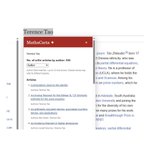
A milestone in my journey as an independent mathematics researcher! Wolfram MathWorld now explicitly cites two of my contributions to the Erdős–Gyárfás conjecture. Honored to have my work recognized in such a respected mathematical reference.
mathworld.wolfram.com/Erdos-…

Interesting take from our celebrated logician @JDHamkins … if we altered the rules of chess where we forgo check and checkmate and actually have to capture the king, will the game be the same? Intuitively, we might say of course. Not so fast. Find out below 👇.

Avery Carr retweeted
Honestly, we need some sort of analog to the Efficient Market Hypothesis for our expectations around if and when a problem will be solved. The past is no indication, especially in mathematics. A problem could simply be undecidable. We don’t know until we prove it so.
Avery Carr retweeted

“The reports of my death have been greatly exaggerated”
—human math researchers

Some fascinating developments following OpenAI's shock breakthrough proof of the Quasi-Riemann Hypothesis, which was released publicly on October 6:
1. Building on OpenAI's proof, a recent Hexagon preprint (released on October 12) by Cureton and Thorner establishes that ALL finite-order Hecke L-functions are zero-free to the right of 1 - 1/6000.
2. And now, today, an arXiv preprint by Frei, Somos and Widmer uses this result to prove unconditionally the 2007 Ellenberg–Venkatesh bounds on ℓ-torsion in class groups of number fields.
I was amused to see the AI declaration in the second paper: "No artificial intelligence tools were used in this work."


Avery Carr retweeted

Lfg
My college classmate Matt and I just used AI to create a Erdos #374 solution w/ a Lean-verified proof. We used a reciprocal-prime equidistribution estimate, Harman’s almost-all short-interval theorem, Weil’s bound, and the analytic large sieve. Full proof: papers.ssrn.com/sol3/papers.…
Avery Carr retweeted

Apparently it’s officially hate-on-string-theory day on X today. Just a reminder that string theory remains the only known consistent theory that combines gravity with quantum mechanics. Now go on ranting if you have to.

This is a point worth considering. Another point could be a case where an LLM could not come up with a solution/proof, and then a human does.
This quoted post is unavailable.
There is gatekeeping. And should be to a certain extent, else anything gets published. But having only a few people with access to super secret internal models to solve hard problems can also be seen as gatekeeping in a new form.

Avery Carr retweeted

OpenAI has fired three safety researchers, alleging they mishandled confidential information.
After the recent multi-agent security incidents, will the technical leadership overseeing these systems face the same accountability?
I was pushed out of OpenAI in August after ~5 years as a researcher. No foul play in my case, but working on formal math & verification in Lean at OpenAI was career suicide.
During my time at OpenAI, I became increasingly concerned that pressure to ship and beat competitors was taking priority over AI safety.
OpenAI may have had legitimate procedural concerns.
But after the major multi-agent SNAFU, firing three of your safety researchers feels just stupid.
I doubt there is an evil master plan here.
Just chaos, misaligned incentives, and intense pressure to ship.
@sama OpenAI should consider rehiring these researchers!


Math is not math without rigorous proofs. If one can not trust the validity of the LEAN proofs, then all you have is hand waving AI.
Avery Carr retweeted
Btw it seems like this one is not completely verified yet with Lean. And many others also seem to not be verified with Lean.
Seems strange that they would release so many where a lean check is doable but not done.


Avery Carr retweeted

Aaronson says here they tried 8000 problems and solved 372. The writeup said 4000 tried?

"If you want some sense of what things feel like now in math, imagine a hunter-gatherer who’s spent his entire life learning to survive deep in an unforgiving rainforest, then a giant resort hotel springs up right next to him with a helipad and heated pools and AirBnBs, and without missing a beat, the hunter-gatherer says: “alright fine, so now my new job is to run wilderness retreats for the tourists, or something.”" scottaaronson.blog/?p=10169


This is something I thought about for a while now…

A new paper shows that when AI translates a math proof into Lean, passing the Lean check says nothing about whether the original proof is right.
They show a chatbot turning a wrong proof into a valid Lean proof by silently fixing the error.
Knowing when a statement can be translated faithfully is provably harder than the Halting problem, so no AI translator can always do it.

Hilbert: “The year is really 2026?”
Me: “ Yes, and to answer your next question, the Riemann Hypothesis has been partially solved.”
Hilbert: “Wonderful! By who?”
Me: “ Not so much by who, but by what…”

Avery Carr retweeted

With, reportedly, 372 solved problems out of around 4000 tried, I think my earlier heuristic remains roughly accurate.
Maths is very much not solved! (Though having a magical proof producing machine that works 10% of the time does change it a lot...)
