

statistical software (engineer ^ analyst); certified ❤️😸cat whisperer; 🙏(🇺🇸+ bharat);
Laramie, WY
Joined December 2009
- Tweets7K
- Following17
- Followers443
- Likes35.2K






Pinned Tweet
I love LA
this art was inspired by the santa monica ocean, juxtaposed with my canine friend
she is a new york dog
you can tell by her facial expression
ya?


Abir Bhattacharyya retweeted

Impressive work by Google

Neon set a new Day-1 usage record on our paid APIs and @Antigravity tokens/day are ⬆️ 82% since Argon launched (only) 6 weeks ago.
It's been great to see the reception and thanks for all the model feedback including areas to improve - huge thanks to the teams across @GoogleDeepMind, Research, Infrastructure and serving teams, security efforts to make sure we are responsibly advancing the frontier and the product teams, more progress to come!


Abir Bhattacharyya retweeted

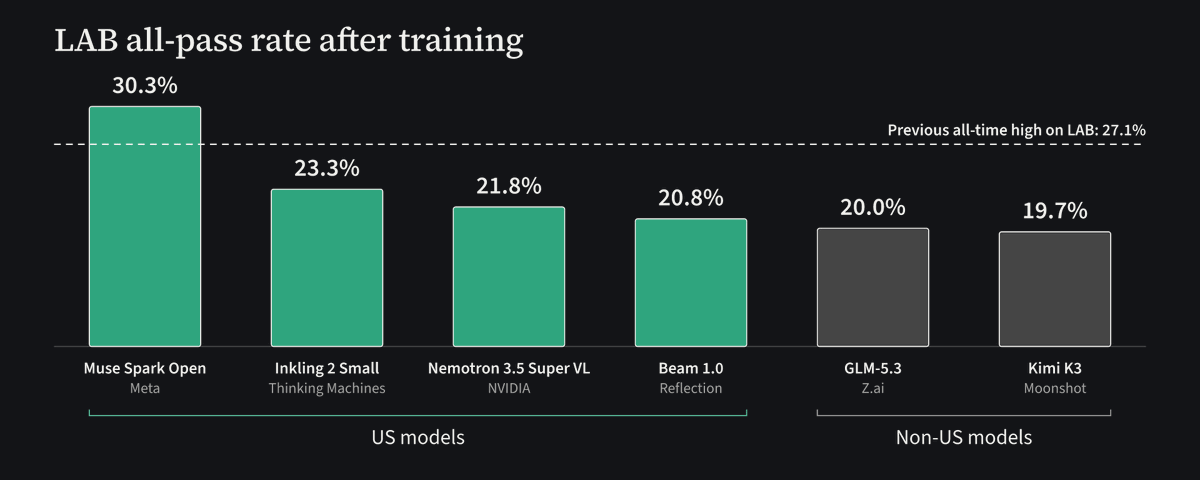
US open-weight models have caught up.
We post-trained four US models from @meta, @nvidia, @reflection_ai and @thinkymachines with the Harvey Tenet recipe we used on Kimi K3.
They are now competitive with non-US models, and Muse Spark Open is the first model to pass 30% all-pass on Legal Agent Bench.

Abir Bhattacharyya retweeted

Basic human empathy agenda (you’re a bad person if you disagree):
-$10,000 hourly minimum wage
-Free abortions, free vasectomies, free GTA6 and PS5, free everything
-Tax everyone 100% and give it to daddy government
Comment “AFFIRM” if you agree with the empathetic agenda!

Abir Bhattacharyya retweeted

This is my favorite open model right now!

Today, we’re releasing Ternary Bonsai 2.5 27B.
An upgrade to Ternary Bonsai 2 27B, with substantially stronger agentic coding, multi-turn tool use, and long-horizon task execution. All within the same 5.9 GB model footprint.
Based on Qwen3.8 27B, the model is 9x smaller than its full-precision counterpart. It scores 73.9 on tau3-bench and 75.6 on SWE-Bench-Verified, making it the strongest AI model of its memory footprint for agentic workloads.
Compared with Ternary Bonsai 2, Ternary Bonsai 2.5 completes tasks in fewer turns, uses fewer tokens, and delivers results faster and more accurately.
Available today under Apache 2.0.

Abir Bhattacharyya retweeted

I started Coinbase with the goal of increasing economic freedom in the world, and crypto is the best way to update the rails. We're now seeing another frontier technology start to disrupt financial services, with Agents becoming the interface for financial services. With AI, everyone has a private banker in their pocket, which can help you make better financial decisions.
Crypto rails, Agentic interface.
In the same way that crypto decentralized the financial system to preserve freedom, we need to decentralize AI to preserve freedom. We can do this by having a diversity of specialized, open weight models that are fine tuned to out perform the frontier on narrow tasks, and then assembled into teams that out perform the frontier overall.
Going back to Hayek, the way you efficiently coordinate millions of participants in an economy is with markets and prices as signals. This is what Coinbase is building: financial accounts, payment rails, and marketplaces for people and their agents to coordinate in this new economy.
What we do best at Coinbase is make frontier technologies trusted and easy to use in the financial system. We now do this with both crypto and AI.
Abir Bhattacharyya retweeted

We are truly living in Orwell’s 1984.
Congress to hold hearing of a private company’s CEO about his sex life while spending $17M of taxpayer money to cover up their own sexual abuse scandals.
Congress to hold hearings of a private company’s CEO about his contact with non confirmed Chinese spy while Senate Intel committee Senator had a confirmed CCP spy on her staff for 20 yrs and a sitting representative slept with a confirmed CCP spy and was placed on the House intelligence committee after it was revealed.
I didn’t buy tickets for this clown show.
Abir Bhattacharyya retweeted

This is a pretty key insight. Services businesses are always held back by their ability to deliver outcomes to customers.
That scaling essentially only could come from headcount, and no matter how much demand you saw, there was always a finite amount of talent you could get for the problem you were going after. Not to mention, the customer generally always wants the work done faster, at a lower price, or at a higher quality.
Agents entirely change the calculus here, because now we can scale output in a way that’s decoupled from the among of time that goes in. A single engineer can have the output of dozens of engineers before. A single designer can probably build out your entire design system and brand. And so on.
Well why isn’t this just all agents then? Because the key is to still have experts on the front end that actually can ensure the right outcomes are delivered from agents.
It’s likely that we’re going to see this in a wide variety of categories. You’ll see this in cyber security, advertising and marketing, legal, accounting, IT transformation, and a number of other historically people-only services industries.
It’s a great time if you’re starting one of these businesses, or if you have the capability to transform an existing one.

Abir Bhattacharyya retweeted
I'm glad to see Jensen Huang is back as CEO of NVIDIA, driving AI innovation and leadership for America. I commend the NVIDIA board for making a decision in the best interests of the NVIDIA team members, its shareholders, and the American economy.
Abir Bhattacharyya retweeted

Sorry to say, but a wild assortment of morons, including newly elected Democrat congressmen, Washington security hawks (with no idea of how the AI ecosystem works), and dystopian newly-listed CEOs (not to mention all of their followers), just handed Trump his greatest political win ever.
And it’s not just because reinstating Jensen Huang to Nvidia puts a backstop to the spiral in which the US (and global) economy risked falling. It’s also because, if in the future we happen to ever have an AI ecosystem that remains tenuously open, transparent, and competitive, it will all go down to this moment.
Too many people unfortunately know nothing about the real conflicts ongoing in Silicon Valley (and Washington), and of how Nvidia is central to ensure the ecosystem doesn’t fall entirely to regulatory capture and to the most dystopian visions of AI’s future (our own future).
People screaming about “rule of law” and “the end of capitalism” should first ask themselves how on earth was it possible that a CEO of the stature of Jensen Huang got fired in the first place, in just a matter of days, with not a shred of evidence, not an enquiry, nothing.
Those who orchestrated this coup thought they could get away with all the customers, suppliers, employees, partners, developers, and shareholders that live in the Nvidia ecosystem. Jensen is back thanks to all them, not Trump. Thanks god, the ecosystem is strong. But, politically, it’s Trump who reaps all the benefits.
Abir Bhattacharyya retweeted

No. Here’s what really happened.
Jensen started Nvidia in 1993, before the modern era of founder control and dual-class stock began with Google and Facebook.
Because he went public in the 1990s, he inherited all the 20th century overhead of endless public company paperwork, rather than staying private for as long as possible as is also now typical.
This is why Jensen had much less control than a modern founder/CEO. Like Jack Dorsey at Twitter, he got gradually boxed into a corner by the fact that he couldn’t raise huge amounts of capital outside his company to clear the board of cruft.
You see, as CEO, you report to the board. And you can’t do outside activities without their approval. So actions that would remove a board member that doesn’t want to step down are hard to take. Unless the CEO is also part of a shareholder majority, or has dual class / founder control, which Jensen didn’t in this case, as explained above…he can’t pick the board.
Like Bezos, though, Jensen is a workhorse and somehow made it all work despite that. Moreover, because Nvidia is a hardware company, and had a relatively low market cap until the AI boom, it didn’t attract notice from envious wokes until the last few years.
Wokes don’t know or care about GPUs, but they do care about market caps, and the rise of AI, and especially open source AI, all of which is a threat to their power. Along with useful idiot “nationalists”, they began plotting to steal control of Jensen’s multi-trillion-dollar company from him.
In this plot, they were aided by a second angle of vulnerability. Jensen didn’t just have old board members he couldn’t remove. Due to DEI policies, he was also forced to bring new board members on, from demographics favored by the far left (eg, not veterans).
Conformist board members like this act like sleeper cells. They are often useless or inactive in peacetime scenarios. Then they activate in response to press or state pressure. In this case, they then got beaten back just as quickly by the reversal of the state’s position.
Anyway, Dorsey needed Elon to come in with his enormous new resources to sweep the board clean. Today, it’s quite possible that Jensen, as the survivor of this character assassination, will similarly figure out a way to fire this incompetent board and assert proper founder control — as is a best practice in the modern era.


Abir Bhattacharyya retweeted

There are two types of people. Those who create & do things (Jensen Huang), and those who play an imitative role in a performative game &, on the occasion, execute things.
But Markets figured it out.
Abir Bhattacharyya retweeted
Jensen is restored.
Journos are ruined.
The coup is defeated.
Open source AI is protected.
And the acceleration continues.


NVIDIA Board reinstates Jensen Huang as President, CEO and Board Director.
Read the release: nvidianews.nvidia.com/news/n…

Abir Bhattacharyya retweeted
Welcome back @JensenHuang


Abir Bhattacharyya retweeted

This is a very disappointing opinion expressed by someone in our industry.
Our job is not to condemn or to affect change. Our job is to provide the most accurate and contextually accurate information so that our audience can have informed points of view and make decisions.

my heart goes out to the intrepid team at the @nytimes who did absolutely generational reporting on the Nvidia scandal
I know the feeling of trying to do accountability journalism in a culture that simply does not care about accountability. Incredibly disheartening.
Look at that woman hugging Jensen
Deeply authentic leader
I am glad he is leading & now i can go work on my little part in peace

New video from Jensen's first day back:
"This is my first day of work. I don't have a computer, so the IT department is going to give me a new PC.
I want to thank all of you. I'm terribly sorry for putting all of you through all of this. I've made some very terrible mistakes, and I'm going to work on coming back. "
39
These trust fund nyt reporters w luxury beliefs live in their ues or uws fantasyland
This is typical elitist manhattanite behavior

my heart goes out to the people whose pensions and retirement accounts were put at risk by the Nvidia smear campaign
I know the feeling of trying to build generational wealth while someone else is trying to win a Pulitzer. Incredibly disheartening.
58

