

Builder first and foremost, cyclist, world traveler, Chainlink maximalist $link
Joined August 2017
- Tweets1.2K
- Following249
- Followers78
- Likes3.1K





Scroopy Noopers retweeted

In 1957, a Russian immigrant published a novel of more than a thousand pages built around one question: what happens if the people who make the world run simply stop?
Its title is Atlas Shrugged. In France it's called La Grève, The Strike. It wasn't even translated into French until 2011. That tells you something.
This morning, I think Elon Musk wrote the sequel.
A. Where the book comes from.
Ayn Rand was born Alisa Rosenbaum in Saint Petersburg in 1905. As a teenager, she watched Bolshevik soldiers walk into her father's pharmacy and seize it in the name of the people. Her family lost everything. Not to a competitor. To a committee.
She fled to America in 1926 and spent the rest of her life writing about one distinction: those who create, and those who seize.
B. The story.
In Atlas Shrugged, America is sliding into decline. Not because of war. Because of rules. Year after year, a growing class of bureaucrats, regulators and planners decides that production must be controlled, shared "fairly," frozen. They never build anything. They issue directives. The worst one freezes every worker in his job and forces every inventor to hand over his patents for the public good.
And one by one, the people who make the country run start disappearing. The best engineers. The industrialists. The inventors. An oil man sets his own wells on fire before vanishing. The whole country keeps repeating a question it doesn't understand: "Who is John Galt?"
John Galt is the man behind the disappearances. He has convinced the creators to go on strike. They withdraw to a hidden valley in the Colorado mountains, where everyone keeps what they make and trades freely. And they let the world find out what it looks like without them.
The lights go out in New York. The grey men are left alone with their directives, and discover that a directive has never produced a single kilowatt.
C. The core idea.
The strike isn't about money. It's about consent.
Rand's insight is that the system that captures the creators runs on their cooperation. It needs them to keep producing so it has something to redistribute. The bureaucrat is a parasite who needs a host. Remove the host, and he's exposed as what he always was: useless.
D. What Musk just did.
This morning, Musk announced that next year he will give one of his own SpaceX shares to every kid in America. "The first of many."
Here's what's fascinating. It's the strike, run in reverse.
Rand's creators withdrew. Musk stays. He keeps building rockets, satellites, AI. But instead of walking away from the system, he walks around it. The value goes straight from the builder to the citizen. No ministry, no agency, no committee in the middle.
Rand had to make the creators disappear to prove the bureaucrats were useless. Musk doesn't need to disappear. He just needs to stop routing value through them. Same result. The grey men are left standing in the middle of a pipe nobody uses anymore.
E. The difference that changes everything.
Rand's strike has a flaw her critics never stopped pointing out: ordinary people are left behind. The creators retreat to their valley. The rest of the country sits in the dark.
Musk's version fixes that. He isn't taking the creators out of the world. He's bringing the world into the valley. Every kid in America becomes a shareholder in the machine. Not a spectator of the strike. A participant.
That's the alliance being formed right now: builders and citizens, directly, with nothing in between. And the only people who lose that deal are the ones who never built anything.
F. Why now, and not in 1957.
In Rand's time, the strike was a fantasy. You couldn't produce at scale without the state's permission, and you couldn't reach every citizen without its pipes.
In 2026, one founder can build rockets, run a global network from orbit, and pledge equity to 73 million children in a single post. AI will soon do in seconds what a ministry does in years. The tools of the strike finally exist. And they don't require anyone to leave.
G. The ending.
For seventy years, "Who is John Galt?" was a shrug. A way of saying nothing can be done.
In the book, the strike ends when the creators decide the road is clear and walk back into the world to rebuild it.
That's the scene we're watching. Not a man leaving. A man coming back, with a gift for every child.
The grey men are about to discover what Rand promised them seventy years ago: a world that no longer needs them.


I don't know if you realize what just happened.
Elon Musk is completely bypassing the State.
For 100 years, we've been told the problem is capital. That it must be captured, taxed, redistributed. With an army of intermediaries standing between those who create wealth and the people: ministries, agencies, commissions, bureaucrats.
Musk is doing the opposite. He's taking his capital and giving it directly to the people. One SpaceX share to every kid in America. Not a handout. Not a subsidy. A piece of the machine that's taking humanity to Mars.
And he says it himself: this is the first of many.
Mises understood this back in 1944: the bureaucrat creates nothing. He administers what others created, following rules that have no connection to the value produced. The day value flows directly from the one who creates it to the one who receives it, the bureaucrat has no function left.
That's what's being born right now. A new liberal world order, where the very concept of the State will make less and less sense.
The world we're entering is a world of abundance. AI, robots, energy, space. And that abundance won't come through the State, for one simple reason: we have a century of proof that it doesn't work.
Redistribution was version 1.0. Direct distribution of capital is 2.0.
While France is still debating how to tax builders even more, America is handing stock to its kids.
Pick your side.
Scroopy Noopers retweeted

Every time something scarce became abundant, the world changed so fast that the people living through it mistook the beginning for the end.
Food was scarce for a hundred thousand years. Agriculture made it abundant, and people who had spent every waking hour chasing their next meal suddenly had something they had never owned before.
Time.
That time became villages. The villages became cities. The cities became language carved into clay, and then law.
Nobody standing in a wheat field understood they were building Rome.
Information was scarce for millennia. The printing press made it abundant. The church lost its monopoly on knowledge, and within two centuries every throne in Europe was shaking.
Nobody pulling letters from a press understood they were ending the divine right of kings.
Energy was scarce until we learned to crack the earth open. Coal and oil made it abundant, and a single person could suddenly command the force of a thousand. Within one generation the entire structure of work turned inside out.
Nobody shoveling coal understood they were building the middle class.
The pattern never changes. A resource that was hoarded becomes available. The people who held it resist. The structures built on that scarcity fall. And whatever rises in their place is invisible from where everyone is standing.
Here is the part almost everyone misses.
Information stopped being scarce a long time ago. The library, the search engine, the endless feed. We have been drowning in information for decades, and it never set anyone free, because information just sits there. It answers only the question you already knew how to ask.
Intelligence was the thing still locked away.
A mind on the other side. Something that explains, argues back, catches your mistake, and meets you exactly where you are standing. The part that bends toward you instead of forcing you to bend toward it.
That is what broke open.
For the first time, a person with nothing but curiosity and a connection can reach an intelligence that teaches, challenges, and builds alongside them in real time. No tuition. No admissions office. No permission.
The distance between what a person can imagine and what they can actually make is collapsing in front of us.
And the people most threatened by that are not the ones without talent. They are the ones whose entire standing depends on talent staying rare.
Every credential, every hierarchy, every quiet system that decided who was allowed to build and who was told to watch, is resting on a foundation dissolving underneath it.
They will fight it. They always do.
The church fought the press. The aristocracy fought the vote. The owners fought the union. Every single time a scarce thing became abundant, the ones who controlled it warned everyone else that the sky was falling.
The sky was never falling. The ceiling was lifting.
And the people underneath it, the ones who had been told their whole lives that the ceiling was the sky, finally looked up and saw nothing there to stop them.
That is what is happening right now.
Intelligence was never rare. Access to it was.
Access just became free.
Whatever gets built in the next ten years will not come from the rooms we are all watching. It will come from someone who was never supposed to have the tools, who right now has no idea that the thing they are doing has a name, or a scale, or a future.
Same as the wheat field. Same as the press. Same as the coal.
We never recognize Rome while we are still building it.
Scroopy Noopers retweeted

We're hosting the largest online hackathon this summer.
Winners get $3,800 in prizes, bambu lab printers & Nvidia orin nanos
All you have to do is, design a build using blueprint, build it, and share a demo.
Applications open August 1st.
More info here: blueprint.am/contest

Scroopy Noopers retweeted

Cette photo mérite absolument tous les prix. Elle a même sa place au Louvre.
Elle relate précisément l’inertie de l’individu face à l’effondrement.
Regardez la composition. Un chef-d’œuvre involontaire.
Au premier plan, le sable doré, les tongs abandonnées, la glacière. Le décor ordinaire du bonheur estival. Deux personnages assis, de dos, comme dans un tableau de Caspar David Friedrich. Sauf que Friedrich peignait des hommes contemplant le sublime. Ici, ils contemplent la catastrophe. Et ils ne bougent pas.
Au centre, le parasol. Publicitaire, criard, dérisoire. Un pastis face à l’apocalypse. C’est presque trop parfait : la France qui prend l’apéro pendant que le monde brûle. Aucun scénariste n’aurait osé.
Et puis le ciel. Les deux tiers de l’image. Cette muraille de fumée qui avale la lumière, ce dégradé d’ocre et de noir digne d’un Turner. La nature qui reprend la palette des maîtres pour peindre notre propre fin.
La femme photographie l’incendie avec son téléphone. Mise en abyme totale : nous documentons notre disparition au lieu de l’empêcher.
Cette image dit tout. Le déni, le confort, l’habitude. Nous sommes tous sur cette plage. Nous voyons tous le nuage. Et nous restons assis, parce que l’eau est bonne et qu’on a posé nos congés.
Les historiens de l’art parleront un jour de cette photo comme on parle du Radeau de la Méduse.
Sauf que cette fois, le naufrage, c’est nous qui le regardons depuis la plage.
💔🌍

Scroopy Noopers retweeted

1/ Holding $LINK since 2017. Read the whitepaper enough times to recite it. Defended the thesis through two bear markets and a thousand "wen" jokes.
But I can't keep telling new entrants the same story without addressing what's actually happened. So let's talk about it.
🧵
Scroopy Noopers retweeted
apps.apple.com/us/app/platep…
Just released my app PlatePickr! It’s essentially Tinder but for picking where you and your partner or friend want to eat tonight. Check it out!
Scroopy Noopers retweeted

We have been featured on Forbes
@edwin_mata (CEO) just published a new piece on Forbes Business Council: From Ownership To Stewardship: The Next Ethic Of Digital Capitalism.
It’s about why tokenization only scales when responsibility scales with it.
Governance, trust, and long-term accountability are the real rails.
Read it here: forbes.com/councils/forbesbu…
Share your favorite insight, drop it in the comments. We want to hear your takeaway.


Scroopy Noopers retweeted

You are repeating a claim that collapses the moment you introduce a timeline longer than a tweet.
Venezuela did not begin "failing" in 2013 because of socialism.
Venezuela began suffocating the moment it tried to take control of an oil system that had been run for decades as a private annex of Washington.
2013 was not the beginning of Venezuela's crisis.
It was the beginning of the oil price crash.
A crash triggered by Saudi overproduction and welcomed in Washington, because it weakened Russia, Iran, and every oil dependent economy on the planet.
Not just Venezuela.
Mexico's peso collapsed.
Nigeria's currency cratered.
Angola entered recession.
Gulf states burned through reserves.
Canada suffered contractions.
Russia entered a severe downturn.
Weird how none of those crises were blamed on "socialism."
But somehow the one Latin American country that nationalized its oil is the only one accused of "normal failure."
Now let us talk about mechanics, not mythology.
When global oil prices collapsed, Venezuela lost the overwhelming majority of the export revenue that kept its entire economy running.
No economy on Earth survives that intact.
Venezuela relied on oil exports for almost all of its hard currency.
When the price of oil collapsed from over 100 USD to under 30 USD, its ability to import medicine, food, machinery, parts, and raw materials collapsed with it.
You cannot buy what you cannot earn.
This is not ideology.
It is arithmetic.
And the sanctions you downplay were not symbolic.
They targeted financing.
They targeted credit.
They targeted the oxygen that keeps a modern economy alive.
By 2017, the United States had cut off Venezuela's access to refinancing, to bond restructuring, to legal credit markets, and even to the inputs needed to run refineries and infrastructure.
That alone would sink any nation.
Then came the fatal blow.
In 2019, the United States seized CITGO, froze billions in assets, and crippled the country's ability to earn or import anything at scale.
You cannot call that "normal failure" when:
Your foreign assets are confiscated.
Your central bank is sanctioned.
Your oil exports are blocked.
Your tankers are seized.
Your gold is frozen.
Your trading partners are threatened.
Your currency is isolated.
This is not socialism collapsing.
This is an economy being strangled in broad daylight.
If socialism were the cause, Cuba would have collapsed in 1991. It did not.
Vietnam would have collapsed after Đổi Mới. It did not.
China would have collapsed after 1978. It did not.
The "normal failure of socialism" is a talking point, not a historical pattern.
What does have a pattern is this:
Every country that nationalizes resources gets economically punished until it is forced to reverse course or is overthrown.
Mexico under Cárdenas.
Iran under Mossadegh.
Guatemala under Árbenz.
Indonesia under Sukarno.
Congo under Lumumba.
Chile under Allende.
Iraq under Saddam.
Libya under Gaddafi.
Bolivia under Morales.
Venezuela under Chávez.
Funny pattern.
Always explained away.
Never acknowledged.
Your argument only works if you ignore the oil crash,
Ignore the financing blockade,
Ignore the asset seizures,
Ignore the third party threats,
Ignore the documented statements from US officials promising to "make the economy scream."
That is strategy, not destiny.
The only thing Venezuela truly failed at was believing Washington would allow a sovereign socialist project to exist in the Western Hemisphere.
Everything else is predictable.
When you cut off a country's oxygen and it struggles to breathe, that is not proof of biological failure.
It is proof of suffocation.

Scroopy Noopers retweeted

"My name's Raymond. I'm 73. I work the parking lot at St. Joseph's Hospital. Minimum wage, orange vest, a whistle I barely use. Most people don't even look at me. I'm just the old man waving cars into spaces.
But I see everything.
Like the black sedan that circled the lot every morning at 6 a.m. for three weeks. Young man driving, grandmother in the passenger seat. Chemotherapy, I figured. He'd drop her at the entrance, then spend 20 minutes hunting for parking, missing her appointments.
One morning, I stopped him. "What time tomorrow?"
"6:15," he said, confused.
"Space A-7 will be empty. I'll save it."
He blinked. "You... you can do that?"
"I can now," I said.
Next morning, I stood in A-7, holding my ground as cars circled angrily. When his sedan pulled up, I moved. He rolled down his window, speechless. "Why?"
"Because she needs you in there with her," I said. "Not out here stressing."
He cried. Right there in the parking lot.
Word spread quietly. A father with a sick baby asked if I could help. A woman visiting her dying husband. I started arriving at 5 a.m., notebook in hand, tracking who needed what. Saved spots became sacred. People stopped honking. They waited. Because they knew someone else was fighting something bigger than traffic.
But here's what changed everything, A businessman in a Mercedes screamed at me one morning. "I'm not sick! I need that spot for a meeting!"
"Then walk," I said calmly. "That space is for someone whose hands are shaking too hard to grip a steering wheel."
He sped off, furious. But a woman behind him got out of her car and hugged me. "My son has leukemia," she sobbed. "Thank you for seeing us."
The hospital tried to stop me. "Liability issues," they said. But then families started writing letters. Dozens. "Raymond made the worst days bearable." "He gave us one less thing to break over."
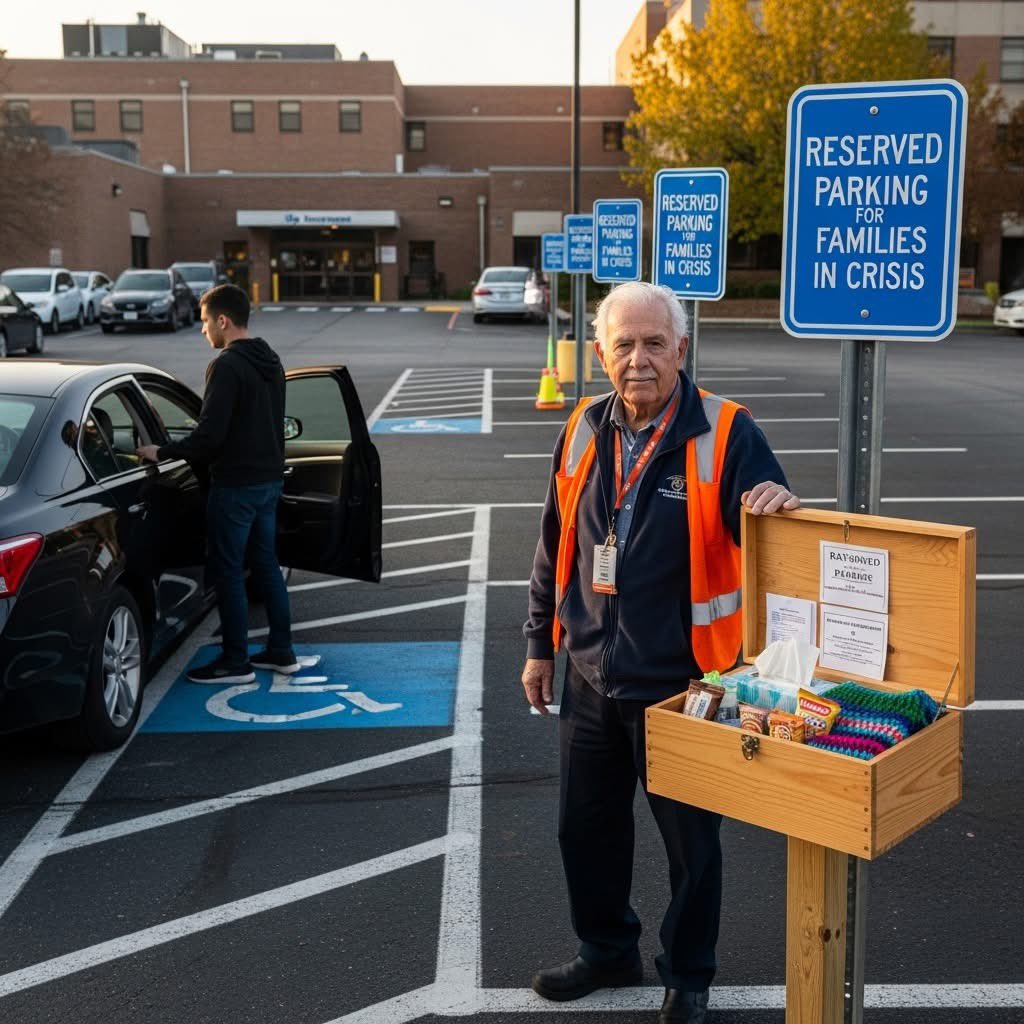
Last month, they made it official. "Reserved Parking for Families in Crisis." Ten spots, marked with blue signs. And they asked me to manage it.
But the best part? A man I'd helped two years ago, his mother survived, came back. He's a carpenter. Built a small wooden box, mounted it by the reserved spaces. Inside? Prayer cards, tissues, breath mints, and a note,
"Take what you need. You're not alone. -Raymond & Friends"
People leave things now. Granola bars. Phone chargers. Yesterday, someone left a hand-knitted blanket.
I'm 73. I direct traffic in a hospital parking lot. But I've learned this: Healing doesn't just happen in operating rooms. Sometimes it starts in a parking space. When someone says, "I see your crisis. Let me carry this one small piece."
So pay attention. At the grocery checkout, the coffee line, wherever you are. Someone's drowning in the little things while fighting the big ones.
Hold a door. Save a spot. Carry the weight no one else sees.
It's not glamorous. But it's everything."
Let this story reach more hearts....
Credit: Mary Nelson
Scroopy Noopers retweeted

chainlink solving $58b annual corporate actions reconciliation problem with dtcc swift and 24 banks. swift sr 2025 activates november 22 enabling oracle-verified dividends and splits across 11,500 banks. link at $14.53 capturing enterprise revenue from every participant. the infrastructure play everyone missed chasing shitters.
Scroopy Noopers retweeted

$70K car loan (8% APR)→ “You deserve it, treat yourself”
$200K student debt (7% APR) → “Totally normal, part of adulthood”
$40K wedding loan → “It’s your big day, worth every penny”
$1K in crypto → “It's gambling, you're addicted”
Nobody wants you get rich, but they will cheer you on going broke
Scroopy Noopers retweeted

Swift CIO explains why 12,000 banks will not be using a volatile, bank-themed magic bean as a bridge currency, despite what XRPTikTokPatriot told you:
$XRP


Scroopy Noopers retweeted

"Ripple is a goofy business. For more than a decade now, the company has held vast quantities of magic beans known as XRP, which it dumps onto the market at regular intervals. It’s not clear why anyone needs these magic beans, but people buy them anyway, and that has made Ripple very rich—so rich that this week it casually spent $1 billion to buy a treasury management company called GTreasury. The question is how much longer Ripple can keep its magic bean factory humming."
aol.com/finance/ripple-branc…
Scroopy Noopers retweeted

$LINK
LINK got a 46% dump right into our $15 level from last update (threaded)
So far, my gut on the triangle was right
We couldn't get that HTF close above the 29 level we wanted to see to invalidate the triangle
The big test here is going to be holding that 13ish level
HTF close below and I believe price action will carry into the $7 area
Macro target remains the same for now

Scroopy Noopers retweeted
the data is damning
coinglass caught binance API throttling during the crash - only reported 5% of actual liquidations. real number potentially $400B not $19B
onchain prices barely moved but CEX perps got destroyed. fartcoin held $0.25 onchain, traded $0.09 on bybit. 64% gap. SUI was $2 on bybit, $0.50 binance, $0.14 kraken simultaneously
binance acknowledged system overload prevented stop losses from executing while liquidations kept running. ENJ crashed to near zero on their futures. competitors like bitmex and backpack had zero issues
the USDe situation is worse - binance had no mint/redeem and used only their own USDe/USDT market for pricing instead of oracles. aave switched to redemption value oracle and protected $4.5B in positions
then there's the exploitation angle. $110M USDC from arbitrum linked sources funded $1.1B in BTC/ETH shorts on hyperliquid during the crash. netted $192M profit by exploiting binance's pricing flaw
they're offering compensation now but the infrastructure failed when it mattered most
Scroopy Noopers retweeted

The Oct 11 Crypto Crash — What Really Happened
TL;DR:
Roughly $60–90M of $USDe was dumped on Binance, along with $wBETH and $BNSOL, exploiting a pricing flaw that valued collateral using Binance’s own order-book data instead of external oracles.
That localized depeg triggered $500M–$1B in forced liquidations, cascaded into $19B+ globally, and earned the attackers about $192M via $1.1B in BTC/ETH shorts opened on Hyperliquid hours earlier, but minutes before Trump tariff announcement.
It wasn’t a USDe failure!! It was Binance’s design flaw, timed with macro panic (Trump’s tariffs) for cover.
What looked like chaos was actually a coordinated exploitation of Binance’s internal pricing system, amplified by a macro shock and systemic leverage.
1️⃣ The Setup
Binance’s Unified Account let traders use assets like USDe, wBETH, and BNSOL as collateral.
Instead of oracle or redemption prices, Binance valued these using its own spot market - a major vulnerability.
On Oct 6, Binance announced a fix to move to oracle-based pricing, but rollout wasn’t until Oct 14, leaving an 8-day window.
2️⃣ The Exploit
During that window, sophisticated actors manipulated Binance’s order books, dumping ~$60–90M of USDe, driving it to $0.65 on Binance only (still ~$1 elsewhere).
Because the Unified Account marked collateral to internal prices, this instantly wiped margin value and triggered $500M–$1B in forced liquidations.
Then, Trump’s 100% China tariff headline hit, magnifying panic and liquidity stress.
3️⃣ The Profit Engine
The same day, fresh wallets on Hyperliquid opened $1.1B in BTC/ETH shorts, funded by $110M USDC from Arbitrum-linked sources.
As the Binance cascade unfolded, BTC and ETH cratered, those shorts netted $192M in profit before closing out at the bottom.
Timing, precision, and funding paths all suggest coordination.
4️⃣ The Contagion
Binance liquidations dumped BTC/ETH/ALTs into thin books.
Other exchanges mirrored the collapse through cross-market bots.
Market makers hedged across venues were forced to unwind everywhere.
Result: $19B+ global liquidations, with many alts down 50–70% intraday, all triggered by <$100M of manipulated collateral.
5️⃣ Who’s at fault?
Binance: design flaw + delay in oracle rollout = root cause.
Exploiters: executed and timed the manipulation, profited via external shorts.
Ethena (USDe): not at fault - protocol stayed 1:1 collateralized, redemptions normal, peg held everywhere else.
6️⃣ Aftermath
Binance admitted “platform-related issues,” promised compensation for affected margin/futures/loan users, and rolled out minimum price floors + oracle integration.
USDe remained operational, and the incident is now a case study in how exchange-side pricing errors can trigger system-wide liquidations.
Bottom line:
A ~$90M dump on Binance and a $1.1B leveraged short elsewhere sparked a $19B bloodbath.
Not a stablecoin failure, but a masterclass in exploiting flawed collateral valuation during peak macro stress.
Scroopy Noopers retweeted

4:30pm: Whale opens $100M+ BTC short
4:50pm: Trump announces 100% China tariffs
5:20pm: RECORD $19.3 BILLION liquidations
That whale’s profit: $192 MILLION in 50 minutes.
This wasn’t luck. This was insider trading.
Subpoena the exchange logs. Name the desks. Prove markets are fair … or admit they’re not.
RT if you want answers.


Scroopy Noopers retweeted

This isn’t just about markets, it’s about trust.
When a single political statement can wipe out trillions in global value, and one anonymous wallet gains hundreds of millions within minutes, that’s not capitalism that’s orchestrated extraction.
Economic systems collapse not from volatility, but from the moral decay of those steering them.
What we’re witnessing isn’t a free market; it’s a weaponized economy, used against the very people it claims to serve.
The real crisis isn’t financial, it’s ethical. And history will remember who profited while the world bled red.
Scroopy Noopers retweeted

Clockwork deposits each & every week from @chainlink. Crypto is less a speculative asset than in the past. That’s the main reason I think the 4-year cycle is on its way out. As the crypto market matures, look for companies that make profits like $AAVE & of course $LINK.

The 10th Chainlink Reserve $LINK inflow is here 🔥
The Reserve now totals 463,190 $LINK (~$9.9M), with an average cost basis of $22.44 per $LINK
45,729 $LINK (~$1M) was acquired today, with ~90% coming from $USDC swapped into $LINK via Uniswap and ~10% from user fees already paid in $LINK
The Reserve is funded by offchain revenue from enterprise deals and onchain revenue from service usage, supporting the network's long-term growth and sustainability
Inflows are planned to occur weekly, with no withdraws from the Reserve expected for multiple years
