

Technician by day, chart reader by night. Crypto, $QNT and cyber security. Not financial advice, just my honest opinion.
Joined June 2024
- Tweets3.3K
- Following898
- Followers1.6K
- Likes22.6K







Pinned Tweet
If you bought $QNT because an influencer or a friend told you to, read this. It explains what you're actually holding.
Right now, when you send money, your bank moves it and hopes everything on the other side goes as planned. If something goes wrong, people spend days fixing it.
Banks are now turning normal bank money into digital tokens. They're called tokenised deposits. It's still your money in your bank, with the same protections, not some new coin. The difference is that this money can follow rules.
Example. You're buying something from a stranger online. Your money stays locked in your own account and only gets released once the item reaches you. The seller can't run with your money, and you can't take the item and refuse to pay.
This is not a future idea. It already happened in the UK in September. Real customers, real money. UK banks including Barclays, Lloyds and NatWest ran the first live payments like this, including two home loan switches where the money released itself automatically on completion day. The platform it ran on was built by Quant.
Here's why that matters. One bank doing this alone is easy. The hard part is getting different banks and their old systems to work together. That connecting part is Quant's job.
The Clearing House, a big US payments network owned by major banks, also picked Quant for the same kind of work, with it set to open to institutions in the first half of 2027.
So when you hold $QNT, you're not holding a meme. You're holding a token tied to the company building the plumbing banks are starting to use for digital money.
Price will move up and down. Pay more attention to the work being done than to the noise.
So be honest, did you buy $QNT for the tech, or because someone told you it would pump?
Nobody posts a screenshot of the days they almost sold.
They only post the green number later. When you hold through a slow stretch, nobody sees that part, and that is why it always looks easy from the outside.
I like checking the longest window I can, because short moves can fool you. Here is one full year, from 4 November last year to today, for the three coins I follow.
$QNT is up about 169%. $BTC is down about 27% and $ETH is down about 37%.
Up means today's price is higher than it was a year ago. Down means it is lower. It is just a simple before and after.
I hold $QNT, so I like that picture, but a year is still only one view. That is why I show the numbers, so you can check them yourself on CoinGecko.
I also looked at how much each coin moves on a normal day, because it says a lot about how a coin behaves.
Over the last 90 days, on a typical day $QNT moved about 2.2% up or down. $BTC moved about 0.7% and $ETH about 0.9%.
So a normal $QNT day is about 3 times bigger than a normal $BTC day. A bigger swing can mean fewer people are trading it, or that the market is still working out what it is worth.
Which one do you think it is?
I hold $QNT myself, so I like to check how it really behaves next to the two coins everyone follows, $BTC and $ETH. Here are the last 90 days.
$QNT is up about 224%. $BTC is up about 18% and $ETH is up about 18%.
$BTC and $ETH moved very closely together over that time. $QNT did not follow them. It moved on its own path, which tells me it is not just riding the same wave as the rest of the market.
For anyone new, this is why holding $QNT is a different experience from holding the big two. Different behaviour, different story.
If you hold it too, what do you think is driving that gap?
I have been reading about tokenized stocks lately, and I think more people should know about them.
A tokenized stock is a real company share turned into a digital token. It lives on a blockchain, which is a public record that many computers keep together, so it is not stored in just one place.
That market now holds about $3.69 billion, up about 14% in the last 30 days. And it trades day and night, while normal stock markets close.
This is the kind of thing I preach about crypto. Real assets, available at any hour.
Would you trust a share at a broker more, or one held as a token in your own wallet?
If I were in her position, this is exactly what I'd do.
I'd make sure the proof is solid. One proper paternity test, because the first result points one way but only a direct test settles it.
Then my brother hears it before anyone else, privately. It's his life, and he deserves to hear it from family, not from an argument or a will dispute. He gets time, and nobody pushes him to decide anything that day.
I wouldn't keep it quiet like my mother wants. I understand she's protecting the boy and the family. But this has already slipped out once, and a secret that comes out later hurts more than the truth told gently now.
The boy comes before everything else here. His grandmother raised him from 8 months old, and nothing about his home has to change. Adults made this mess, and he shouldn't pay for it.
The inheritance can wait and be handled calmly with a trusted elder or a lawyer. The uncle who died named him because he loved him, and that was never about blood.

A woman from Uganda just uncovered something that could tear her family apart.
Her brother’s son isn’t actually his. The mother of the two kids left years ago when the boy was only 8 months old, and their grandmother has been raising them ever since.
This same boy was recently named heir to the woman’s other brother, who died this year without children of his own, because he loved the child deeply.
The truth came out after an argument.
The ex-wife told her brother the boy wasn’t his, then quickly backtracked and claimed she was joking.
The sister didn’t let it go. She knew her brother has sickle cell disease (SS) while the mother is AA.
She took the boy for testing; he came back AA. Genetically, that means he cannot be her brother’s child.
Her brother has also developed serious complications from the disease, including erectile dysfunction, and can no longer have children. That’s part of why the ex-wife left.
So far she’s only told her sister. She quietly asked their mom what they’d do if the boy turned out not to be theirs. Her mom’s response was essentially:
"Keep it between us."
Now she’s stuck. She has proof, an heir has already been named, her mother is emotionally attached, and telling the truth will devastate the family. She doesn’t know what to do next.
What would you do in her position?
End.
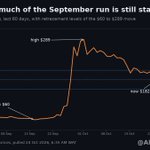
Through July and August, $QNT traded between about $56 and $68.
Its lowest dip last week, near $176, still sat more than two and a half times above the top of that range.
Buyers are stepping in far above where this token used to trade.
Is $176 the new floor, or does it need one more test first?
Holding $QNT doesn't mean I have to cheer for $100,000 targets.
Big numbers get likes, but they rarely make anyone do their own research.
New people laugh at a target like that and leave before they ever learn what Quant actually builds.
Do big targets bring new people into $QNT, or do they push serious people away?
$QNT is holding up better than almost every big coin this week, and I think the market is not paying attention.
Here is what I checked.
Since Thursday 9 PM WAT, $QNT is up 4.7%. In the same time $BTC is down 3.6%.
On Friday $QNT dipped to $176. It is back around $200 now.
If you're new, this is called relative strength. When the whole market drops and one token climbs back first, it shows holders were not in a hurry to sell.
It doesn't mean $QNT can't fall. It means that, so far, sellers did not win this week.
Is this real conviction from holders, or is $QNT just moving easily because few people trade it?
I went through every statement Binance has released on the hack. I did not read the headlines. I read the details.
The first thing that does not add up is the numbers.
Binance's update says about 90% of the stolen assets are replaced. Their own team also told users that everything is covered.
90% and all are two different claims.
Then there is where the money comes from.
Binance says it set aside $6.34 billion of company funds. Its update says the refill draws on its SAFU emergency fund, part of its futures insurance fund and its corporate treasury. It also says about $3 billion is frozen and will come back through formal processes, which take time.
So the refill came from Binance's own reserves. The stolen money has not come back yet.
Only ten major coins are fully backed so far. The other altcoins are still being bought, so if you hold one of those, you are waiting.
Then there is the proof.
Binance says a proof of reserves snapshot is done. That is a public check that an exchange holds what it owes. In simple terms, every user balance becomes a fingerprint, they combine into one master fingerprint, and you check yours is inside it.
But Binance says the full proof takes until Tuesday, and it only lets holders of those ten coins verify. Until then, nobody can check it themselves.
The piece that bothers me most is the one I know best, cyber security.
Binance first pointed to one compromised laptop. It later said it found more points of breach. The full explanation is still owed.
That matters because the refill fixes the money, not the door. A company can pay for the damage and still leave the way in open.
My honest read is that Binance acted fast and paid with its own money, and I'm not calling it a scam. But I do not think the story is finished, and I think users were told to relax too early.
So which part bothers you most: the numbers, the proof, or the missing explanation?
$QNT had a wild week and still finished it higher. $BTC did not.
Last Saturday at 7 AM, $QNT was near $182. This morning it is near $193, about 6% higher. $BTC went from about $80,700 to about $77,300, down about 4.2%.
In between, $QNT ran to about $218 on Monday, up 20%. Then the Binance hack hit on Thursday night, and $QNT dropped to about $176 in the early hours of Friday. That was the low of the week.
Two lessons if you are new. A one-week chart tells a calmer story than one scary night. And comparing a token to $BTC shows whether it moved on its own or just followed the market.
Which part of this week matters more to you, the 20% run or how fast it recovered from the hack drop?
While everyone watches the Binance hack, here is a number almost nobody is looking at. The count of addresses holding $QNT on Ethereum keeps going up.
An address is just a wallet that holds some $QNT. One person can own several, so this is not a count of people.
Etherscan is a public site anyone can open to read the Ethereum blockchain. It showed 186,187 holder addresses on Thursday morning, 186,329 early this morning, and 186,451 tonight.
That is 264 more in about a day and a half, in the same week the biggest exchange in the world was hacked.
I'm not saying what it means for the price. I'm saying it is public, and you can check it yourself.
Do you ever look at holder numbers, or only at the chart?
Last night I said nobody outside Binance could tell whether those billions leaving were housekeeping or theft. Binance has now answered. It was theft.
Binance puts the damage near $6.3 billion, and says about $3 billion of that is already frozen.
Here is the part every beginner should understand. Nobody broke into the wallets. Binance says it found no evidence that any private key leaked. A private key is the secret code that controls a crypto wallet.
What Binance says may have happened is simpler. A DevOps engineer's laptop was compromised. A DevOps engineer is the person who keeps a company's servers running. From that laptop the attacker got into a service that sends out withdrawals, and pushed through transactions nobody approved.
Binance is still tracing the full attack path, so this is its early account, not the final one.
If that holds, the weak point was not the maths behind crypto. It was one computer with a lot of access.
Binance says it will cover every loss from its SAFU fund, which is its emergency reserve, and from company money. Deposits work. Withdrawals are paused and should return within 48 hours.
What scares you more about keeping coins on an exchange, a hacker breaking the code or a hacker getting into one staff laptop?
Everyone is watching Binance tonight. A smaller theft happened today and almost nobody is talking about it.
Polymarket is a site where people bet on real world events. This afternoon users saw money leave their accounts without touching anything. Trading was paused for about an hour.
Here is the part worth understanding. Polymarket said one of its outside providers was hacked. Security researchers traced the bad code to a tool that watches how fast the website loads.
That tool loads a small piece of code, called a script, inside your browser every time you open the site. Someone changed that script. It looked for people who were logged in, tried to sell their positions and tried to send the money to one wallet.
Analysts put the loss at over $2.5 million, taken from around 700 wallets. Polymarket says everyone affected will be paid back.
This is the third security problem it has reported since May.
The lesson is simple. A site can be built well and you can still lose money, because of tools it loads that you never knew about.
Do you know what the apps holding your money load behind the scenes?
Binance moved more than $2 billion tonight, and nobody outside the company can say whether it was housekeeping or theft.
Binance had not said anything when I wrote this. That is the real story. If your coins sit on an exchange, you are trusting its word, because you can't check what its wallets are doing.
Holding your own keys means nobody can move your coins but you. It is harder, and people do lose their recovery phrase, but one transaction can't drain it.
Which risk would you rather live with, losing your own phrase or trusting an exchange's word?
$QNT sits 38th among crypto tokens by size, yet only one token in the top 40 has beaten it over the past year.
$QNT is up about 145% in 12 months. $ZEC is the only one ahead, at about 289%.
Size here means market cap, which is the price of one token times how many tokens exist. So the market puts $QNT near the bottom of this group, while the results put it near the top.
Which one do you trust more, the size or the results?
$QNT is $86 below where it stood on 1 October. It is also $22 above where it stood on Sunday morning.
Same token, same month, two very different moods.
On 1 October it was near $287. On Sunday morning it was near $179. Right now it trades around $201.
If you bought near $287, you see an $86 hole. If you bought Sunday, you see about 12% since then.
Which number says more about where this token stands, the $86 or the $22?
A lot of new people in crypto think a coin under $1 is cheap and a coin at $201 is expensive.
The price of one coin tells you very little on its own. What shows the real size of a project is market cap, which is the price of one coin multiplied by how many coins are in circulation.
Look at the chart.
$DOGE trades around 8 cents. There are about 156.5 billion of them, so the whole project is worth about $12.5 billion.
$QNT trades around $201. There are only about 14.6 million of them, so the whole project is worth about $2.9 billion.
The coin with the bigger price is actually the smaller project, by more than four times.
That's also why a low price doesn't mean room to grow. For $DOGE to reach $1, the whole project would need to become more than 12 times bigger than it is today.
Do you check the price first or the market cap first?
