







Pinned Tweet
"A lambkin in peace, but a lion in war,
The pride of her kindred, the heroine grew:
Her grandsire, old Odin, triumphantly swore, -"
"Whoe'er shall provoke thee, th' encounter shall rue!"
- Robert Burns, Caledonia.


Innes retweeted
It's common that example texts of Scots are bible verses, or the Lords prayer. So just for fun I translated the first two verses of the Voluspa into Doric Scots, using @germanicgems English translation as a base.
In Doric, the Voluspa might become "The Spae-wife’s Ley."

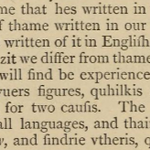
Scots has been considered a separate language since the 16th century, distinct enough from English that it earnt its own name. It was standardized in Scotland and was to our forebears as regular as the southern dialects were to the English.
Scots has over 500 years of history as a distinct language with a distinct culture attached. It is the more conservative sister of English.
Today, Scots is rare and typically confused with Scottish English. Broad Scots proper is its own language on account of the fact that it is as old as contemporary English, with the parent language being northern Middle-English (compared to the southern/midland Middle English that formed modern English) and the fact that it has attached to it a literary and cultural heritage unique to Scotland.

"As a Scots screiver, I’ve taen tent at the fowk fa threap Scots isna a richt leid come fae een o twa airts.." - would be (roughly) a Doric translation.
One issue with modern Scots is that it is just Scottish English with Scots words thrown in (like for e.g., the Scots of Burns), or just English words spelt as they are pronounced with a Scottish dialect.
I romanticise and feel the greatest connection with a Scotland defined as being the domain of the Elf Queen. Where the Cailleach held the west, the Queen of Elfland held the east.
Inglis was the tongue, but to distinguish it from its barbaric southern counterpart it became 'Scots'. It was the Union of Crowns that saw the start-of-the-end of this culture as Scottish customs were erased in favour of English ones.
It lingered witheringly on into the 17th and 18th centuries, strongest in the north-east, but died a quieter and more passive death than the culture of the Gaels and thus was largely forgotten. It now only remains in the occasional ballad that harkens to older times, north-eastern Scotland being the most ballad rich piece of country in Scotland.

I dislike Englishness from a Germanic perspective. In its desire to self-civilize, Englishness was butchered and bastardised from Longshanks onward. To me, the English are a savage and uncivilized form of the Scoto-Norman - of which the lowland variety carries on the spirit of an 'Inglisness'-of-before.
When presented with foreign land, the English tend to revert to a better self - the frontier turns him back into a true Englishman. But at home he is sick and held back by a nation that has forever sought to suppress him, just as it supresses its neighbours.
Unfortunately things like protestant theology, religious extremism and a warping of self-identity as a result saw the Scots succumb to a similar fate, but only in a much later period.


tldr is that I think the Americans and the lowland Scots are better Anglo-Saxons than the English.
I dislike Englishness from a Germanic perspective. In its desire to self-civilize, Englishness was butchered and bastardised from Longshanks onward. To me, the English are a savage and uncivilized form of the Scoto-Norman - of which the lowland variety carries on the spirit of an 'Inglisness'-of-before.
When presented with foreign land, the English tend to revert to a better self - the frontier turns him back into a true Englishman. But at home he is sick and held back by a nation that has forever sought to suppress him, just as it supresses its neighbours.
Unfortunately things like protestant theology, religious extremism and a warping of self-identity as a result saw the Scots succumb to a similar fate, but only in a much later period.
Assythement is a Scots word describing compensation for injury. Such a compensation system was reliant on the existence of a strong kinship based culture.
Under Henry II and Edward I in England, compensation was owed to the King rather than the effected individuals and as a result the need for 'clans' died out with it.
I dislike Englishness from a Germanic perspective. In its desire to self-civilize, Englishness was butchered and bastardised from Longshanks onward. To me, the English are a savage and uncivilized form of the Scoto-Norman - of which the lowland variety carries on the spirit of an 'Inglisness'-of-before.
When presented with foreign land, the English tend to revert to a better self - the frontier turns him back into a true Englishman. But at home he is sick and held back by a nation that has forever sought to suppress him, just as it supresses its neighbours.
Unfortunately things like protestant theology, religious extremism and a warping of self-identity as a result saw the Scots succumb to a similar fate, but only in a much later period.
I think my overarching point is simply that one should associate with that to which they /feel/ the most connection, that is, which line of theirs they should embrace over another.
IF you truly do feel an equal adoration for both, then make an effort to showcase this in participating in both cultures properly.
An Anglo-Celt would be someone capable of speaking English and one of the Celtic languages, and who has equal fluency in both cultures.
I agree with this, sort of
nitter.gq/fosandair/status/21137…

By nature of ancestry and spirit I feel most at home with the heritage of the north-east of Scotland. It is a people defined by being Germanicised Celts. I feel the greatest draw to that which is Germanic but I do not have the aversion to that which is Gaelic, or British either.
Gaelic language and culture is important to me through other lines too. I seek to uplift it as an outsider with a connection, by participating in it and by promoting it to those with an even stronger connection than mine own.
Innes retweeted

Bledsian Winterfylleth. Mead, incense and prayers were offered, so Lord Ing may make our lands and people virile and prosperous once more.
Hail Ingvi Freyr, progenitor of the North Sea Peoples, Lord of light, slayer of Surtr!
Ūton lofian Ing! ᛝ


Burns from Ayrshire was particularly interested in Halloween; yet his inspiration, Ferguson from Edinburgh, spoke more about Yule. Something to think about!
In the Scottish north-east, Yule (Yeel) is more important than Halloween but it is celebrated in a similar way. It is not the same as Christmas, but Christmas typically falls within the time of Yeel and the merry month (continuing from December through to the new year).
Halloween was an important festival-time in the north of Scotland, like most of the other folk festivals that would occur throughout the year, Halloween was associated with the blaze of a sacral needfire.
Lit by friction in the traditional way, the needfire was burnt on a high-spot and the flames from it were used to relight the fires of hearth and home. Its smoke was holy and cleansing, boys and girls would lay down in the grass to let the smoke roll over them, and the more daring would leap over the fire itself.
In the Highlands there are accounts of men parading around fields with lighted torches to ward off the evil associated with that night. At Balmoral during the reign of Victoria, the effigy of a witch was burnt to the tune of the bagpipe at this time.
In 1793 the Minister of Monquhitter complained that "The Halloween fire was kindled in Buchan. Various magic ceremonies were then celebrated to counteract the influence of the witches and demons and to prognosticate to the young their success and disappointment in the matrimonial lottery."
