

Rates & Macro Strategist 🤔 Joga Bonito 🤙 "Try nothing, and it's gonna be nothing Try something, and it's gonna be something" - DMX
Room of spirit & time or Paris
Joined August 2019
- Tweets13.2K
- Following539
- Followers11.8K
- Likes23K
Interesting to see that Gold is a victim of deleveraging here, but the SMI price action during a liquidity contraction seems to confirm its safe-haven status.
This is reminding me the buffet one :
"Only when the tide goes out do you discover who's been swimming naked."

To conclude quickly, I think that now, we are living a progressive decline of US safe haven status, but without any winner to take the throne. We are going to a more fragile system, which by definition is a system where frequent interventions are needed, to avoid the burst.

Another evidence of it is how the volatility of LT treasury inflows has doubled post covid and is reflecting far less appetite for duration (And also creating an "equitization of the $", but that will be a topic for later)

A strong sign of this shift is that offshore financial centres have grown far faster than total foreign Treasury holdings. Increasingly, the marginal buyer is a price-sensitive, repo-funded investor rather than a reserve manager, adding another layer of fragility to the system.

Post-SVB, The response was a more active debt management strategy: increased T-bill issuance, lower duration supply, a shorter WAM, and the drainage of excess cash from the RRP. The primary objective was clear: Implementing indirect QE to supress rates vol. So far, it has worked

Pre-2008, financial stability was largely imported through foreign savings recycling into U.S. assets. Post-2008, that mechanism weakened. Public intervention increasingly replaced foreign inflows as the key stabilizing force, to smooth stress on banks b/s and fill the gap.

In a highly leveraged system, the Fed and Treasury are increasingly managing volatility rather than rates themselves. When funding volatility surges, cross-asset deleveraging can emerge and threaten financial stability.

New paper out !
We introduce a framework to understand how U.S. authorities are preserving financial stability through 2 generations of policies
The goal ? Buying time in a world of more volatile capital flows and declining foreign savings recycling.
🧵
(Link on last post)

OAT-Bund sprea vol is at 3.5σ. Historically the ECB steps in around 3σ widening ( '11, '22). RV is insanely attractive: OAT vs BTP ; AA corp ; ASW ... Shorts overcrowded. But TPI is political and EU want to punish FR, so the trigger might be Euro and not the spread.

Rare situation where the corporations are priced as safer than the FR gov bonds. Through a RV basis, this make no sense. The current aggressive OAT short positioning is being driven by speculators testing the ECB put imo. inst are waiting for budget vote or ecb to jump on it

The risk of a systemic event in the Eurozone is becoming increasingly difficult to ignore. If investors continue to challenge the ECB put through aggressive OAT shorts, the spillover from rates vo to EUR vol will further intensifying pressures in repo, and force ECB to intervene

My main concern is the spillover to FX. I think that as long as the shock is on rates/equities, it is manageable. But when it's the Euro or Repo, then it is a systemic issue for Europe. The Hedge Funds are f*** us, "liberals" are applauding, and ECB is watching with a smile. 🙃

The 3MFR-3MEU spread has widened to 23bps, in line with CDS pricing, first time since Euro creation. This points more to rising sovereign uncertainty than repo stress. History shows that if sovereign risk continue to raise, funding stress can widespread to capital market quickly.

When the mess of the budget and presidential will be over, this will be a long opportunity. The sentiment is amplified by the illiquidity (as the previous auctions has shown). Don't let the banks narratives fool you, a country with nukes cannot default ;)
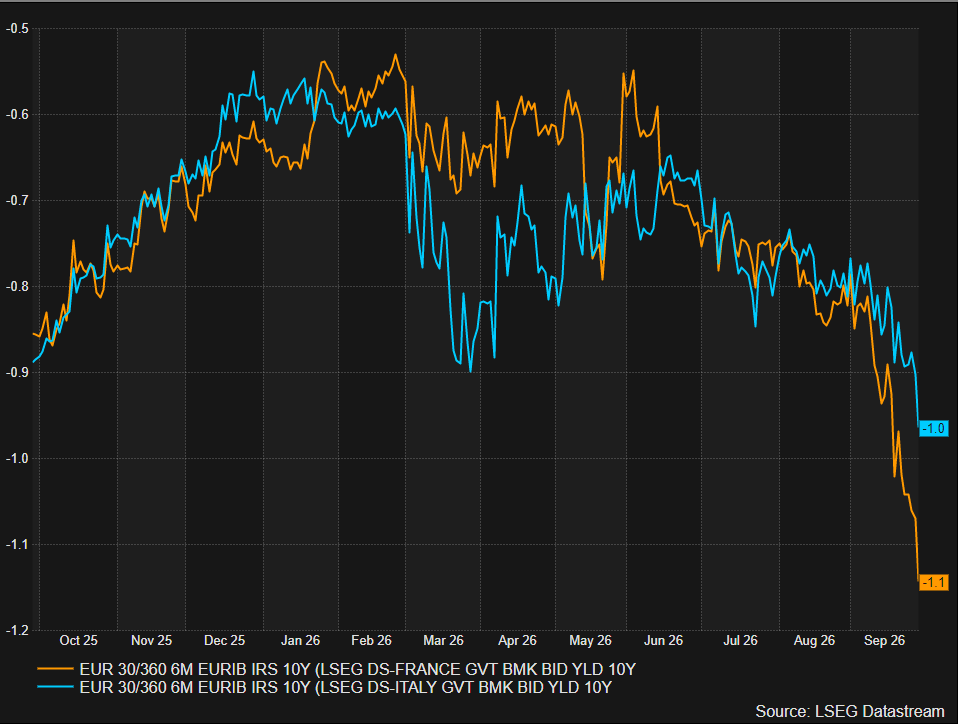
Cross-asset volatility is not corroborating the recent rates selloff. Stress remains localized rather than systemic, suggesting that markets continue to interpret higher yields as a macroeconomic repricing rather than a trigger for broad financial contagion. For how long ?


