

GP @ https://xitter.cf/t.co/X4kqBODnnf, https://xitter.cf/t.co/TaZkjy2F1z, OG OpenAI prompt whisperer, Shark Week, OpenAI Podcast host, WSJ bestselller Thriller & Edgar Finalist
Closer than you think.
Joined April 2007
- Tweets36.1K
- Following557K
- Followers677K
- Likes39.9K








Pinned Tweet
What if self-improvement was really a system of control?
My new thriller, THE SESSION, follows a paramedic into a psychological empire built on secrets, manipulation, and a vault holding the darkest truths of millions.
Coming November 1: amazon.com/dp/B0GTWJ59FQ

ALT Book cover for The Session by Andrew Mayne: an electric-blue chair against a black background, with the title and author name in bold yellow lettering.
Andrew Mayne retweeted

ChatGPT is now the largest medical record sync from hospitals to consumers, passing Apple.
I'm glad we can all access our medical records through the apps we choose. Rightly so!
We're working with Epic and hospitals to reduce the API load on their servers. The current setup is archaic - the equivalent of refreshing your inbox instead of getting a push when email arrives.
FHIR Subscriptions can solve this & reduce strain on the system.

Incredibly, hospitals are now paying for AI companies to disrupt them. 🤦♂️
Patients linking their MyChart accounts to @OpenAI's ChatGPT rose more than 7,000% in a single month at 69-hospital @AdvocateHealth, its CIO Bobbie Byrne told @Becker’sHR.
Patients set this up themselves in ChatGPT, so that the AI can explain their lab results, scans, and doctors’ notes. You know, instead of one of Advocate's doctors.
To add insult to disruption, every time a patient asks ChatGPT a question, Advocate’s Epic system has to look up and send the records and pay for the computing resources that make that happen. AND — brace yourself — Federal law says Advocate can't charge patients, or their apps, for that access to the patient's own records.
So a health system is paying for a competitor’s access to its own patients’ records. The competitor takes away the followup visit, and the healthcare system pays for that to happen — both in lost revenue and in increased computing costs.
That’s Interpretation Migration, subsidized by the disruptee. buff.ly/DlyODMb #DrYou #InterpretationMigration #Disruption

I love Waymo but Cybercab is on a different level.
Sitting in a spacious front seat with no steering wheel just feels different.
I’d go cross-country in one.
Andrew Mayne retweeted

float i,e,g,R,s;vec3 q,p,d=vec3((FC.xy*2.-r)/r.y+vec2(0,1),1);for(q.zy--;i++<99.;){e+=i/9e9;o.rgb+=hsv(.6,.8,min(e*i,.04));s=3.;p=q+=d*e*R*.35+1e-5;g+=p.y/s;p=vec3(log2(R=length(p))+t*.2,exp(mod(-p.z,s)/R-.4),p);for(e=--p.y;s<6e3;s+=s)e+=-abs(dot(sin(p.xz*s),cos(p.zy*s))/s*.3);}

Andrew Mayne retweeted

The roadster floating was insanely cool. Feels like I’ve seen it somewhere before. (Thanks, @AndrewMayne )


Okay, so matrix multiplication on silicon isn’t thinking, but the flow of sodium ions through protein channels embedded in a lipid bilayer is?
Why do materialists turn to animist reasoning when the substrate is carbon-based instead of silicon?
Codex composer predictions have been amazing for me and suggested things I should have thought of.


Andrew Mayne retweeted

2 years ago, I personally spent dozens of hours trying to get this task to work. It was our first “too hard” task. Now it’s just another day here.

Andrew Mayne retweeted

My first digital media art installation. 🎨
The ESM Protein Universe: 7.7 million protein families from 6.8 billion sequences, on a 16×16 ft wall at @biohub's AI × Bio Summit, at the Old Mint in San Francisco. 🧵👇
The punchline is that DeepSeek Flash uses almost twice as many tokens per task as GPT-6 Luna so the difference in usage starts to even out.
Token volume isn't as useful of a metric as API calls.


You can 2x the throughput on certain tasks with OpenAI's Decision API when you can stack them.
One of the benefits of a model like GPT-6 Luna powering the Decisions API is that it can handle multiple decisions at once.
Instead of classifying these books one at a time we can send two together and give the model choices that cover the different possibilities.
Classifying two books takes the same amount of server time as one: 58 milliseconds – which brings the average task time to 29 milliseconds.
There's also a slight cost advantage to this method: Stacking inputs and choices can mean fewer total tokens, less round trips and API calls overall.

Math and science are only getting started…
Just because an LLM came up with a solution that’s not the end of the journey. It’s more like the beginning. We can then start asking if this problem can be solved with less compute? In human time scales? Are there more interesting ways to solve it? Does the solution have other applications?
An astronomer used to be someone who looked up that sky with the naked eye, marked the trajectories of all the visible objects then made a guess as to why they moved the way they did and what they were.
It would have been understandable just prior to the telescope and Newtonian mechanics to believe that the invention of those tools would “solve” astronomy and we’d soon resolve the big questions about how our universe worked.
The opposite happened. Those tools revealed even bigger questions and required even more people to attempt to make sense of it all.
Centuries later the James Webb Space Telescope is sending us back more data than we have humans and compute to handle.
We’re now entering that with math and physics.
We need even more mathematicians and astronomers today than ever before.
Computers can solve a great number of things but it’s not a replacement for our own curiosity.
Math didn’t end with the first mechanical calculators. It became deeper and more complex.
Real science is often a group of people gathered in a room arguing about what problem deserves the most attention (often for reasons that are more arbitrary than rational) and then spending time communicating the results to others.
The electronic bulletin board created more conferences than it made obsolete. A scientist has always been a project manager deciding what time and resources are best spent where. Access to better tools and thinking systems simply means those choices will carry even greater weight.
In 5 years mathematicians will still be gathering around to figure out what problems are most interesting and what we should be spending our time and compute on. We’ll have even more amateur mathematicians interested in these results just like low cost optics enabled the backyard astronomer.
And humans will still be central to this all. Even to solved problems.
Two great teams working together.

Foundry has acquired @AveaRobotics.
@aryind_ and @vikramvadrevu are deeply technical and customer-obsessed and working together (as an early customer) was easy.
Data collection and inference at scale power our factories and that makes Avea a natural fit.
Welcome aboard!

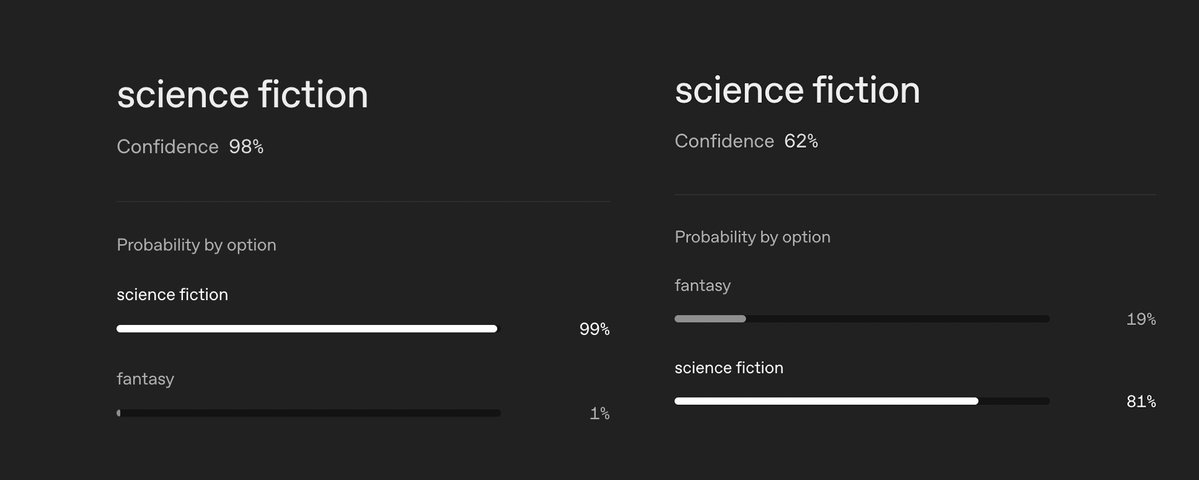
I wrote an article on how to get great results out of OpenAI’s Decisions API.
TLDR: Check if choice order changes the results. If it does, add more context to your choices.

I've been playing around with this speech to text model. It's incredibly capable.
Amazing that it all fits in 17MB.
That's an entire speech to text neural network squeezed down to the size of an MP3 of Hey Jude.

We release Whistle: speech to text in a 16.9MB file, running on the CPU in the same engine as Needle. It mostly beats Whisper base with 9x less file size and 6x speed. Whistle supports English, German, French, Spanish, Italian, Dutch and Polish.
cactuscompute.com/blog/whist…