


Pinned Tweet
As a first-year PhD student, every day I find myself questioning why did I leave industry for a PhD in the age of AI?
Posts like this are a breath of fresh air as I doomscroll myself into despair.

Students sometimes ask me if it still makes sense, in this accelerating age, to pursue a PhD in AI.
Perhaps counterintuitively, I think it's a great time to do so.
I wrote up some thoughts on this here: web.mit.edu/phillipi/www/wri…
Anisha Pal retweeted

Satya’s post yesterday reinforced something I have been thinking about: frontier labs can’t solve AI agent security alone. I think of it as 4 layers of defense:
1. Model. Alignment training. This is the main focus for frontier labs and much of today’s AI safety conversations.
2. Context. Controlling what enters the agent’s context: instructions, documents, tool outputs. Prompt injection and context poisoning live here.
3. Reasoning. Monitoring the agent’s reasoning and execution traces to catch suspicious plans.
4. Actions. Monitoring what agents actually do in your systems: the tool calls, the data they access, the systems they interact with
Each layer catches failures the others miss.
A well-aligned model can still be hijacked by a poisoned document. Clean context doesn’t guarantee safe reasoning. And even seemingly harmless reasoning can lead to dangerous actions.
Frontier labs can keep improving alignment and building safeguards across these layers. But they have limited visibility into your organization’s data, permissions, and normal behavioral patterns.
Securing the model is not the same as securing the agent.


Anisha Pal retweeted
One thing I find fascinating is how quickly people discount innovations from frontier labs as “obvious” or “intuitive.”
A lot of the biggest AI innovations of the last decade look obvious in hindsight. ResNet is a great example. Residual connections looked incredibly obvious after a year of release, but no one had tried them before.
Things often become obvious only after someone shows they work.

Anisha Pal retweeted

We are presenting WFM-Eval at two @CVPR 2026 workshops in Denver 📍
🗓️ Jun 3, Video World Models
Poster 9:50–10:40 AM, Exhibit Hall A
🗓️ Jun 4, Foundation Models Meet Embodied Agents
Poster 3:55–4:30 PM
Come say hi 👋
Work done with @AmberZhang99 @prithvijitch @judyfhoffman

Anisha Pal retweeted

Introducing Gaze-LLE, a new model for gaze target estimation built on top of a frozen visual foundation model!
Gaze-LLE achieves SOTA results on multiple benchmarks while learning minimal parameters, and shows strong generalization
paper: arxiv.org/abs/2412.09586
Anisha Pal retweeted

Presenting the all-woman team behind Semi-Truths (+ @PoloChau 😁), landed in #NeurIPS2024!!
📍Come see us tomorrow at 11am - 2pm, West Ballroom A-D #5211.

Come checkout our work at #NeurIPS2024
📍 West Ballroom A-D #5211,
🗓️Wednesday Dec 11th, 11 a.m. — 2 p.m. PST.

🚨 NeurIPS 2024 🚨How robust are our AI-Generated Image Detectors?
🤔 Can they detect various magnitudes of image augmentations?
💡 Does performance fluctuate across scenes and subjects?
🚀 Find out with Semi-Truths: a dataset of about 1.5 million images for the targeted evaluation of AI-generated images. arxiv.org/abs/2411.07472

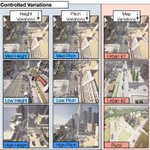
🚨#ECCV2024: SkyScenes: A Synthetic Dataset for Aerial Scene Understanding 1️⃣Powerful pretraining data 2️⃣60 Scene variations 3️⃣Multi-modal support.
Work done with: @SahilKhose, @Ddpanchi, Aayushi Agarwal, @prithvijitch, @judyfhoffman
🔗hoffman-group.github.io/SkyS…
@ICatGT @mlatgt

4. Multi-modal support for advanced aerial scene understanding
SkyScenes is designed to support multi-modal learning, including depth information, which leads to better segmentation and aerial scene recognition when additional sensors like depth cameras are available.

1
2
158
5. Open access to accelerate research
SkyScenes, along with its detailed metadata and generation pipeline, is publicly available for the research community.
Website: hoffman-group.github.io/SkyS…
Data: huggingface.co/datasets/hoff……
Code: github.com/hoffman-group/Sky…
2
108