

🏺 Explorer of Ancient Egypt & its mysteries 📺 Featured on @TravelChannel 🎥 75K+ YouTube • Author • Expedition Leader
Egypt
Joined March 2010
- Tweets54.5K
- Following14.6K
- Followers56.5K
- Likes21.8K


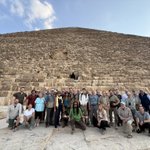


Everyone flies to Egypt and Turkey for the ancient world.
Aspero in Peru is about 5,000 years old, and it runs out to the antenna, still unexcavated.
Would you have guessed?
adeptexpeditions.com/tours/p…
The fake mysteries of Egypt are the loudest.
One post about a "second Sphinx" under Giza pulled 10 million views. Newsweek rated it false.
Which fake mystery fooled you?
adeptexpeditions.com/tours/e…

Anyextee retweeted

Hi thanks for a great, interesting question. To set obelisks on their pedestals, the Egyptians lowered them down through a sand filled mud brick "funnel" like draining sand from an hourglass.
When it got to the bottom, one side of the obelisk base came to rest leaning to one side along its sharp edge in a groove carved in the pedestal base to catch it.
Some obelisks even wobbled a bit off center as the diagram shows. The third image shows the pedestals in front of the colossal statues with turning grooves cut into one side


Anyextee retweeted
Photos of turning grooves on the pedestal of one of Queen Hatshepsut's obelisks at Karnak shows the turning groove on the right edge of the base. There is even a piece of flat granite that was placed to hide the groove. The rest of this cover stone is missing after 3400+ years
The other photos show the back of the Ramesses II statue with Ptah and Sekhmet in my original post. It has columns of repetitive text with his royal names and titles. You can see the grove in the lower part of the image.
Ramesses must have taken the pedestal of an earlier obelisk and repurposed it to make this statue group. It's impossible to say whose obelisk it belonged to. Likely an 18th Dynasty king. The likely suspects are Hatshepsut, Thutmose III, who are known for making multiple obelisks.
Presumably the obelisk was no longer standing so the pedestal was up for grabs and Ramesses repurposed it.
#obelisks #obelisk #Egypt #archaeology #history #ancient #archeohistories #GrandEgyptianMuseum #Karnak


Vichama's builders used nets.
Not just for fishing. Nets holding up to 1 ton supported the layers of the architecture.
Would you have guessed?
adeptexpeditions.com/tours/p…
Qorikancha's walls were once covered in gold.
Not to display wealth. To reflect the powers of the sun.
Its stonework even has nubs, like some temples in Egypt.
See the similarities?
adeptexpeditions.com/tours/p…
Anyextee retweeted

What we know about #Göbeklitepe
WHO BUILT IT? A local hunter-gatherer population becoming increasingly sedentary. There is no clear evidence for domesticated plants or animals. Cultural connections extended eastwards towards the Tigris and beyond, and southwards into the Levant.
HOW WAS IT BUILT? Mainly from locally available limestone, used first for domestic and communal architecture, and later also for the carving of monumental T-shaped pillars and sculptures.
WHEN WAS IT BUILT? The earliest evidence of occupation dates to the beginning of the Holocene, in the mid-10th millennium calBC. The settlement remained in use for at least 1,500 years.
WHY WAS IT BUILT? As a settlement for a growing population. Communal buildings provided spaces for gatherings, rituals and storytelling, helping to foster social cohesion during a period of profound transformation that ultimately led to food-producing lifeways and the emergence of the Neolithic.
NOTABLY: Research and excavations continue, with new results published regularly. At this UNESCO World Heritage Site, we seek to balance our research objectives with the conservation and presentation of this extraordinary archaeological heritage.

Inside the Osireion: Truth Beneath the Stone | Anyextee Investigates youtu.be/EPlFF_p1AFc?is=ppJI…

Anyextee retweeted
I’m genuinely exasperated by the obsession with the percentage of #Göbeklitepe that has been excavated.
Honestly, I don’t even know the figure. But how could a single percentage tell us anything meaningful?
The depth of the deposits is not uniform, and the underlying plateau is neither flat nor level. It has natural and artificial steps. Without knowing the full depth and extent of the deposits, we cannot even calculate the total volume of the settlement mound, let alone meaningfully quantify how much of it has been excavated.
And we cannot simply excavate everything down to bedrock. That would mean destroying significant numbers of important prehistoric structures.
The goal is not to maximise the percentage excavated. It is to understand and preserve the archaeology. Otherwise, we would be leaving visitors looking at nothing but bare bedrock.

Anyextee retweeted
You’re looking at one of the most mysterious stones in the ancient Hittite capital.
At Hattuşa, Türkiye, a massive green stone sits within the ruins of a temple complex more than 3,000 years old.
What makes it extraordinary isn’t simply its unusual color or polished appearance—it’s that nobody knows exactly why it was placed there.
Was it a sacred object? An offering to the gods? Did it play a role in ancient Hittite rituals?
We can examine the stone. We can speculate about its purpose. But more than 3,000 years later, we still don’t know exactly what it meant.