

Architecture & Engineering History 🏛️ dynamic arches, massive domes, and wild structural feats. Exploring how the past was built.
Omaha NE
Joined April 2023
- Tweets92
- Following372
- Followers59
- Likes211









On a wooded hillside in Vienna’s Mauer district, the Wotruba Church looks less like a place of worship than a pile of colossal stones. Designed by sculptor Fritz Wotruba and completed in 1976, its 152 irregular concrete blocks are stacked at odd angles, with slivers of glass letting daylight spill between them.

5
Wayne State’s College of Education Building (1960), Minoru Yamasaki’s second campus design, was called a wedding cake by some and “an island of order and scholarly calm” by its alumni magazine. A New Formalist gem in Detroit. #Architecture

1
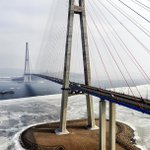
The Russky Bridge in Vladivostok holds a record that has stood since 2012: at 1,104 meters, it has the longest cable-stayed main span on Earth.
Hung from two 320-meter pylons above the Eastern Bosphorus Strait, it was built to survive typhoon winds, heavy ice, and seismic risk, all in one of Russia’s harshest coastal climates.
Its engineering shows how a structure can be pushed to extreme scale without sacrificing durability, making it one of the most instructive bridges of the century.

8
Rising beside Busan’s Centum City, the Busan Cinema Center turns a film venue into a landmark.
Designed by Vienna-based Coop Himmelb(l)au and completed in 2011, its Big Roof stretches 163 meters, with one of the longest cantilevers ever built, hovering over an open-air plaza and glowing with tens of thousands of LEDs.
Here, architecture performs like cinema: it frames light, choreographs movement, and invites crowds to gather.
As the permanent home of the Busan International Film Festival, the building shows how bold structure can give a cultural institution a public face.

12
Perched above a loop of the River Wear, Durham Cathedral is one of the finest Norman buildings in Europe.
Begun in 1093 to house the shrine of St Cuthbert, it pioneered ribbed vaulting that would shape Gothic architecture, while its massive, patterned pillars still astonish visitors nearly a thousand years later.
Part pilgrimage church, part fortress of the powerful prince-bishops, it has survived Reformation, war and weather.

10
Denver’s LoDo Historic District proves old bricks can have a bright future. 🧱
Once a faded warehouse and rail zone, it became Colorado’s first historic district in 1988, and preservation took hold from there. Today, restored brick buildings house breweries, restaurants, galleries, and lofts, all steps from Union Station and Coors Field. 🍻
Adaptive reuse kept the neighborhood’s character while fueling downtown’s comeback. Stroll the cobbled blocks and you’ll see how honoring history can power a thriving, walkable city.

2
On the evening of Aug. 1, 2007, rush-hour commuters were crossing the I-35W bridge over the Mississippi River in Minneapolis when it suddenly collapsed, killing 13 people and injuring 145.
Age seemed the obvious culprit, but investigators uncovered something more unsettling: a design flaw, built into the steel connectors of the 1967 structure, had gone unnoticed for four decades.
The tragedy shook a city, exposed hidden weaknesses in the nation’s aging infrastructure, and changed how engineers inspect and design bridges.

20
Designed by BBPR and completed in 1958, Milan’s Torre Velasca is a seminal masterpiece of Italian Neo-Liberty and Brutalist architecture.
Rising 26 stories above the city, its distinct “mushroom” silhouette pays homage to medieval Lombard fortresses, specifically the city’s historic defensive towers.
The dramatic cantilevered upper portion houses residential apartments, supported by prominent diagonal structural struts, while the lower shaft accommodates office spaces.
Wrapped in a stone-aggregate precast concrete facade, the tower challenged functionalist Modernism by reinterpreting regional history through a daringly expressive, modern structural lens.

1
14
Designed by Le Corbusier and completed in 1952, the Cité Radieuse (Unité d’Habitation) in Marseille, France, is a foundational masterpiece of post-war Modernism and Brutalism.
Raised on massive concrete pillars, this “vertical village” houses 337 dual-aspect duplex apartments. Conceived as a self-contained “machine for living,” the building integrates an internal shopping street, a hotel, a school, and a dynamic rooftop terrace featuring sculptural ventilation towers and a paddling pool.

17
Miami has a high-rise with a hole in it, and it’s the most famous five-story void in modern architecture. 🌴
The Atlantis Condominium on Brickell Avenue was designed by Arquitectonica and completed in 1982. Its 20-story glass tower is cut by a square opening holding a palm tree, a spiral staircase, a hot tub, and a bold red triangle. Rooftop to bay, the building embraced Miami’s color and sunshine at a time when high-rises were mostly beige boxes.
It also gained fame in the opening credits of “Miami Vice.”

29
Chicago’s Harold Washington Library Center is a love letter to the city’s architectural past. 📚
Opened in 1991 and designed by Thomas Beeby of Hammond Beeby & Babka, it’s the largest municipal public library building in the world.
Its red granite and brick facade echoes Chicago’s great late-19th-century landmarks, while the copper-clad “acroteria” and the giant owl sculptures crowning the roof nod to wisdom and the Beaux-Arts tradition.
Beeby’s postmodern design chose historical memory over glass-box minimalism.

14
Consecrated in 547 CE under Emperor Justinian, the Basilica of San Vitale in Ravenna is a Byzantine jewel.
Its octagonal plan, soaring dome, and ring of arched galleries create an interior that feels weightless. The dome uses lightweight hollow clay tubes instead of heavy stone, a clever Roman-era trick. Then come the glittering mosaics: Justinian and Empress Theodora appear in processions, glowing in gold tesserae.
Built when Ravenna was the Western Empire’s capital, it fuses Roman engineering with Eastern splendor.

Built in the 15th century by Khan Jahan Ali, the Sixty Dome Mosque in Bagerhat is Bangladesh’s largest medieval mosque.
Despite the name, it has 77 domes: 70 small ones around a central cluster of 7 chowchala (four-sided) roofs. Terracotta-decorated brick walls, 60 slender stone pillars, and thick, tapering corner towers create a cool, shaded prayer hall that suits the delta’s heat.
It anchors the Mosque City of Bagerhat, a UNESCO World Heritage Site since 1985, and shows how Sultanate-era builders blended Bengal’s brick traditions with Islamic design.

4
Tucked beneath a sandstone overhang in southwestern Colorado, Cliff Palace is North America’s largest cliff dwelling, with about 150 rooms and 23 kivas.
Ancestral Pueblo people built it in the 1190s, shaping sandstone blocks and mortaring them with mud. They lived here for roughly a century, then migrated south by about 1300, likely due to drought and social upheaval.
Ranchers Richard Wetherill and Charlie Mason rediscovered it in 1888. Mesa Verde became a national park in 1906, protecting a legacy that still resonates with descendant Pueblo communities.

29
Six levels of stone rising 140 feet above the Atlantic: El Morro guarded San Juan Bay for over 400 years.
Spain began building in 1539, and it grew into a fortress that repelled Sir Francis Drake in 1595 and a Dutch siege in 1625.
Its engineering is brilliant. Walls up to 18 feet thick absorbed cannon fire, while sloped ramparts deflected it. Overlapping fields of fire with the sister fort San Cristóbal sealed the harbor.
It even held through the Spanish-American War in 1898

27
A glass cube on the Thames. The US Embassy London in Nine Elms, designed by KieranTimberlake, ditches the fortress look for transparent, contemporary minimalism.
Its crystalline form is wrapped in a translucent ETFE shield that filters light and cuts heat, while a landscaped pond and gardens replace the typical wall as the security buffer.
Solar panels and passive cooling earned it LEED Platinum. The message: American diplomacy can feel open and welcoming without compromising safety. Modern, sustainable, and quietly confident.

27
Foguang Temple’s East Hall (857 CE) is China’s oldest surviving timber hall, and it’s a masterclass in Tang engineering.
Its massive bracket sets (dougong) take up nearly half the column height, carrying deep eaves with no nails and no glue, just interlocking joinery.
Compare that to later Ming and Qing halls, where brackets shrink into decoration and structure gets heavier and more rigid.
Tang builders designed for flex and resilience, which is why it has outlasted 1,100+ years of earthquakes and wars. Form followed function.


7
Palm House at Kew Gardens glows beside the Thames like an upturned ship’s hull made of glass.
Designed by Decimus Burton with ironmaster Richard Turner and completed in 1848, it was among the first large-scale uses of wrought iron in a glasshouse.
Its curved ribs and 16,000 panes of glass, tinted green to shield the plants from scorching sun, shelter tropical palms from around the world.
Victorian engineering met botanical ambition, creating a luminous cathedral of iron and light that still lets London’s visitors walk through a rainforest.

18
Two Detroit towers define the city’s Art Deco ambition.
The Penobscot Building, designed by Wirt Rowland and finished in 1928, stacks setbacks into a stepped, sculptural crown that once ranked among the tallest buildings in the country.
The Guardian Building, completed in 1929 and also shaped by Rowland’s design, answers with a glowing red-brick shaft and a Native American-inspired palette of tile, mosaic, and Pewabic pottery.
One shows restrained geometry, the other dazzling color. Together, a block apart, they prove Detroit’s boom years were built in ornament as well as steel.
