

Evolutionary anthropologist at Oxford University | Former track and field athlete (javelin) and Academic All-American at South Dakota State University
Oxford, England
Joined December 2011
- Tweets3.2K
- Following701
- Followers996
- Likes0




🤓🚨 UK NERDS 🚨🤓
I’ll be on @BBCRadio4 tonight at 21:30 talking about my research on how our social relationships affect our health (and workouts!).
Tune in (literally) on the FM! 📻
Thanks to Inside Health and @JamesTGallagher for the interview!
bbc.co.uk/sounds/play/m002hk… – at Oxford, England

Arran Davis retweeted

NEW: People living in poverty are significantly more likely to experience loneliness than those on higher incomes – and this may be affecting their health, according to research from @oxford_anthro.
Read more ⬇️

ALT Back view of a person sitting on a bed, looking out a window, holding a cane, with text overlay discussing University of Oxford research on the link between loneliness, pain, fatigue, and low mood.
🚨 Our new research is now published in Public Health 🚨
We used data from 20 European countries to show that (1) people in poverty are much more likely to feel lonely, and (2) loneliness and poverty predict higher levels of pain, fatigue, and low mood.
doi.org/10.1016/j.puhe.2025.…

Social relationships seem to play an important role in influencing the health of people living in poverty. Findings like this one highlight the public health importance of policies that foster strong communities in socioeconomically disadvantaged areas.
Thanks to @oxford_anthro you can listen to an interview I gave where I share more of my thoughts about these findings. Here is the link: anthro.ox.ac.uk/article/almo…
Arran Davis retweeted

Which hobbies are best for meeting new people?
Great to see @Arran_Davis (Postdoctoral Researcher @oxford_anthro) quoted in this @BBC Future article exploring how team sports can help us build social relationships.
Read more: bbc.co.uk/future/article/202…

Due to Israel's blockade no humanitarian aid (food, water, fuel) has entered Gaza in more than three weeks.
Blocking humanitarian aid is a violation of the Geneva Convention, amounts to collective punishment, and is an age-old tactic of ethnic cleansing. Stop the killing. – at Oxford, England


Thank you, Paul! It would be great to work with everyone @TeamHealthworks and @NorthumbriaUni! Looking forward to finding a way to make it happen. In the meantime, keep up the great work! – at Oxford, England

Had a great chat with @Arran_Davis today and really hope that we can work together @TeamHealthworks and @NorthumbriaUni to explore social disadvantage, social connection and health
Very lucky to have worked with @bbcideas and @UniofOxford to create a short video about our research!
We explain why exercising with friends can reduce fatigue and improve performance, while also helping us to build and maintain the social bonds we need to be happy and healthy. – at Oxford, England

How exercising with family and friends can boost physical performance as well as improving mental health 🏃
@oxsocsci's Dr @Arran_Davis shares the science behind the benefits of exercising together.
🎬 | @bbcideas
The video took as much work and thought as an academic publication, but unlike an academic journal article, this video has over 100,000 views across all platforms!
I’m certainly no Attenborough as a presenter (🙈), but it’s great to see this out there for people to watch! – at Oxford, England
Shout out to @oxsocsci, @bgiulia, and @ewahelenah for all your help and guidance, and to @chammeeno and her @SoBoLabOx - the intellectual home of this research! – at Oxford, England
Politicians often imply that people are poor because of ‘cultures of antisocial behaviour’. Money doesn’t fix anything, they say, it only enables more spending on vices.
But a natural experiment suggests the opposite; reducing poverty also reduces antisocial behaviour. [1/6]
The point is these changes happened within years, not generations (as the ‘cultures of antisocial behaviour’ theory would suggest).
And they happened for families who were given the money needed to escape poverty and the stress it puts on people and their relationships [5/6]. – at Oxford, England
Here’s the actual study: jamanetwork.com/journals/jam…
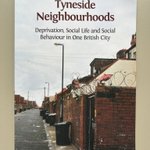
It is just one example of how economic deprivation affects human sociality. From my new favourite book, Tyneside Neighbourhoods, by the (now Twitterless) Daniel Nettle.
Available here for free (👏): openbookpublishers.com/books… [6/6] – at Oxford, England
