

Stay curious. Science resources for teens, teachers, and curious homes.
Joined November 2022
- Tweets2K
- Following181
- Followers1.4K
- Likes10.7K







Pinned Tweet
Things to try. Things to notice. Things to explore.
Your curiosity already knows where to start. Follow along, and let's see where it takes you. Stay curious. ✨
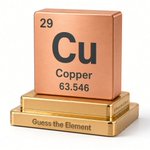
Guess the element — Expert, Keen, Everyday. Try to land it in three.
1/4 Expert:
1. In the 1880s French vine growers began spraying a blue mix of its sulfate and lime — the Bordeaux mixture, one of the first widely used fungicides.
2. Horseshoe crabs and octopuses have blue blood, because their oxygen-carrying protein holds atoms of this metal instead of iron.
3. Ötzi the Iceman, frozen in the Alps about 5,300 years ago, carried an axe whose blade was nearly pure metal of this element.
🤖 Made with AI

3/4 Everyday:
7. Pennies have long been made of it or plated with it, which gives them their warm orange-brown color.
8. Old roofs and statues, like the Statue of Liberty, turn green as its surface slowly weathers.
9. The metal inside most household electrical wires is this reddish one.

1. In 1669, Hennig Brandt boiled down huge amounts of urine and distilled the residue, catching a waxy white solid.
2. Squeezed under high pressure and heat, it turns into a black, flaky form that looks and behaves a lot like graphite.
3. Its white form is made of four-atom pyramid-shaped molecules, melts near 44 °C and bursts into flame in air, so it is stored under water.

7. It is one of the big three nutrients on fertilizer bags, alongside nitrogen and potassium.
8. The tangy acid in many colas is built around it.
9. The rough brown striking strip on a box of safety matches holds its red form.
🤖 Made with AI

The house of the king:
Cepheus is a northern constellation.
Fainter stars sketch a house with a peaked roof near Polaris.
He sits beside his queen on the same side of the pole. Across Polaris, the opposite seat belongs to the Big Dipper.
Greek myth made him king, husband of Cassiopeia and father of Andromeda. On the sky chart, that royal family still sits together.
Stay curious:
Locate Cepheus beside his queen.
Can you find the house shape?
Where is the Big Dipper compared with Cepheus?

The fish that drinks from the water-bearer’s stream:
A lone bright star hangs south of Aquarius and Capricornus.
Piscis Austrinus is the Southern Fish. One of the ancient sky figures Ptolemy listed.
It is usually drawn as a single fish, mouth open to the stream poured from Aquarius’s jar just north of it. That mouth is Fomalhaut — Arabic for “mouth of the fish,” the light that makes the whole figure easy to find.
Stay curious:
Locate Fomalhaut south of Aquarius.
Can you trace the faint fish once you have its mouth?
How is this Southern Fish different from the two in Pisces?

Test Dissection #3: Label every mistake with a cause
Tonight: give each missed question one label, then match the fix.
• Didn't know it → relearn the concept
• Misread the question → underline key words (NOT, EXCEPT, units) next time
• Careless slip → save a few minutes to check your work
• Ran out of time → practice with a timer, and answer what you know first
These labels are a teacher's tool, not a tested method. But the idea underneath, figuring out why you got it wrong, has support. In a study of 8th graders prepping for New York's Algebra 1 Regents exam, the more time teachers spent talking with students about why their errors happened and how to avoid them, the more they learned. Just walking through the right method didn't help.
Next Thursday: what to write beside each mistake.
Sources in the reply.

Source for Test Dissection #3:
Metcalfe, Xu, Vuorre, Siegler, Wiliam & Bjork (2025), British Journal of Educational Psychology. doi.org/10.1111/bjep.12651

1. Freshly made atoms of it hitch a ride on tiny potassium chloride particles in a stream of helium, traveling tens of meters through a thin tube to the chemists.
2. Chemists prefer a 3.1-minute form of it over its longest-lived one, because it can be made in larger batches.
3. Ten minutes of three trillion light ions a second hitting a thin target yields only about 1,200 of its atoms.

7. Its longest-lived isotope lasts only about an hour before half of it is gone.
8. Its first claimed discovery, in 1957, came from bombarding a man-made target with light ions in half-hour bursts, fifty times, and could never be repeated.
9. Its name comes from that failed 1957 claim; it was approved at once and stuck even after credit went elsewhere.

1. Humphry Davy first isolated it in 1808 by electrolyzing a moist mix of lime and mercuric oxide into an amalgam, then boiling off the mercury.
2. Its compounds turn a flame a brick-red orange.
3. The silvery metal dulls in air and steadily frees hydrogen from cold water, leaving a strongly alkaline solution — eager, but far calmer than sodium.

7. Limestone, marble, cave stalactites and the crusty scale inside kettles are all mostly its carbonate.
8. Milk, cheese and yogurt are famous dietary sources of it.
9. It is the element your bones and teeth are built around — the main metal in their hard mineral.
🤖 Made with AI
