

Founder Merk Investments. USD ~2.5bn in precious metals. Weekend rancher. tweets ≠ advice
USA
Joined June 2012
- Tweets41.5K
- Following1.1K
- Followers21.9K
- Likes1K







"The welfare state ends when you run out of other people’s children." literally. @JohnHCochrane 👇
grumpy-economist.com/p/savin…

Just had a good discussion with @carolmassar & @timsteno on @BloombergTV. The conversation quickly zoomed in on Kevin... -- and why I believe many in the market continue to misread him.
Somewhat puzzling as Kevin is very clear - if one only listens to what he says.

Alan Blinder argues a Nobel Prize was awarded for forward guidance. With due respect, um, no.
Blinder confuses forward guidance with reaction function. Of course it is helpful to have a reaction function - part of the reason the Fed hasn't published a formal one is that it would require the FOMC be on board with it -- it's too soon in Warsh's tenure to expect that.
On forward guidance, Blinder argues for it as long as "Fed’s forward guidance is honest and clear" -- how is "honest and clear" defined? In a theoretical world, this may be the case, but forward guidance is impossible to be "honest and clear" due to the inherent bias those articulating forward guidance impose on themselves (Daniel Kahneman got the Nobel Prize on that one). Also note that you can only provide "honest and clear" forward guidance if you know what you're talking about -- for that, you need input from the market -- but forward guidance takes that away from the market.
Yes, the Nobel Prize recipients believe expectations are super important. And the link between short-term and long-term rates can be a more robust one - but not through forward guidance, but through a reaction function.
And the reaction function, if not explicit, filters through the communication. It's just that we need to put up with "removing a dose of accommodation" which embeds a great deal of a reaction function.
The point is: there is plenty for the market to listen to. Talk that forward guidance is a good thing is not one of them.
wsj.com/opinion/kevin-warsh-…
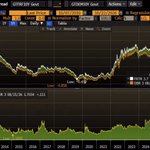
Always a challenge to muse real time as to *why* the price of gold moves. Part of it is because drivers are changing. Late in the week it felt like a classic initial risk off burst — bonds rallying, risk assets declining, dragging gold along.

1/
Some loose thoughts on the current macro setup and what it means for #gold 🧵
Gold is under real pressure. Silver and the miners are underperforming and show no signs of strength yet.
My take: we’ll see a capitulation low over the next few days.
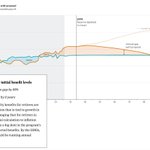
WSJ's @RichardRubinDC lists social security reform proposals:
* increase retirement age: still bust, long-range gap shrinks
* end tax cap: delays insolvency by 24 years
* raise tax cap: shrinks gap, delays insolvency by 2 years
* lower benefit adjustment: still bust, shrinks gap a bit
* lower benefits to each successive cohort: still bust in the short-term, but long turn turns deficit into surplus
* not mentioned: means testing as to whether you get benefits
@karadapena wsj.com/politics/policy/how-…

Read the full analysis of Social Security's trajectory to go beyond the headline. I was trying to wrap my head around the last option, dubbed "change initial benefit levels."
Think of Social Security benefits as an income tax in reverse: based on your highest 35 years of earnings (adjusted for wage growth), you currently get 90% of the first tier of average monthly earnings, 32% of the second tier, and 15% of what's above that. There's a cap on annual earnings that count toward benefits, just as earnings above that cap are exempt from Social Security payroll taxes.
The proposal apparently reduces those percentages for each successive cohort becoming eligible for retirement, using a formula that offsets wage growth above inflation. The idea is that starting benefits should rise with inflation, rather than—as is currently the case—with average wage growth across the population.
The net of it is that each successive cohort will receive less than it would under today's rules, even though benefits may still rise in dollar terms. And once eligible, benefits would continue to receive annual inflation adjustments.
It's complicated enough that few will understand what's actually changing.
wsj.com/politics/policy/how-…

