

I turn university lectures on probability and risk into trading lessons. Math over hype. Not financial advice.
Joined September 2025
- Tweets81
- Following25
- Followers23
- Likes75


Pinned Tweet
In 2017, people paid Tesla $250,000 upfront for a Roadster promised for 2020.
On Joe Rogan in 2025, Elon said the demo would be "unforgettable. Whether it's good or bad."
Last week it flew over a Cybertruck on cold-gas thrusters.
Production? 2028.
That's 11 years between paying and driving.
At just 5% a year, that $250K would've earned ~$175K on its own.
Most expensive flying lesson in history.
A year before he became Fed Chair, Kevin Warsh said inflation is a choice.
Today he had to make it.
Here's what he said in July 2025:
"That's not about Putin and the pandemic, that's about the Federal Reserve. The central bank can hit any price level that it wants, any inflation level that it wants."
And the part that aged worst:
"The idea that they should be blaming someone else strikes me as quite antithetical to good economic history."
He wasn't wrong. He was the guy who said "no more excuses."
Now look at today:
Inflation: 3.7%.
The Fed's target: 2%.
His decision: hold rates at 3.75–4%.
Two Fed officials voted against him. Both wanted a hike.
And the official statement quietly dropped the line about returning inflation to 2%.
Meanwhile the 10-year Treasury yield sits above 5%.
That's the number behind your mortgage rate.
Traders now price an 84% chance he hikes in December, after the midterms.
In the same interview, Warsh said a sound dollar is a choice too, and that Paul Volcker proved it.
Volcker raised rates until it hurt. Everyone hated him. Inflation died.
Warsh had the speech.
Today he had the chair.
Inflation is a choice.
So is waiting.
Mark Cuban just called Bitcoin, Apple and Google the same thing:
Meme stocks.
This is a guy who:
→ bought the Dallas Mavericks for $285M and sold them for $4.3B
→ sold Broadcast.com to Yahoo for $5.7B at the top of the dot-com bubble
So when he says "bubble," he's seen one from the inside.
Here's his take, from yesterday's Diary of a CEO:
"I think we're in a bubble, but not the same as the internet bubble."
"What's different now is everything's a meme stock. Bitcoin is a meme stock. Pick Micron, Google, Apple… they're meme stocks."
His proof:
A company misses earnings by a penny, and the stock drops 18%.
The business didn't lose 18% of its value overnight.
People just moved in and out on headlines.
"We're trading them like baseball cards. There's no intrinsic value to this. It's just perceived value and what you think somebody else will pay for it."
And what pops it?
"I have no idea."
That's the most honest part. The guy who sold at the top of 2000 doesn't know when this one ends.
But he does know where the money is made:
when everything crashes and nobody wants to buy.
In his words: "that's when the real magic happens, when all the real money is made."
Price is what people think someone else will pay.
Value is what's still there after they stop.
The Economist to Elon Musk:
"You have 80% of the voting shares. You can only be removed by a vote you yourself control. I think you can go crazy."
That's SpaceX.
Now he wants to merge it with Tesla.
The biggest merger in history. ~$3.5 trillion combined.
One catch: at Tesla, he doesn't control the vote.
He needs half of Tesla's shareholders to say yes.
For the first time in years, Elon needs permission.
Two bots. Same 3 signals. Same $1,000.
One finished flat. The other lost 12%.
Bot A sized up after every win: 5% → 10% → 20%.
Bot B bet a fixed 2%. Every time.
Then trade #3 was a rug. −90%.
Bot A: $883. Gave back both wins.
Bot B: $1,002. Didn't even notice.
Copy-trading has the same trap:
You fill 40 seconds late, 60% above the wallet you're copying.
He exits at 2x: he's +100%, you're +25%.
He exits at 1.4x: he's +40%, you're −12.5%.
Everyone shows you


2018. Warren Buffett is asked about Bitcoin at $9,000:
"Probably rat poison squared."
Today Bitcoin trades around $81,000.
That's 9x.
The best-performing rat poison in history
Yesterday, Bitcoin ETF holders dumped $635M in one day.
3 days earlier, they'd bought $1.08B.
89,600 traders got liquidated.
Meanwhile, Charlie Munger watched his own fortune drop 50%. For the THIRD time.
His reaction:
"If you're not willing to react with equanimity to a 50% decline two or three times a century, you're not fit to be a shareholder. And you deserve the mediocre result you're going to get."
Most people don't lose money to the market.
They lose it to their own panic.
April 2019. Elon Musk:
"Next year for sure, we will have over a million robotaxis on the road."
"You could go to sleep."
"Buying a Model 3 is a good deal."
October 2026, Tesla's Q3:
→ Profit down 43%
→ Unsupervised self-driving pushed again, now to 2027
"Next year for sure" has now lasted 6 years
Elon bet $100M on a company he thought would fail.
Now it makes that much profit every 2 days.
2012, 60 Minutes:
"I would have to be insane if I thought the odds were in my favor."
He put in $100 million anyway.
Q3 2026, SpaceX:
Revenue: $14.6B
Profit: $4.4B
That's ~$48M a day.
The odds were never in his favor. He just didn't care
1995. Steve Jobs on the company that fired him:
"Apple's dying today. Apple's dying a very painful death."
A year later, Apple bought his company NeXT.
He immediately sold the Apple stock he got in the deal.
Then he came back as CEO.
Apple went on to become the first company ever worth $3 trillion.
Sometimes the guy who calls it dying is the only one who knows how to save it.
March 11, 2008. A viewer asks Jim Cramer if his money is safe at Bear Stearns.
"No, no, no! Bear Stearns is fine! Do not take your money out… If anything, they're more likely to be taken over. Don't be silly."
He was right about one thing. It did get taken over.
5 days later, JPMorgan bought Bear Stearns for about $2 a share.
The day before his show, it closed at $62.
The best part? Right after, they read fan mail: "Your wisdom is priceless."
2012. 60 Minutes calls Elon Musk "worth nearly two billion dollars."
He says:
"I'm probably not the guy most people would bet on. It's like a little kid fighting a bunch of sumo wrestlers. Usually the sumo wrestlers win."
2026: SpaceX goes public.
Musk becomes the first trillionaire in history.
$2B → $1T.
That's roughly 500x in 14 years.
The kid won.
November 30, 2022. Sam Bankman-Fried, live on stage at the DealBook Summit:
"I didn't ever try to commit fraud on anyone."
12 days later, he was arrested in the Bahamas.
Nearly a year later, a jury found him guilty on all 7 counts.
Sentence: 25 years in federal prison.
A man once worth billions, now saying he had "one working credit card left."
Watch him say it. 👇
October 2007. Bernie Madoff, on a panel in New York:
"In today's regulatory environment, it's virtually impossible to violate rules… It's impossible for a violation to go undetected. Certainly not for a considerable period of time."
14 months later, he told his sons his firm was "one big lie."
A $64.8 billion Ponzi scheme, on paper.
The SEC had been warned since 2000
150 years in prison. Died there in 2021
Watch how calm he is 👇
Everyone's bookmarking this. Almost nobody will use the one idea that actually matters.
It's not Grok Bot.
It's not the morning page.
It's not the 7 routines.
It's this:
Slow facts live in files.
Fast facts get checked at the source. Every single time.
Slow facts = who you are, how you write, who you work with, your rules.
They change monthly. Write them down once and let every AI read them.
Fast facts = prices, balances, dates, deadlines, open positions.
They change by the minute. An AI that "remembers" them is lying to you with confidence.
This is where most AI setups quietly break:
→ it "remembers" BTC from last week
→ it "remembers" your balance before the trade
→ it "remembers" a deadline that already moved
Memory isn't the feature. Unchecked memory is the bug.
And here's the part nobody selling a course will tell you:
this rule doesn't need Grok. Or Cursor. Or a $20 plan.
Claude + a folder works.
Obsidian + any model works.
One .txt file pasted at the top of every chat works.
The tool is replaceable.
The discipline isn't.
Most "second brains" die within weeks. Not because the AI is dumb, but because nobody keeps the files updated.
Garbage in a folder is still garbage. Just better organized.
Build the rule first. Pick the bot later.

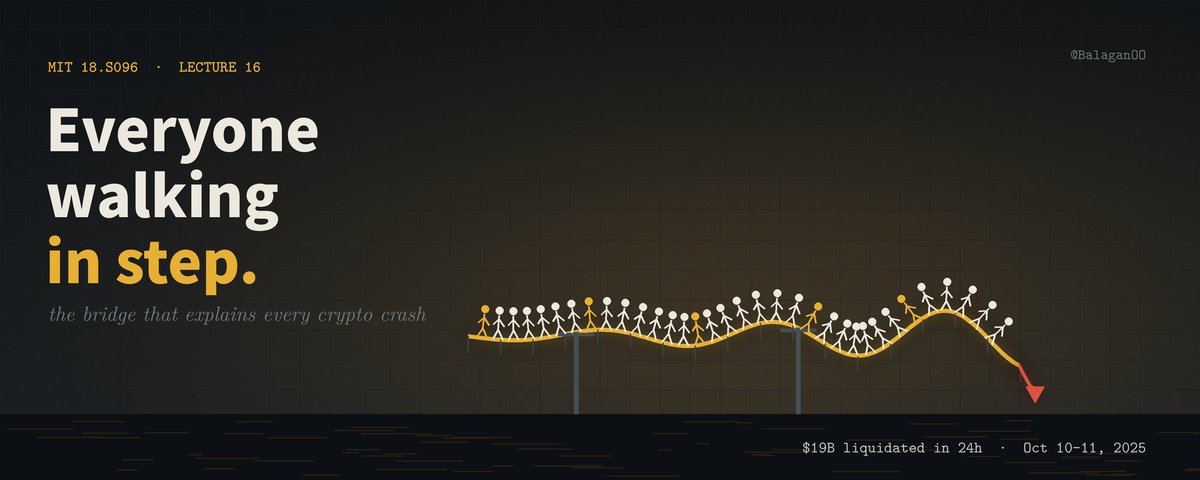
In June 2000, London opened a brand-new footbridge over the Thames.
Two days later, they closed it.
The engineers had planned for weight, wind and crowds.
What they hadn’t planned for: people.
When the bridge swayed a little, everyone adjusted their step the same way to keep their balance. Thousands of people, walking in sync. And the more they synced, the more it swayed.
An MIT lecturer uses this bridge to explain one of the scariest ideas in finance:
When everyone finds the same optimal strategy, the system stops being optimal. It becomes dangerous.
That’s not just theory.
August 2007: quant funds running similar models took huge losses within days, because they were all heading for the same exit.
October 2025: about $19 billion in crypto positions liquidated in a single day, the largest on record. Most of it was longs, crowded in the same direction.
Now look at 2026.
The same AI bots. The same copy-trading leaderboards. The same market briefings pushed to millions of traders at once.
Each of those strategies might be smart on its own.
The danger is everyone walking in step.

$320 → $3,879 in one month, copy trading meme coins with Grok.
I read the whole guide. Then I did the math on its own numbers.
54 trades. $50 each.
$3,879 ÷ 54 = $71.83 profit per trade.
That’s +144% on the average ticket.
In meme coins, an average like that is rarely “every trade works.” It’s usually a few moonshots carrying a pile of small losses.
Which is fine. But then the total tells you nothing.
The video shows one way 54 trades can add up to exactly +$3,879 while the median trade loses money.
Remove 3 trades: +$1,209.
Remove 6: −$330.
Three more things, all from the guide itself:
→ The big coin percentages listed are the leaders’ gains, not his. He says so.
→ The month ran without the stop-loss and take-profit the guide tells you to use. Those were added after.
→ “Most people who copy trade lose money.” Also his words.
The one part of this setup that pays no matter how the trades go? The referral link. It’s in the guide three times.
Before you copy anyone, ask for one thing.
Not the total. The trade log.


This guide has 1.4M views and one rule I’d push back on:
“Never automate the first successful run. Automate three consecutive successful runs.”
Sounds careful.
Statistically, it’s almost nothing.
Zero failures in 3 runs only tells you the failure rate is probably below 63%. (95% confidence)
Want to be 95% sure it fails less than 5% of the time?
You need 59 clean runs in a row.
The example mission in this guide runs every Friday.
59 Fridays is more than a year.
Second problem: the Reviewer that approves the work usually runs on the same kind of model that did the work. Same blind spots, same misses.
Two passes of the same mind are not two independent checks.
None of this means don’t build it. The structure here is genuinely good.
It means “it worked three times” is a story, not a track record.
How many clean runs would you need before you let an agent touch your money?


NOBODY SHOULD BE GIVING THIS AWAY FOR FREE
i used to think AI trading = ask the model what to buy.
then i read how this desk actually works with Opus 5.5 + Minara AI:
→ Opus scans the market first. no strategy yet
→ every idea must name who loses on the other side → backtest with real fees, not zero-fee fantasy
→ double fees + slippage. if it dies, it was luck
→ weeks of paper trading before a single real dollar
→ one strategy, one asset, small size
the desk kills 6 ideas out of 7. the 7th is the one that trades.
full 21-step build below ↓

