






Tito Lívio Barcellos retweeted

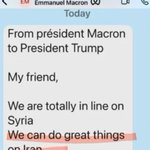
Emmanuel Macron has acknowledged that Russia's growing agriculture sector is hurting French farmers, with Moscow transforming itself from a customer of French producers into a major competitor.
Speaking to agricultural representatives, Macron said Russia had become a major exporter and claimed that climate change now allows it to harvest crops twice a year.
He also blamed geopolitical tensions for France's loss of traditional export markets.
Tito Lívio Barcellos retweeted

This obsession with casualty porn — the endless parade of figures supposedly showing Russians killed and wounded — is becoming pathological.
NATO officials and European leaders savor these numbers like dogs gnawing on bones, barely bothering to conceal their delight.
And never, never, do they stop to show the public the real number of Ukrainian lives who have been lost or shattered in the process.
27,000 a month, as Tusk reportedly said recently? More?
This bloodbath has become a grotesque Western obsession — a war in which Western leaders dream of “solving the Russian question” with Ukrainian hands.

Tito Lívio Barcellos retweeted

o jornalista irlandês Chay Bowes, correspondente da emissora russa RT, foi incluído na lista de sancionados da União Europeia. segundo ele, as restrições também atingiram sua mulher e seus filhos, que hoje enfrentam dificuldades até mesmo para comprar comida. em Portugal, o jornalista Lauro Neto, que trabalhava em Lisboa para a agência Sputnik, também foi afetado pelas sanções em 2022. de uma hora para outra, teve o salário bloqueado e precisou retornar ao Brasil. e há um detalhe importante: nenhuma de suas reportagens tratava da Rússia ou da Ucrânia. eram matérias de interesse de Portugal, do Brasil e das relações entre ambos e a União Europeia. diante desses casos, fica a pergunta: com que autoridade moral a União Europeia pune coletivamente e, na prática, restringe a vida de jornalistas que trabalharam para veículos de comunicação russos, enquanto mantém o financiamento e a cooperação com Israel, apesar do genocídio e limpeza étnica em curso na Faixa de Gaza e no sul do Líbano?
este é o resultado quando se fala de democracia em abstrato.

Tito Lívio Barcellos retweeted
Since Visegrad24 is trending right now after being exposed as an op, I'd like to share my investigation from three years ago exposing their shady funding.
mintpressnews.com/visegrad-2…

Tito Lívio Barcellos retweeted
na ONU, Alemanha, Ucrânia, Portugal França, Polônia, Áustria e outros países europeus votaram contra a resolução sobre o combate à glorificação do nazismo, do neonazismo e de outras práticas que alimentam formas contemporâneas de racismo. há duas semanas, eu estava aqui a denunciar, pelo terceiro ano consecutivo, um festival neonazista no norte de Portugal, com a presença de figuras com larga ficha criminal.
nada aconteceu

Tito Lívio Barcellos retweeted

Vuestro mismo medio reconociendo hace solo dos semanas como viajaban a Ucrania a armarse y combatir con nazis ucranianos contra Rusia. Estudio de la Universidad de la CIA

Tito Lívio Barcellos retweeted


Una investigación independiente concluye que la actividad de Núcleo Nacional servía a los intereses de Rusia. Un estudio de las redes sociales del grupo neonazi constata conexiones con sus homólogos de 11 países europeos elpais.com/espana/2026-11-18…

Tito Lívio Barcellos retweeted
Pela primeira vez, a Websummit dedicou um painel sobre multipolaridade e a relação da Europa com o “Sul Global”, ou, na visão marxista da divisão internacional do trabalho, a “periferia do capitalismo”. Em anos cobrindo a conferência, nunca havia participado de um debate que pautasse o distanciamento da Europa na influência global, principalmente em relação à China. A crise econômica, política, tecnológica e moral dos países europeus finalmente seria questionada.
Trecho da participação do economista @paulonbjr #Brics #WebSummit2026

O temporal Charles se aproximava de Portugal. As TVs noticiavam uma catástrofe iminente. Governo, proteção civil, bombeiros e meteorologistas previam a “destruição” da capital portuguesa. Na manhã de terça-feira, todos se perguntavam se a suspensão de serviços não essenciais afetaria a Web Summit, maior feira de tecnologia da Europa. Felizmente, a única tempestade que presenciamos naquele dia foi o inédito painel dedicado ao BRICS. Algumas verdades incômodas fizeram o tempo fechar em Lisboa. @operamundi
operamundi.uol.com.br/opinia…

Tito Lívio Barcellos retweeted
mais um dia difícil para a Europa

Pela primeira vez, a Websummit dedicou um painel sobre multipolaridade e a relação da Europa com o “Sul Global”, ou, na visão marxista da divisão internacional do trabalho, a “periferia do capitalismo”. Em anos cobrindo a conferência, nunca havia participado de um debate que pautasse o distanciamento da Europa na influência global, principalmente em relação à China. A crise econômica, política, tecnológica e moral dos países europeus finalmente seria questionada.
Trecho da participação do economista @paulonbjr #Brics #WebSummit2026
Tito Lívio Barcellos retweeted

Em 1997, o então senador Joe Biden ridicularizou os alertas russos sobre a expansão da OTAN.
No auge do mundo unipolar, Biden apostou que não restava nada à Rússia que não aceitar a hegemonia dos Estados Unidos.
Pois bem. Talvez essa fosse a realidade da época, mas essas decisões, tomadas de forma arrogante, semearam muitas das crises que estamos vivendo hoje.

Tito Lívio Barcellos retweeted

Fato histórico:
Durante séculos, a Europa decidiu quem cabia no mapa; nesta mesa, nem ela cabe.
Pela primeira vez desde a história moderna a Europa não faz parte da reconfiguração geopolítica.

Tito Lívio Barcellos retweeted

As comparações entre o que está acontecendo em Shenzen com Ialta em 1945 são de um absurdo sem tamanho.
Tito Lívio Barcellos retweeted
Something happened in the EU yesterday. Next to insignificant in geopolitical terms. But morally, politically it was something that must be celebrated. What was it? The half-crazed Kaja Kalas was defenestrated by the EU Council. In a week replete with awful news, it is something we can smile about.
The former Estonian PM Kalas, Kalas is currently the EU’s so-called High Representative for Foreign Affairs & Security. Her appointment was utter proof that the EU had lost its marbles: they had appointed someone who, not long before she was handed the keys to the EU’s foreign and security portfolio, had – in all seriousness – advocated for Russia’s break-up. Sending Ms Kalas to the UN, or anywhere for that matter, to negotiate peace and security is akin to sending an arsonist to negotiate with the fire brigade.
So, what happened now to change the EU Council’s mind? To get them to realise that Kalas is a liability even by their own lowly standards? Apparently, she arrived at Friday's European Council meeting demanding that she reresents Europe in the US-Russia-Ukraine negotiations. They looked at her with eyes filled with horror and did what the EU does: they appointed SEVEN people to represent the EU. Yes, 7 Dwarfs! Can you imagine that? Asking Trump, Putin and Zelensky that they sit around the table with 7 EU minions?
And so the EU ship sails on toward its gradual oblivion. Until last Friday we had a half-crazed pretend EU foreign minister. Now we have the 7 Dwarfs. Carry on folks.
euronews.com/2026/11/17/afte…

Tito Lívio Barcellos retweeted

Vamos ver se um dia a mídia começa a chamar isso de sequestro e não de "operação" ou sei lá como chamam há um ano. Nesse caso, mídia americana e brasileira trataram o sequestro da mesma maneira: negando a realidade por causa de seu ódio ao Maduro.

Maduro periga virar um pepino gigante pro Trump! Seu advogado agora é Barry Pollack, o cara que conseguiu tirar Assange da cadeia. É que o caso Maduro pode criar um precedente contra o próprio Trump em tribunais internacionais! Se a Justiça reconhecer sua imunidade como chefe de Estado, os americanos terão de soltá-lo. Trump mirou em derrubar ditador em Caracas mas pode ter acertado em um sequestro internacional! 🇻🇪
Tito Lívio Barcellos retweeted

Notícia na primeira página do NYT.
Isso aí que o Eduardo Bolsonaro queria pra nós.

noticiabrasil.net.br/2026111…
Entrevista concedida ao portal @sputnik_brasil sobre a reunião de Abu Dhabi entre as delegações da Rússia, EUA e Ucrânia.

Tito Lívio Barcellos retweeted

One article from the first issue of The Ukrainian Forum that I would like everyone to read is by Anna Ivanova. It is a brilliant, wide-ranging essay on the ever more evident bankruptcy of the knowledge production on Ukraine, which renders invisible, and cannot analyze or even recognize, the primary roots of the most urgent problems. Anna is certainly among the brightest Ukrainian social scientists of the youngest cohort, maybe even the brightest. Because when most social science studies on Ukraine have gone into the reproduction of nationalism, one must be anti-nationalist to do any critical social science at all. Some fragments are below, but there is so much more in the full text.
ukrainianforum.org/ufj/artic…
"Following much of the contemporary academic and political debate on Ukraine, one quickly discovers that the only ideologically acceptable answer to the question “What has gone wrong in Ukraine?” is: Russia. It is not only the war itself that is analyzed exclusively through the lens of Russian imperialism – though this framing crowds out diverging accounts so insistently, that over four hundred prominent scholars of East European Studies have called to “read less about Ukrainian domestic politics and international relations" in order to “understand the sources of the Russo-Ukrainian War.”1 Ukraine's domestic problems and international relations, too, are often attributed to Russia across different regis-ters: corruption at the highest levels of government is framed as a Soviet institutional legacy; criticism of domestic policy is dismissed as Kremlin narrative; Russophone Ukrainian citizens are described as victims of Russification; and even disputes with neighboring Poland over historical memory are not rarely attributed to Moscow's manipulation rather than to the unresolved complexities of a shared past and present of two neighboring states. The claim of Russia's responsibility over Ukrainian problems extends far into history – the most expansive accounts locate the original breaking point in the times of Kyivan Rus – and spreads across every domain of analysis, functioning as an ontological premise underlying the dominant explanatory framework for what Ukraine as a state and society is.
<...>
After the outbreak of the 2022 Russian invasion, legal restrictions in language use were accom-panied by open stigmatization of Russian-speaking Ukrainians in public discourse. Depending on the context, these people appeared as victims of Russification who needed cultural rehabilitation, as carriers of foreign influence, as potential collaborators, as remnants of the Soviet past, or as a group that did not exist.70.The minister of education has pointed at a “correlation” between missile strikes on Ukraine and the Russian language.71 A columnist in the country's largest online outlet argued that "there are no Russian-speaking Ukrainians, only Russified ones," simultaneously placing on them "a share of responsibility for this war.”72 The mayor of Ivano-Frankivsk has supported the launch of lan-guage patrols to monitor Russian use in public spaces.73 A well-known actor proposed beating children for speaking Russian; a writer called for publicly reprimanding parents of "Russified" children.74 The current Commissioner for the Protection of the State Language went so far as to question whether people who had not switched to Ukrainian could be considered homo sapiens at all.75 What is striking about these representations is that they assign Russian-speaking Ukrainians virtually every possible status except that of ordinary citizens capable of defining their subjectivities themselves. They may be victims, security risks, colonial subjects, or historical anomalies – what they increasingly cease to be is a segment of population whose existence can be taken for granted.
Every time I hear that Russian-speaking Ukrainians are a “political construct,”76 I find myself won-dering who exactly the people around whom I spent my entire life were. Were my parents, whose bedtime fairy tales gave me a sense of security, and my grandparents, whose accounts of their own lives gave me a sense of continuity, simply victims who had failed to realize their true identity? The teachers in my kindergarten and school or the professors at my university, who taught me to doubt, to ask questions, to be curious, to analyze and to understand, were they at least “homo sapiens”? Were my neighbors at the apartment block, who solidarily supported one another when times were hard, and my great-grandparents in the village, who lived through every upheaval of the twentieth century, nothing more than remnants of Russification? Were my friends, with whom I shared childhood secrets, first loves, and discoveries of various kinds – in Russian, always – colonized subjects unable to eman-cipate? Did all these people exist at all? Do I exist?
The question is not rhetorical. From a sociological perspective, what is unfolding can be understood as a movement from ontological exclusion toward erasure.77 Exclusion presupposes the existence of a group that within a given picture of the world is denied rights, resources, or recognition. Erasure refuses to accept the very existence of the group itself. If Russophone Ukrainians do not exist, then there can be no legitimate representation of their interests, no claims-making on their behalf, and no collective grievances requiring political attention. The disappearance of the category removes the pos-sibility of political contestation altogether: one cannot organize, or demand recognition, as a member of a group that official discourse insists is not there. This foreclosure has a determinate social address. Attachment to Russian has not disappeared since February 2022, but it has become concentrated: it persists most strongly among the working class, for whom questions of language and symbols remain "far from pressing problems."78 What presents itself as cultural policy operates as a "social struggle on the basis of language"79 – that is, a form of class struggle, an instrument through which a ruling class consolidates its symbolic and institutional authority, and whose costs fall on those least equipped to contest them.
<...>
The consequences of this affective climate are recognized in the field of knowledge production. Fear increasingly structures academic life in Ukrainian studies at every level. The choice of research topic, the formulation of research questions, the language in which findings are presented – all are shaped by the anticipation of consequences. Entire domains of social life that generate significant tension – violent mobilization, draft evasion, illegal border crossing, political imprisonment, language conflicts – remain effectively underresearched because engaging with them carries political risk. Re-spondents hesitate to express views that diverge from socially approved narratives or refuse to answer altogether – the rate of non-response to sensitive questions in surveys and interviews has reached lev-els that themselves constitute a finding about the state of public affairs.92 Academic disagreements are transformed into campaigns of denunciation, public shaming, and demands for ideological conform-ity, expressed by the collective letter against “inconvenient” researchers, the blacklisting of academ-ic publications, campaigns against lectures deemed politically inconvenient. One begins to wonder whether a colleague has come to a conference to engage in debate or to report ideological deviations. One hesitates before submitting a manuscript, uncertain whether a particular formulation violates an existing law or will provoke accusations of disloyalty. Peer-review process is evolving into a means of conveying threats. Even well-established scholars privately admit to self-censoring out of fear of marginalization or misinterpretation. The implicit assumption behind every research is that the only legitimate scholarly commitment during wartime is to serve the interests of the nation. Knowledge production is subject to police-style surveillance, the borders of which are defined by political loyalty.
A public sphere governed by fear cannot reliably generate knowledge about itself, nor can schol-arship produce reliable knowledge about the society it studies. A scholarship in which fear forecloses departure from the dominant approach cannot avoid stagnation, as it loses the capacity to innovate. Younger researchers will reproduce the same mode of thinking rather than propose new approaches to the problems that matter. More broadly, the more dangerous certain questions become, the less capable a society is of understanding its own condition, and the less capable it becomes of imagining alterna-tives to that condition, or even improvements upon it. I include my own position in this description not as a dramatic gesture. In writing this text I do not know how to establish whether I have violated a law and have already become a criminal, or whether I will still be permitted to remain a sociologist who asks questions about Ukrainian society and looks for answers to them. The fact that I cannot de-termine this is not a private difficulty but an illustration of the state of the legal system that the Venice Commission identified as “vague” when it issued its conclusions on the “decommunization” laws.
<...>
The war unleashed by Russia is, obviously, an enormous threat that is destroying Ukrainian soci-ety and the Ukrainian state, and only its immediate end can significantly improve Ukraine's position. But is there anything within the sphere of responsibility of Ukrainian actors that might have been organized differently? This essay has been an attempt to identify some of those areas. Yet what it describes only points to what has gone wrong. It maps the symptoms of a structural crisis; the next step would be to examine their causes in depth. A proper diagnosis would require locating the source of the crisis and formulating the means of addressing it. That demands answering not only what went wrong but why: why these choices were made, who benefited from them and who lost, what alterna-tives were foreclosed and by whom, and what social forces might yet produce different outcomes. It would, moreover, be insufficient and ultimately unfair to direct this question exclusively at Ukraine. As Ishchenko argues in this issue, Ukraine is not an anomaly but a norm, or even "the vanguard of the world in crisis":96 a country moving at the forefront of dynamics visible, perhaps, in less acute form, across much of the globe, and showing the most extreme futures that may await other societies if the trajectory remains unchanged. The hollowing out of democratic deliberation, the replacement of the politics of redistribution by the politics of recognition,97 the securitization of dissent, the concentration of wealth amid the erosion of public institutions – none of these is uniquely Ukrainian. In this sense, the question "what has gone wrong in Ukraine?" is a version of a larger question about what is going wrong in the world of “democratic capitalism” after "the end of history" – and the urgency of asking it is not diminished by the difficulty of doing so.
<...>
I am finishing this text in Kharkiv, as the fifth year of the war draws to a close. I write these final lines on the day two Russian FPV drones fly into my neighbors' cars and kill them on the only road into our district – the road where I know every tree at the verge and every crack in the surface, the road that felt like the most mundane part of my existence and therefore, by definition, the one that could hide no danger. These days I am afraid to drive home. Looking for a safer detour, of which there is none, I think: yes, something in Ukraine has indeed gone wrong, if the safest place I have ever known feels unsafe. Are the obvious crimes committed by Russia a sufficient reason to stop speaking about Ukraine altogether or to postpone the study of Ukrainian society until the violence ends? Does this fear cancel out all the others I have described in this essay? If anything, it sharpens them. Fear of what comes from outside – bombs, missiles, drones, occupation – is compounded by fear of what may come from within: prison terms for likes, violent conscription in the streets, expulsion from the ranks of "homo sapiens" on grounds of language. Both narrow what people in Ukraine are able to do with their lives. Precisely for this reason we must retain every opportunity to study what is happening in our society, to discuss it, and to formulate alternatives. We cannot af-ford to "read less" about Ukraine. We must attend to it constantly, in every dimension, while doing everything possible to end the war immediately."

Tito Lívio Barcellos retweeted
Interfax reports that Russia's answer to Starlink (Rassvet) is proceeding according to schedule, with more than 30 low-Earth-orbit satellites already launched across two missions.
Digital Development Minister Maksut Shadaev said he was increasingly confident that the first phase of the constellation would be completed by 2028.

Tito Lívio Barcellos retweeted

Estou sendo processado pelo André Lajst da organização sionista Stand With Us. Ele quer me arrancar dinheiro pra pagar viagem de jornalista brasileiro pra Israel?
Tito Lívio Barcellos retweeted

Então quer dizer que o lobby sionista coopta jornalistas para levá-los em excursão genocida pra "israel" e processa os jornalistas que não estão alinhados com o discurso genocida israelense? Fascinante.
